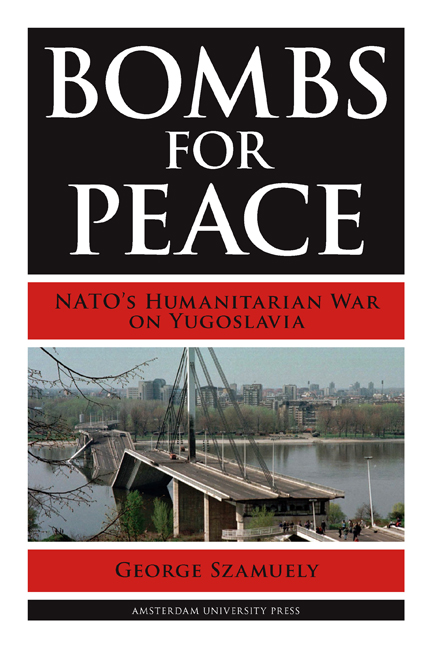
Bombs for Peace

-
The digital format of this book is no longer available to purchase from Cambridge Core. Other formats may be available.
-
Select format
-
- Publisher:
- Amsterdam University Press
- Publication date:
- 12 February 2021
- 09 April 2013
- ISBN:
- 9789048519675
- 9789089645630
- Dimensions:
- Weight & Pages:
- Dimensions:
- Weight & Pages:
You may already have access via personal or institutional login
Show more authors 
You may already have access via personal or institutional login
Book description
In the late 1990s NATO dropped bombs and supported armed insurgencies in Yugoslavia while insisting that its motives were purely humanitarian and that its only goal was peace. However, George Szamuely argues that NATO interventions actually prolonged conflicts, heightened enmity, increased casualties, and fueled demands for more interventions. Eschewing the one-sided approach adopted by previous works on the Yugoslavian crisis, Szamuely offers a broad overview of the conflict, its role in the rise of NATO's authority, and its influence on Western policy on the Balkans. His timely, judicious, and accessible study sheds new light on the roots of the contemporary doctrine of humanitarian intervention.
Contents
Contents
Metrics
Altmetric attention score
Full text views
Full text views helpTotal number of HTML views: 0
Total number of PDF views: 0 *
 Loading metrics...
* Views captured on Cambridge Core between #date#. This data will be updated every 24 hours.
Usage data cannot currently be displayed.
Accessibility standard: Unknown
Why this information is here
This section outlines the accessibility features of this content - including support for screen readers, full keyboard navigation and high-contrast display options. This may not be relevant for you.
Accessibility Information
Accessibility compliance for the PDF of this book is currently unknown and may be updated in the future.