
Skip to main content Accessibility help
×
  • Cited by 245
    • Show more authors
    • You may already have access via personal or institutional login
    • Select format
    • Publisher:
      Cambridge University Press
      Publication date:
      02 December 2009
      15 August 2002
      ISBN:
      9780511606410
      9780521016292
      Dimensions:
      Weight & Pages:
      Dimensions:
      (228 x 152 mm)
      Weight & Pages:
      0.405kg, 252 Pages
    You may already have access via personal or institutional login
  • Selected: Digital
    Add to cart View cart Buy from Cambridge.org

    Book description

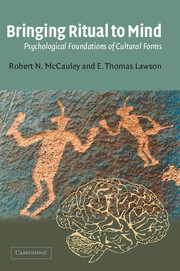
    Bringing Ritual to Mind explores the cognitive and psychological foundations of religious ritual systems. Participants must recall their rituals well enough to ensure a sense of continuity across performances, and those rituals must motivate them to transmit and re-perform them. Most religious rituals the world over exploit either high performance frequency or extraordinary emotional stimulation (but not both) to enhance their recollection (the availability of literacy has little impact on this). But why do some rituals exploit the first of these variables while others exploit the second? McCauley and Lawson advance the ritual form hypothesis, arguing that participants' cognitive representations of ritual form explain why. Reviewing evidence from cognitive, developmental and social psychology and from cultural anthropology and the history of religions, they utilize dynamical systems tools to explain the recurrent evolutionary trajectories religions exhibit.

    Reviews

    ‘Bringing Ritual to Mind makes a substantial contribution to one corner of the cognitive field, the cognitive basis of ritual forms. The book extends and clarifies aspects of the theory of ritual competence presented in the authors‘ Rethinking Religion (1990).‘

    Source: Numen

    '… a provocative and very stimulating set of ideas …'.

    Source: Anthropos

    Refine List

    Actions for selected content:

    Select all | Deselect all
    • View selected items
    • Export citations
    • Download PDF (zip)
    • Save to Kindle
    • Save to Dropbox
    • Save to Google Drive

    Save Search

    You can save your searches here and later view and run them again in "My saved searches".

    Please provide a title, maximum of 40 characters.
    ×

    Contents

    References
    References
    Abbink, J. (1995). “Ritual and Environment: The Mosit Ceremony of the Ethiopian Me'en People,” Journal of Religion in Africa 25, 163–190
    Apuleius (1989). Metamorphoses (volume II). J. A. Hansen (ed. and trans.). Cambridge, MA: Harvard University Press
    Baranowski, A. (1994). “Ritual Alone.” PhD dissertation. University of Toronto
    Baranowski, A. (1998). “A Psychological Comparison of Ritual and Musical Meaning,” Method and Theory in the Study of Religion 10, 3–29
    Baron-Cohen, S. (1995). Mindblindness: An Essay on Autism and Theory of Mind. Cambridge, MA: MIT Press
    Barrett, J. L. (2000). “Exploring the Natural Foundations of Religion,” Trends in Cognitive Sciences 4, 29–34
    Barrett, J. L. (forthcoming). “Dumb Gods Versus Smart Gods: The Role of Social Cognition in Structuring Ritual Intuitions.” In Current Approaches in the Cognitive Study of Religion. I. Pyysiainen and V. Anttonen (eds). London: Cassell/Continuum
    Barrett, J. and Keil, F. (1996). “Conceptualizing a Non-natural Entity: Anthropomorphism in God Concepts,” Cognitive Psychology 31, 219–247
    Barrett, J. L. and Lawson, E. T. (2001). “Ritual Intuitions: Cognitive Contributions to Judgments of Ritual Efficacy,” Journal of Cognition and Culture 1, 183–201
    Barsalou, L. (1992). Cognitive Psychology: An Overview for Cognitive Scientists. Hillsdale, NJ: Erlbaum
    Barth, F. (1975). Ritual and Knowledge Among the Baktaman of New Guinea. New Haven: Yale University Press
    Barth, F. (1987). Cosmologies in the Making: A Generative Approach to Cultural Variation in Inner New Guinea. Cambridge: Cambridge University Press
    Bloch, M. (1992). Prey into Hunter. Cambridge: Cambridge University Press
    Bohannon, J. N. and Symons, V. L. (1992). “Flashbulb Memories: Confidence, Consistency, and Quantity.” In Affect and Accuracy in Recall: Studies of “Flashbulb” Memories. E. Winograd and U. Neisser (eds.). New York: Cambridge University Press, 65–91
    Boyd, R. and Richerson, P. J. (1985). Culture and the Evolutionary Process. Chicago: University of Chicago Press
    Boyer, P. (1994). The Naturalness of Religious Ideas. Berkeley: University of California Press
    Boyer, P. (1996). “Cognitive Limits to Conceptual Relativity: The Limiting Case of Religious Categories.” In Rethinking Linguistic Relativity. J. Gumperz and S. Levinson (eds.). Cambridge: Cambridge University Press, 203–231
    Boyer, P. (2001). Religion Explained: The Evolutionary Origins of Religious Thought. New York: Basic Books
    Boyer, P. and Ramble, C. (2001). “Cognitive Templates for Religious Concepts: Cross-Cultural Evidence for Recall of Counter-Intuitive Representations,” Cognitive Science 25, 535–564
    Brewer, W. F. (1992). “The Theoretical and Empirical Status of the Flashbulb Memory Hypothesis.” In Affect and Accuracy in Recall: Studies of “Flashbulb” Memories. E. Winograd and U. Neisser (eds.). New York: Cambridge University Press, 274–305
    Brown, R. and Kulik, J. (1982). “Flashbulb Memories.” In Memory Observed. U. Neisser (ed.). San Francisco: W. H. Freeman, 23–40
    Christianson, S.-A. (1989). “Flashbulb Memories: Special, But Not So Special,” Memory & Cognition 17, 435–443
    Clark, A. (1993). Associative Engines: Connectionism, Concepts, and Representational Change. Cambridge, MA: MIT Press
    Clark, A. (1997). Being There: Putting Brain, Body, and World Together Again. Cambridge, MA: MIT Press
    Cohn, N. (1970.) The Pursuit of the Millennium. New York: Oxford University Press
    Colegrove, F. W. (1899/1982). “The Day They Heard about Lincoln.” In Memory Observed. U. Neisser (ed.). San Francisco: W. H. Freeman, 41–42
    Damasio, A. R. (1994). Descartes' Error: Emotion, Reason and the Human Brain. New York: Avon Books
    Damasio, A. R. (1999). The Feeling of What Happens: Body and Emotion in the Making of Consciousness. New York: Harcourt Brace
    Dawkins, R. (1982). The Extended Phenotype. Oxford: Oxford University Press
    Dennett, D. C. (1995). Darwin's Dangerous Idea: Evolution and the Meaning of Life. New York: Simon & Schuster
    Diamond, J. (1998). Guns, Germs, and Steel: The Fate of Human Societies. New York: Norton
    Donald, M. (1991). Origins of the Modern Mind: Three Stages in the Evolution of Culture and Cognition. Cambridge, MA: Harvard University Press
    Eldredge, N. and Gould, S. J. (1972). “Punctuated Evolution: An Alternative to Phyletic Gradualism.” In Models in Paleobiology. T. J. M. Schopf (ed.). San Francisco: Freeman
    Evans-Pritchard, E. (1956). Nuer Religion. Oxford: Clarendon Press
    Fernandez, J. W. (1982). Bwiti: An Ethnography of the Religious Imagination in Africa. Princeton: Princeton University Press
    Firth, R. (1963). “Offering and Sacrifice: Problems of Organization,” Journal of the Royal Anthropological Institute 93, 12–24
    Fodor, J. A. and Pylyshyn, Z. W. (1988). “Connectionism and Cognitive Architecture: A Critical Analysis,” Cognition 28, 3–71
    Gardner, D. S. (1983). “Performativity and Ritual: The Mianmin Case,” Man (n.s.) 18, 346–360
    Gellner, E. (1969). “A Pendulum Swing Theory of Islam.” In Sociology of Religion: Selected Readings. R. Robertson (ed.). Harmondsworth: Penguin
    Goodall, J. (1992). In the Shadow of Man. Boston: Houghton Mifflin
    Goody, J. (1987). The Interface Between the Written and the Oral. Cambridge: Cambridge University Press
    Gopnik, A., Meltzoff, A. N., and Kuhl, P. (1999). The Scientist in the Crib. New York: William Morrow
    Guthrie, S. (1993). Faces in the Clouds. Oxford: Oxford University Press
    Hertz, R. (1960). A Contribution to the Study of the Collective Representation of Death. London: Cohen & West
    Heuer, F. and Reisberg, D. (1990). “Vivid Memories of Emotional Events: The Accuracy of Remembered Minutiae,” Memory and Cognition 18, 496–506
    Heuer, F. and Reisberg, D. (1997). “What Do We Know about Emotion's Effects on Memory?” Address at Emory University, Atlanta, Georgia
    Hirschfeld, L. A. and Gelman, S. A. (1994). Mapping the Mind: Domain Specificity in Cognition and Culture. New York: Cambridge University Press
    Humphrey, C. and Laidlaw, J. (1994). The Archetypal Actions of Ritual. Oxford: Oxford University Press
    Hunter, I. M. L. (1985). “Lengthy Verbatim Recall: The Role of Text.” In Progress in the Psychology of Language. A. Ellis (ed.). Hillsdale, NJ: Erlbaum, 207–235
    Lanternari, V. (1963). The Religions of the Oppressed: A Study of Modern Messianic Cults. New York: New American Library
    Larsen, S. F. (1988). “Remembering Without Experiencing: Memory for Reported Events.” In Remembering Reconsidered: Ecological and Traditional Approaches to the Study of Memory. U. Neisser and E. Winograd (eds.). New York: Cambridge University Press, 326–355
    Lawson, E. T. (1985). Religions of Africa: Traditions in Transformation. San Francisco: Harper Collins
    Lawson, E. T. and McCauley, R. N. (1990). Rethinking Religion: Connecting Cognition and Culture. Cambridge: Cambridge University Press
    Lawson, E. T. and McCauley, R. N. (1993). “Crisis of Conscience, Riddle of Identity: Making Space for a Cognitive Approach to Religious Phenomena,” Journal of the American Academy of Religion 61, 201–223
    Lawson, E. T. and McCauley, R. N. (forthcoming). “The Cognitive Representation of Religious Ritual Form: A Theory of Participants' Competence with their Religious Ritual Systems.” In Current Approaches to the Cognitive Study of Religion. I. Pyysiainen and V. Anttonen (eds.). London: Continuum
    Leslie, A. (1995). “A Theory of Agency.” In Causal Cognition: A Multidisciplinary Debate. D. Sperber, D. Premack, and A. J. Premack (eds.). New York: Oxford University Press, 121–147
    Livingston, R. B. (1967a). “Brain Circuitry Relating to Complex Behavior.” In The Neurosciences: A Study Program. G. C. Quarton, T. Melnechuck, and F. O. Schmitt (eds.). New York: Rockefeller University Press, 499–514
    Livingston, R. B. (1967b). “Reinforcement.” In The Neurosciences: A Study Program. G. C. Quarton, T. Melnechuck, and F. O. Schmitt (eds.). New York: Rockefeller University Press, 568–576
    Lord, A. B. (1991). Epic Singers and Oral Tradition. Ithaca, NY: Cornell University Press
    Lumsden, C. J. and Wilson, E. O. (1981). Genes, Minds, and Culture. Cambridge, MA: Harvard University Press
    McCauley, R. N. (1996). “Explanatory Pluralism and the Co-evolution of Theories in Science.” In The Churchlands and Their Critics. R. N. McCauley (ed.). Oxford: Blackwell Publishers, 17–47
    McCauley, R. N. (1998). “Levels of Explanation and Cognitive Architectures.” In Blackwell Companion to Cognitive Science. W. Bechtel and G. Graham (eds.). Oxford: Blackwell Publishers, 611–624
    McCauley, R. N. (1999). “Bringing Ritual to Mind.” In Ecological Approaches to Cognition: Essays in Honor of Ulric Neisser. E. Winograd, R. Fivush, and W. Hirst (eds.). Hillsdale, NJ: Erlbaum, 285–312
    McCauley, R. N. (2000). “The Naturalness of Religion and the Unnaturalness of Science.” In Explanation and Cognition. F. Keil and R. Wilson (eds.). Cambridge, MA: MIT Press, 61–86
    McCauley, R. N. (2001). “Ritual, Memory, and Emotion: Comparing Two Cognitive Hypotheses.” In Religion in Mind: Cognitive Perspectives on Religions Experience. J. Anavesen (ed.). Cambridge: Cambridge University Press, 115–140
    Metcalf, P. and Huntington, R. (1991). Celebrations of Death: The Anthropology of Mortuary Ritual (second edition). Cambridge: Cambridge University Press
    Michotte, A. (1963). The Perception of Causality. London: Methuen
    Mithen, S. (1996). The Prehistory of the Mind. London: Thames & Hudson
    Neisser, U. (1982). “Snapshots or benchmarks?” In Memory Observed. U. Neisser (ed.). San Francisco: W. H. Freeman, 43–48
    Neisser, U. (1986). “Remembering Pearl Harbor: Reply to Thomson and Cowan,” Cognition 23, 285–286
    Neisser, U. and Harsch, N. (1992). “Phantom Flashbulbs: False Recollections of Hearing the News about Challenger.” In Affect and Accuracy in Recall: Studies of “Flashbulb” Memories. E. Winograd and U. Neisser (eds.). New York: Cambridge University Press, 9–31
    Neisser, U., Winograd, E., Bergman, E., Schreiber, C., Palmer, S., and Weldon, M. S. (1996). “Remembering the Earthquake: Direct Experience vs. Hearing the News,” Memory 4, 337–357
    Paivio, A. (1986). Mental Representations: A Dual Coding Approach. New York: Oxford University Press
    Parry, M. (1971). The Making of Homeric Verse: The Collected Papers of Milman Parry. A. Parry (ed. and trans.). Oxford: Oxford University Press
    Penner, H. H. (1975). “Creating a Brahman: A Structural Approach to Religion.” In Methodological Issues in Religious Studies. R. D. Baird (ed.). Chico, CA: New Horizons Press, 49–66
    Perner, J., Leekam, S. R., and Wimmer, H. (1987). “Three-Year-Olds' Difficulty with False Belief,” British Journal of Developmental Psychology 5, 125–137
    Pfeiffer, J. (1982). The Creative Explosion: An Inquiry into the Origins of Art and Religion. New York: Harper & Row
    Plotkin, H. (1998). Evolution in Mind: An Introduction to Evolutionary Psychology. Cambridge, MA: Harvard University Press
    Ray, B. (1973). “‘Performative Utterances’ in African Rituals,” History of Religions 13, 16–35
    Reber, A. S. (1993). Implicit Learning and Tacit Knowledge: An Essay on the Cognitive Unconscious. New York: Oxford University Press
    Reisberg, D. (1995). “Emotion's Multiple Effects on Memory.” In Brain and Memory: Modulation and Mediation of Neuroplasticity. J. L. McGaugh, N. Weinberger, and G. Lynch (eds.). New York: Oxford University Press, 84–92
    Rochat, P., Morgan, R., and Carpenter, M. (1997). “Young Infants' Sensitivity to Movement Information Specifying Social Causality,” Cognitive Development 12, 441–465
    Rochat, P. and Striano, T. (1999). “Social Cognitive Development in the First Year.” In Early Social Cognition. P. Rochat (ed.). Mahway, NJ: Erlbaum, 3–34
    Roediger, H. L. (1990). “Implicit Memory: Retention Without Remembering,” American Psychologist 45, 1043–1056
    Ross, L. and Nisbett, R. E. (1991). The Person and the Situation: Perspectives of Social Psychology. New York: McGraw Hill
    Rubin, D. (1992). “Constraints on Memory.” In Affect and Accuracy in Recall: Studies of “Flashbulb” Memories. E. Winograd and U. Neisser (eds.). New York: Cambridge University Press, 265–273
    Rubin, D. (1995). Memory in Oral Tradition: The Cognitive Psychology of Epic, Ballads, and Counting-out Rhymes. New York: Oxford University Press
    Rundus, D. (1971). “Analysis of Rehearsal Processes in Free Recall,” Journal of Experimental Psychology 89, 63–77
    Schank, R. C. and Abelson, R. P. (1977). Scripts, Plans, Goals, and Understanding: An Inquiry into Human Knowledge Structures. Hillsdale, NJ: Erlbaum
    Schwartz, T. (1962). “The Paliau Movement in the Admiralty Islands, 1946–1954,” Anthropological Papers of the American Museum of Natural History 49, 210–421
    Scribner, S. and Cole, M. (1981). The Psychology of Literacy. Cambridge, MA: Harvard University Press
    Severi, C. (1987). “The Invisible Path: Ritual Representation of Suffering in Cuna Traditional Thought,” Res Anthropology and Aesthetics 14, 66–85
    Severi, C. (1993). “Talking about Souls.” In Cognitive Aspects of Religious Symbolism. P. Boyer (ed.). Cambridge: Cambridge University Press, 165–181
    Sherzer, J. (1983). Kuna Ways of Speaking: An Ethnographic Perspective. Austin: University of Texas Press
    Sherzer, J. (1990). Verbal Art in San Blas: Kuna Culture through its Discourse. New York: Cambridge University Press
    Shore, B. (1995). Culture in Mind: Cognitive Dimensions of Cultural Knowledge. Oxford: Oxford University Press
    Somayajipad, C. V., Nambudiri, M. I. R., and Nambudiri, E. R. (1983). “Recent Nambudiri Performances of Agnistoma and Agnicayana.” In Agni: The Vedic Ritual of the Fire Altars: volume II. F. Staal (ed.). Berkeley: Asian Humanities Press, 252–255
    Sperber, D. (1975). Rethinking Symbolism. Cambridge: Cambridge University Press
    Sperber, D. (1996). Explaining Culture: A Naturalistic Approach. Oxford: Blackwell
    Sperber, D. and Wilson, D. (1986). Relevance: Communication and Cognition. Cambridge, MA: Harvard University Press
    Staal, F. (1979). “The Meaningless of Ritual,” Numen 26, 2–22
    Staal, F. (ed.) (1983). Agni: The Vedic Ritual of the Fire Altars: volume II. Berkeley: Asian Humanities Press
    Staal, F. (1990). Rules Without Meaning: Ritual, Mantras, and the Human Sciences. New York: Peter Lang
    Thompson, C. P. and Cowan, T. (1986). “Flashbulb Memories: A Nicer Interpretation of a Neisser Recollection,” Cognition 22, 199–200
    Tooby, J. and Cosmides, L. (1989). “Evolutionary Psychology and the Generation of Culture, Part I: Theoretical Considerations,” Ethnology and Sociobiology 10, 29–49
    Tovalele, P. (1977). “The Pomio Cargo Cult – East New Britain.” In Socio-Economic Change – Papua New Guinea. R. Adams (ed.). Lae: University of Technology, 123–139
    Tucker, D. M., Vannatta, K., and Rothlind, J. (1990). “Arousal and Activation Systems and Primitive Adaptive Controls on Cognitive Priming.” In Psychological and Biological Approaches to Emotion. N. L. Stein, B. Leventhal, and T. Trabasso (eds.). Hillsdale, NJ: Erlbaum, 145–166
    Tulving, E. (1962). “Subjective Organization in Free Recall of ‘Unrelated’ Words,” Psychological Review 69, 344–354
    Tulving, E. (1983). Elements of Episodic Memory. Oxford: Clarendon Press
    Van Gennep, A. (1960). The Rites of Passage. Chicago: University of Chicago Press
    Weber, M. (1947). The Theory of Social and Economic Organization. Oxford: Oxford University Press
    Wellman, H. M. (1990). The Child's Theory of Mind. Cambridge, MA: MIT Press
    Wells, G. L. and Murray, D. (1984). “Eyewitness Confidence.” In Eyewitness Testimony. G. L. Wells and E. F. Loftus (eds.). New York: Cambridge University Press, 155–170
    Whitehouse, H. (1989). “The Oscillating Equilibrium of Production among the Mali Baining.” Research in Melanesia 13, 62–67
    Whitehouse, H. (1992). “Memorable Religions: Transmission, Codification and Change in Divergent Melanesian Contexts.” Man (n.s.) 27, 777–797
    Whitehouse, H. (1995). Inside the Cult: Religious Innovation and Transmission in Papua New Guinea. Oxford: Clarendon Press
    Whitehouse, H. (1996a). “Apparitions, Orations, and Rings.” In Spirits in Culture, History, and Mind. A. Howard and J. Mageo (eds.). London: Routledge, 173–194
    Whitehouse, H. (1996b). “Rites of Terror: Emotion, Metaphor, and Memory in Melanesian Initiation Cults,” Journal of the Royal Anthropological Institute, 2, 703–715
    Whitehouse, H. (2000). Arguments and Icons: Divergent Modes of Religiosity. Oxford: Oxford University Press
    Wiebe, D. (1991). The Irony of Theology and the Nature of Religious Thought. Montreal: McGill-Queen's University Press
    Wimmer, H. and Perner, J. (1983). “Beliefs about Beliefs: Representations and Constraining Function of Wrong Beliefs in Young Children's Understanding of Deception,” Cognition 13, 103–128
    Wimsatt, W. (1999). “Genes, Memes, and Cultural Heredity,” Biology and Philosophy 14, 279–302
    Winograd, E. and Killinger, W. A. (1983). “Relating Age at Encoding in Early Childhood to Adult Recall: Development of Flashbulb Memories,” Journal of Experimental Psychology: General 117, 413–422
    Wright, D. and Gaskell, G. D. (1992). “The Construction and Function of Vivid Memories.” In Theoretical Perspectives on Autobiographical Memory. M. A. Conway, D. C. Rubin., H. Spinnler, and W. A. Wagenaar (eds.). Boson: Kluwer, 275–292

    Metrics

    Altmetric attention score

    Full text views

    Total number of HTML views: 0
    Total number of PDF views: 0 *
    Loading metrics...

    Book summary page views

    Total views: 0 *
    Loading metrics...

    * Views captured on Cambridge Core between #date#. This data will be updated every 24 hours.

    Usage data cannot currently be displayed.

    Accessibility standard: Unknown

    Why this information is here

    This section outlines the accessibility features of this content - including support for screen readers, full keyboard navigation and high-contrast display options. This may not be relevant for you.

    Accessibility Information

    Accessibility compliance for the PDF of this book is currently unknown and may be updated in the future.
