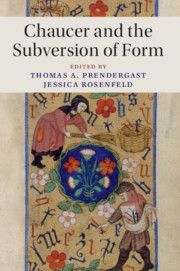

Responding to the lively resurgence of literary formalism, this volume delivers a timely and fresh exploration of the works of Geoffrey Chaucer. Advancing 'new formalist' approaches, medieval scholars have begun to ask what happens when structure fails to yield meaning, probing the very limits of poetic organization. While Chaucer is acknowledged as a master of form, his work also foregrounds troubling questions about formal agency: the disparate forces of narrative and poetic practice, readerly reception, intertextuality, genre, scribal attention, patronage, and historical change. This definitive collection of essays offers diverse perspectives on Chaucer and a varied analysis of these problems, asking what happens when form is resisted by author or reader, when it fails by accident or by design, and how it can be misleading, errant, or even dangerous.
'… original critical engagement with a range of Chaucer’s works and the issues they raise.'
A. S. G. Edwards Source: The Times Literary Supplement
'... this collection will be warmly received by scholars working on Chaucer, medieval conceptions of form and the literary, and - perhaps especially - the intersection of medieval philosophy and literature. Medievalists interested in the state of New Formalist criticism at present will also want a copy of this handsome volume, as will those curious about how far a formally oriented medieval studies might take us in the future.’
Taylor Cowdery Source: Studies in the Age of Chaucer
‘This brilliant and challenging collection of essays shows that form is not static but in itself a principle of animation that requires us to rethink not only how but also why we read literature.’
Elizabeth Robertson Source: Studies in Medieval and Renaissance Teaching (SMART)
Loading metrics...
* Views captured on Cambridge Core between #date#. This data will be updated every 24 hours.
Usage data cannot currently be displayed.
This section outlines the accessibility features of this content - including support for screen readers, full keyboard navigation and high-contrast display options. This may not be relevant for you.
Accessibility compliance for the PDF of this book is currently unknown and may be updated in the future.
