Classes of Ladies

-
Select format
-
- Publisher:
- Edinburgh University Press
- Publication date:
- 05 August 2016
- 20 January 2015
- ISBN:
- 9780748694877
- 9780748694860
- Dimensions:
- Weight & Pages:
- 00kg,
- Dimensions:
- Weight & Pages:
- Subjects:
- Islam, Religion, Religion: General Interest
You may already have access via personal or institutional login- Subjects:
- Islam, Religion, Religion: General Interest
Show more authors 
You may already have access via personal or institutional login
Book description
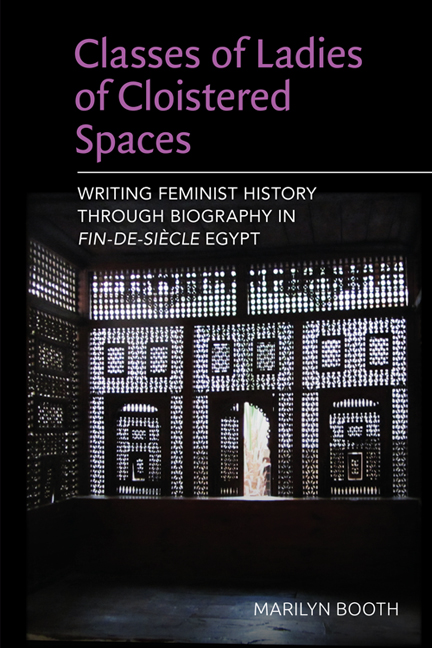
Zaynab Fawwaz (c.1860-1914) was as a forceful voice in support of women's rights to education and work choices in colonial-era Egypt. Her volume of 453 women's lives, al-Durr al-manthur fi tabaqat rabbat al-khudur (Pearls scattered in times and places: Classes of ladies of cloistered spaces, 1893-6) - featuring Boudicca, Catherine the Great, Zaynab (granddaughter of the Prophet Muhammad), Victoria Woodhull, the Turkish poet Sirri Hanim and many others - built on the Arabic-Islamic biographical tradition to produce a work for women in the modern era, grafting European, Turkish, Arab, and Indian life narratives, amongst others onto Arabic literary patterns. In Classes of Ladies of Cloistered Spaces Marilyn Booth argues that Fawwaz's work was less 'exemplary biography' than feminist history, in its exploration of achievement but also of patriarchal trauma in the lives of women across times and places. She traces Fawwaz's creative use of her sources, her presentation of biographical narratives in the context of the political essays she wrote in the Arabic press, her publicised dialogue with the President of the Board of Lady Managers of the 1893 World Columbian Exposition - where she attempted to send the volume - and how her inscription of a feminine ancient history diverged from that of men writing history in 1890s Egypt.Key Features Includes *descriptions of biographies of women from the US, Britain, Europe, India, the Maldives, as well as the Middle East (Iran, Turkey and the Arab world) *Presents the dictionary as a key text in the debates on gender and national efficacy in 1890s Egypt and Ottoman Syria *Takes a close look at issues of text circulation and borrowing *Argues that Fawwaz's book can be regarded as 'feminist history'
Contents
Contents
Metrics
Full text views
Full text views helpTotal number of HTML views: 0
Total number of PDF views: 0 *
 Loading metrics...
* Views captured on Cambridge Core between #date#. This data will be updated every 24 hours.
Usage data cannot currently be displayed.
Accessibility standard: Unknown
Why this information is here
This section outlines the accessibility features of this content - including support for screen readers, full keyboard navigation and high-contrast display options. This may not be relevant for you.
Accessibility Information
Accessibility compliance for the PDF of this book is currently unknown and may be updated in the future.