
Skip to main content Accessibility help
×
  • Cited by 74
    • Show more authors
    • You may already have access via personal or institutional login
    • Select format
    • Publisher:
      Cambridge University Press
      Publication date:
      01 December 2016
      24 November 2016
      ISBN:
      9781139680455
      9781107072398
      9781107420878
      Dimensions:
      (228 x 152 mm)
      Weight & Pages:
      0.64kg, 320 Pages
      Dimensions:
      (229 x 152 mm)
      Weight & Pages:
      0.5kg, 322 Pages
    You may already have access via personal or institutional login
  • Selected: Digital
    Add to cart View cart Buy from Cambridge.org

    Book description

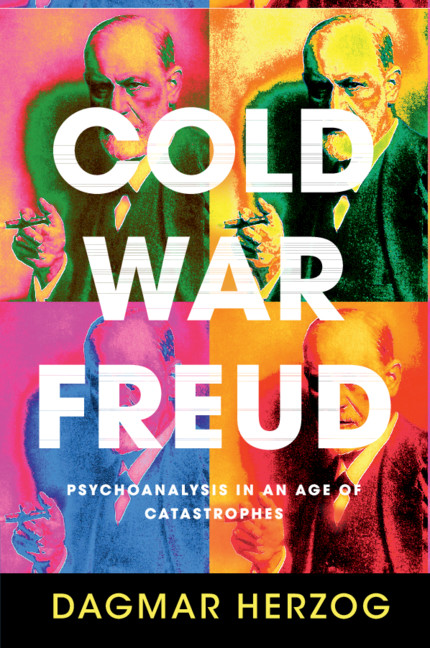
    In Cold War Freud Dagmar Herzog uncovers the astonishing array of concepts of human selfhood which circulated across the globe in the aftermath of World War II. Against the backdrop of Nazism and the Holocaust, the sexual revolution, feminism, gay rights, and anticolonial and antiwar activism, she charts the heated battles which raged over Freud's legacy. From the postwar US to Europe and Latin America, she reveals how competing theories of desire, anxiety, aggression, guilt, trauma and pleasure emerged and were then transformed to serve both conservative and subversive ends in a fundamental rethinking of the very nature of the human self and its motivations. Her findings shed new light on psychoanalysis' enduring contribution to the enigma of the relationship between nature and culture, and the ways in which social contexts enter into and shape the innermost recesses of individual psyches.

    Awards

    Winner, 2017 Choice Outstanding Academic Title

    Reviews

    'This is surely a history of the Cold War world as we did not know it, in which psychoanalytic conformists and rebels flex their way through the controversies of the era - Auschwitz, My Lai, student protests, postcolonial insurgencies, the culture of narcissism. Partly about the collapse of psychoanalysis in its bid to be the regulating body for Christian American normalcy, it is even more so the story of psychoanalysis resurgent and radical. Fiercely relevant.’

    Matt Ffytche - author of The Foundation of the Unconscious

    ‘A fascinating and impeccably researched history of post-World War II psychoanalysis as a highly charged field of intellectual combat. Herzog shows how in complex and often surprising ways, the legacy of Freud configured debates over hetero- and homosexuality, politics, Nazism, PTSD, and even religion. Passionately argued and lucidly written, she has given us an account of psychoanalysis for the twenty-first century.’

    Anson Rabinbach - author of In the Shadow of Catastrophe

    ‘In this brilliant book, Herzog explores the relationship between politics and psychoanalysis in the aftermath of World War Two. As she convincingly shows, psychoanalysts were deeply engaged with their contexts and they revised their theories to better understand how desire, violence, and power interacted. This will change the way we think not only about psychoanalysis but also about the Cold War.’

    Camille Robcis - author of The Law of Kinship

    ‘In this illuminating work, Dagmar Herzog explores post-War psychoanalysis, rescuing often neglected or glibly marginalized figures and placing them firmly at the center of debates that took place in the sombre decades that followed the Holocaust over the nature of self, sexuality, cruelty, and political life. A ground-breaking study.’

    George Makari - author of Soul Machine and Revolution in Mind

    ‘In her scintillating new book, Dagmar Herzog shows that in the years between World War Two and the 1960s, Freud almost replaced Marx as the cornerstone of radical thought. The result is a new way of thinking about the Cold War - and about our own time as well.’

    Eli Zaretsky - author of Political Freud

    ‘Dagmar Herzog takes us on an illuminating tour through postwar landscapes of the mind, and into the fields of desire, pleasure, guilt, anxiety, and aggression. This is a finely measured and surprising survey, as well as a strong argument for exploring psychoanalytic ideas historically. Her book deserves a wide readership.’

    Daniel Pick - author of Psychoanalysis: A Very Short Introduction

    'Against the backdrop of Nazis and the Holocaust, the sexual revolution, feminism, gay rights and anti-colonial and anti-war activism, Dagmar charts the heated battle over the late Austrian Jewish founder of psychoanalysis.'

    Source: Jewish Telegraph

    'Herzog shows with telling detail how the variety of psychoanalysis that was developed in the US after the second world war had little in common with Freud’s initial project. … Herzog brings fascinating documents to bear to show how US psychoanalysts formed alliances with Christian clergy who themselves wanted treatment. … Like an anthropologist engaged in fieldwork, Herzog moves from site to site to give us a textured understanding of complex historical matter.'

    Lisa Appignanesi Source: The Guardian

    'Herzog’s account treats the Cold War less as a specific struggle between America and the USSR, and more as the setting for a broad range of political and cultural forces that swept up and transformed psychoanalysis.'

    Warren Breckman Source: New Republic

    'This is a brilliant, ambitious, passionate book … a scintillating and thought-provoking work of intellectual history, a rich, sophisticated, and exciting analysis of ideas in historical context. It is an important book and will be productive for Herzog’s readers both for its empirical and for its theoretical contribution.'

    Edward Ross Dickinson Source: Journal of the History of Sexuality

    '… Herzog succeeds in defending the Freudian tradition. Not, to be sure, as a single, commanding paradigm, as insiders like Kubie and Rangell once believed, but as a worthy interlocutor and critic of contemporary psychiatry, especially its view of mental health and personality 'as a matter mostly of chemical reactions and/or encoding in the genes'.'

    George Reisch Source: Metascience

    'In this wonderfully researched and elegantly argued contribution to the history of psychoanalytic thought, Herzog … offers an account of Freudianism in the decades following World War II that will alter the direction of much historicism pertaining to the upheavals in ideology and activism for which, for example, the decade of the 1960s is renowned. Herzog shows the struggles over key dimensions of Freudian thought as they unfold internationally, against the background of social movements such as feminism, anti-colonialism, and gay rights, paying attention to the impact of Nazism, the intractability of homophobia, and Oedipal authority. Particularly noteworthy is a chapter on post-traumatic stress disorder (PTSD) as its diagnosis, etiology, and treatment were shaped and unshaped in the aftermath of the 20th-century's greatest trauma, the Holocaust. The book provides new angles on key figures in Freudian and anti-Freudian philosophy, including Karen Horney, Karl Menninger, Herbert Marcuse, Konrad Lorenz, Paul Parin, and coauthors Gilles Deleuze and Félix Guattari. There is no doubt that this book will prove indispensable for scholars of history, the history of ideas, and psychoanalysis.'

    M. Uebel Source: CHOICE

    'Herzog shows convincingly that without the pressures exerted by the world beyond the consulting room, psychoanalysis would have withered away in irrelevance. No one has shown more forcefully than Herzog that the recurrently staged 'mutual rescue operation[s] of psychoanalysis and politics' secured the discipline’s future.'

    Elizabeth Lunbeck Source: Journal of Interdisciplinary History

    Refine List

    Actions for selected content:

    Select all | Deselect all
    • View selected items
    • Export citations
    • Download PDF (zip)
    • Save to Kindle
    • Save to Dropbox
    • Save to Google Drive

    Save Search

    You can save your searches here and later view and run them again in "My saved searches".

    Please provide a title, maximum of 40 characters.
    ×

    Contents

    • Introduction
      pp 1-18

    Metrics

    Altmetric attention score

    Full text views

    Total number of HTML views: 0
    Total number of PDF views: 0 *
    Loading metrics...

    Book summary page views

    Total views: 0 *
    Loading metrics...

    * Views captured on Cambridge Core between #date#. This data will be updated every 24 hours.

    Usage data cannot currently be displayed.

    Accessibility standard: Unknown

    Why this information is here

    This section outlines the accessibility features of this content - including support for screen readers, full keyboard navigation and high-contrast display options. This may not be relevant for you.

    Accessibility Information

    Accessibility compliance for the PDF of this book is currently unknown and may be updated in the future.
