Skip to main content Accessibility help
×
  • Cited by 2
    • Show more authors
    • You may already have access via personal or institutional login
    • Select format
    • Publisher:
      Cambridge University Press
      Publication date:
      19 January 2024
      08 February 2024
      ISBN:
      9781009422635
      9781009422642
      Dimensions:
      (229 x 152 mm)
      Weight & Pages:
      0.56kg, 302 Pages
      Dimensions:
      Weight & Pages:
    You may already have access via personal or institutional login
  • Selected: Digital
    Add to cart View cart Buy from Cambridge.org

    Book description

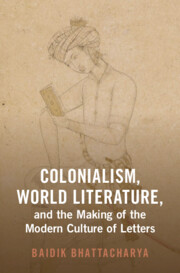
    In a radical and ambitious reconceptualization of the field, this book argues that global literary culture since the eighteenth century was fundamentally shaped by colonial histories. It offers a comprehensive account of the colonial inception of the literary sovereign – how the realm of literature was thought to be separate from history and politics – and then follows that narrative through a wide array of different cultures, multilingual archives, and geographical locations. Providing close studies of colonial archives, German philosophy of aesthetics, French realist novels, and English literary history, this book shows how colonialism shaped and reshaped modern literary cultures in decisive ways. It breaks fresh ground across disciplines such as literary studies, anthropology, history, and philosophy, and invites one to rethink the history of literature in a new light.

    Reviews

    ‘In this magisterial book, Baidik Bhattacharya develops a surprising thesis: that the modern conception of literature as an autonomous, self-directed cultural form was the product of a highly political process – the efforts of colonial British administrators to extend their sway in India and beyond. This is a compelling, revisionary genealogy of the contemporary idea of culture, and a major contribution to debates on the intertwined origins of world literature and modern empire.’

    David Damrosch - Ernest Bernbaum Professor of Comparative Literature, Harvard University

    ‘Baidik Bhattacharya’s erudition in the fields of Indian and British literary history and his transdisciplinary approach to ‘lettered sovereignty’ as a catalyst of colonial modernity give us a fresh perspective on what Pascale Casanova famously dubbed the ‘world republic of letters.’ Philological legacies; questions of race, language, and translation; the formation and deformation of epistemic habits crucial to narratives of empire; comparatism in the colony (including the complex reception of European philosophies of aesthetic judgment and nationalist imagination within Indian education) – all receive fine-grained analysis, making Colonialism, World Literature, and the Making of the Modern Culture of Letters essential reading for scholars, critics, historians, and theorists committed to rethinking the postcolonial public sphere in the contemporary humanities.’

    Emily Apter - Julius Silver Professor of French and Comparative Literature at New York University, and author of Against World Literature: On the Politics of Untranslatability

    ‘Recommended.’

    L. A. Brewer Source: CHOICE

    Refine List

    Actions for selected content:

    Select all | Deselect all
    • View selected items
    • Export citations
    • Download PDF (zip)
    • Save to Kindle
    • Save to Dropbox
    • Save to Google Drive

    Save Search

    You can save your searches here and later view and run them again in "My saved searches".

    Please provide a title, maximum of 40 characters.
    ×

    Contents

    Metrics

    Altmetric attention score

    Full text views

    Total number of HTML views: 0
    Total number of PDF views: 0 *
    Loading metrics...

    Book summary page views

    Total views: 0 *
    Loading metrics...

    * Views captured on Cambridge Core between #date#. This data will be updated every 24 hours.

    Usage data cannot currently be displayed.

    Accessibility standard: Unknown

    Why this information is here

    This section outlines the accessibility features of this content - including support for screen readers, full keyboard navigation and high-contrast display options. This may not be relevant for you.

    Accessibility Information

    Accessibility compliance for the PDF of this book is currently unknown and may be updated in the future.

