
Skip to main content Accessibility help
×
  • Cited by 4
    • Show more authors
    • You may already have access via personal or institutional login
    • Select format
    • Publisher:
      Cambridge University Press
      Publication date:
      29 November 2018
      06 December 2018
      ISBN:
      9781108349444
      9781108420518
      9781108430371
      Dimensions:
      (228 x 152 mm)
      Weight & Pages:
      0.47kg, 254 Pages
      Dimensions:
      (228 x 152 mm)
      Weight & Pages:
      0.37kg, 254 Pages
    • Subjects:
      Socio-Legal Studies, Law, Sociology of Religion, Sociology
    You may already have access via personal or institutional login
  • Selected: Digital
    Add to cart View cart Buy from Cambridge.org
    Subjects:
    Socio-Legal Studies, Law, Sociology of Religion, Sociology

    Book description

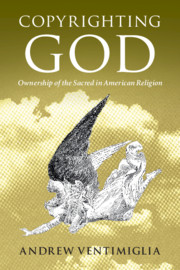
    Copyrighting God provides the first detailed account of how American religious organizations used copyright in sacred texts not simply for economic gain but also for social organization and control. Including chapters on the angelic authorship of The Urantia Book, Mary Baker Eddy's use of copyright to construct the Christian Science Church, interdenominational disputes in the Worldwide Church of God, and the Church of Scientology's landmark lawsuits against Internet service providers, this book examines how religious copyright owners mobilized the law in order to organize communities, protect sacred goods, produce new forms of spiritual identity, and even enchant the material world. In doing so, this book demonstrates that these organizations all engaged in complex efforts to harmonize legal arguments and theological rationales in order to care for and protect religious media, thereby coming to a nuanced understanding of secular law as a resource for, and obstacle to, their unique spiritual objectives.

    Reviews

    'Copyrighting God explores how copyright law is crucially involved in constructing and maintaining the sacredness of religious texts and the aura of charismatic leaders, framing a church’s relationship with internal and external critics, and maintaining the boundaries and identity of new religious communities. Even more surprising, some of the specific challenges that religions have posed to intellectual property have been influential to its further articulation. Superbly researched and subtly argued through copious printed and archival sources, Copyrighting God has many gems to offer to many disciplines, from religious studies to law, media studies, American studies and history, and cultural studies. Ventimiglia’s gift to communicate complex arguments in crystal-clear prose will gain this book many admirers, from the classroom to the public sphere.'

    Mario Biagioli - Distinguished Professor, University of California, Davis

    'Focusing on disputes around intellectual property, Ventimiglia demonstrates how religious communities rely on secular law to define and protect their religious knowledge. I can’t imagine a more innovative, more timely, or more urgently needed investigation of the dynamics between law, religion, publishing, and technology. Ventimiglia’s book makes a powerful contribution to our understanding of how contemporary religion takes shape.'

    Ari Y. Kelman - Jim Joseph Professor of Education and Jewish StudiesStanford University Graduate School of Education

    'This exciting book asks scholars of religion to identify intellectual property law as an important site for organizing - and controlling - religious practice. Through rich analysis of legal disputes, the author considers how the commercial management of property defines modern religious experience. A powerful and necessary new argument.'

    Kathryn Lofton - Yale University, Connecticut

    'This is an original, engaging, and thoughtful book that will be of interest to anyone seeking to gain a deeper understanding of an important but neglected area of the history of copyright law, as well as the complex relationship between religion and law in the United States. Through careful socio-legal analysis and archival research, the author reveals the legal resourcefulness that American religious leaders and organizations have employed in asserting ownership over sacred and prophetic texts. At the same time he also demonstrates that a greater dependence on the law might damage religious credibility and vice-versa.'

    Brad Sherman - University of Queensland

    'Undergraduate and advanced readers of this unique and fascinating study will gain a renewed appreciation for the deep entanglement of religion and the law, and a new vantage through which to study the history of NRMs in the US.'

    Cody Musselman Source: Reading Religion

    ‘This book marks an exciting addition to scholarship on religion, law, and media, and will appeal to anyone interested in the organization and regulation of American religious life.’

    Isaac Weiner Source: Journal Religious Studies Review

    Refine List

    Actions for selected content:

    Select all | Deselect all
    • View selected items
    • Export citations
    • Download PDF (zip)
    • Save to Kindle
    • Save to Dropbox
    • Save to Google Drive

    Save Search

    You can save your searches here and later view and run them again in "My saved searches".

    Please provide a title, maximum of 40 characters.
    ×

    Contents

    Metrics

    Altmetric attention score

    Full text views

    Total number of HTML views: 0
    Total number of PDF views: 0 *
    Loading metrics...

    Book summary page views

    Total views: 0 *
    Loading metrics...

    * Views captured on Cambridge Core between #date#. This data will be updated every 24 hours.

    Usage data cannot currently be displayed.

    Accessibility standard: Unknown

    Why this information is here

    This section outlines the accessibility features of this content - including support for screen readers, full keyboard navigation and high-contrast display options. This may not be relevant for you.

    Accessibility Information

    Accessibility compliance for the PDF of this book is currently unknown and may be updated in the future.
