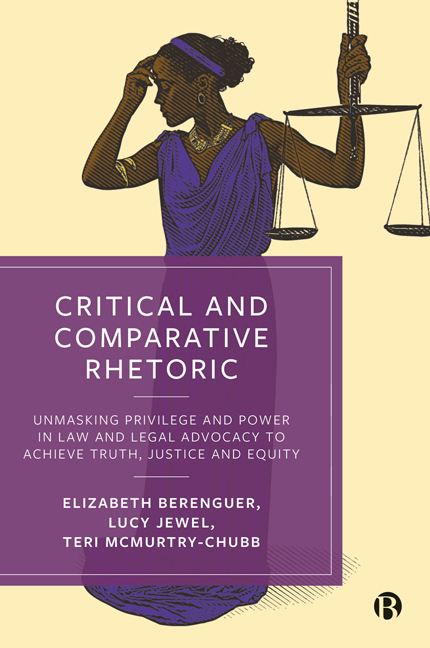
Critical and Comparative Rhetoric

-
Select format
-
- Publisher:
- Bristol University Press
- Publication date:
- 18 January 2024
- 30 June 2023
- ISBN:
- 9781529226034
- 9781529226010
- Dimensions:
- Weight & Pages:
- Dimensions:
- Weight & Pages:
- Subjects:
- Law, Jurisprudence
Show more authors 
You may already have access via personal or institutional login
Book description
Through the lenses of comparative and critical rhetoric, this book theorizes how alternative approaches to communication can transform legal meanings and legal outcomes, infusing them with more inclusive participation, equity and justice.
Contents
Contents
Metrics
Altmetric attention score
Full text views
Full text views helpTotal number of HTML views: 0
Total number of PDF views: 0 *
 Loading metrics...
* Views captured on Cambridge Core between #date#. This data will be updated every 24 hours.
Usage data cannot currently be displayed.
Accessibility standard: Unknown
Why this information is here
This section outlines the accessibility features of this content - including support for screen readers, full keyboard navigation and high-contrast display options. This may not be relevant for you.
Accessibility Information
Accessibility compliance for the PDF of this book is currently unknown and may be updated in the future.