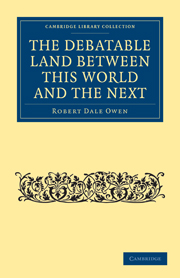
The Debatable Land between this World and the Next

-
Select format
-
- Publisher:
- Cambridge University Press
- Publication date:
- 05 March 2012
- 19 May 2011
- ISBN:
- 9780511978272
- 9781108073110
- Dimensions:
- Weight & Pages:
- Dimensions:
- (216 x 140 mm)
- Weight & Pages:
- 0.59kg, 466 Pages
You may already have access via personal or institutional login- Subjects:
- History of Ideas, Social and Cultural Anthropology, Religion, Anthropology, Religion: General Interest, General
Show more authors 
You may already have access via personal or institutional login
Book description
Robert Dale Owen (1801–1877) left Scotland at the age of twenty-four to help run an experimental colony in New Harmony, Indiana, established by this father Robert Owen, the social reformer. While in the United States, he became a prominent proponent of slave emancipation and public education, eventually joining the Indiana legislature before moving on to become a member of the United States Congress, which led to his posting as a diplomat in Naples. In addition to his political interests, Owen was fascinated with the world of spiritualism. In this work, published in 1871, he assesses Protestantism and Catholicism and considers how spiritualism can 'confirm the truths and assure the progress of Christianity'. He goes on to explain at length the characteristics of spiritualism, including the physical manifestations and identity of spirits, as well as his own experience of apparitions.
Contents
Contents
Metrics
Full text views
Full text views helpTotal number of HTML views: 0
Total number of PDF views: 0 *
 Loading metrics...
* Views captured on Cambridge Core between #date#. This data will be updated every 24 hours.
Usage data cannot currently be displayed.
Accessibility standard: Unknown
Why this information is here
This section outlines the accessibility features of this content - including support for screen readers, full keyboard navigation and high-contrast display options. This may not be relevant for you.
Accessibility Information
Accessibility compliance for the PDF of this book is currently unknown and may be updated in the future.