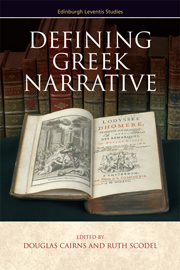
Defining Greek Narrative

-
Select format
-
- Publisher:
- Edinburgh University Press
- Publication date:
- 05 September 2014
- 24 March 2014
- ISBN:
- 9780748680115
- 9780748680108
- Dimensions:
- Weight & Pages:
- 00kg,
- Dimensions:
- Weight & Pages:
You may already have access via personal or institutional login
Show more authors 
You may already have access via personal or institutional login
Book description
The 'Classic' narratology that has been widely applied to classical texts is aimed at a universal taxonomy for describing narratives. More recently, 'new narratologies' have begun linking the formal characteristics of narrative to their historical and ideological contexts. This volume seeks such a rethinking for Greek literature. It has two closely related objectives: to define what is characteristically Greek in Greek narratives of different periods and genres, and to see how narrative techniques and concerns develop over time. The 15 distinguished contributors explore questions such as: How is Homeric epic like and unlike Gilgamesh and the Hebrew Bible? What do Greek historians consistently fail to tell us, having learned from the tradition what to ignore? How does lyric modify narrative techniques from other genres?
Contents
Contents
Metrics
Altmetric attention score
Full text views
Full text views helpTotal number of HTML views: 0
Total number of PDF views: 0 *
 Loading metrics...
* Views captured on Cambridge Core between #date#. This data will be updated every 24 hours.
Usage data cannot currently be displayed.
Accessibility standard: Unknown
Why this information is here
This section outlines the accessibility features of this content - including support for screen readers, full keyboard navigation and high-contrast display options. This may not be relevant for you.
Accessibility Information
Accessibility compliance for the PDF of this book is currently unknown and may be updated in the future.