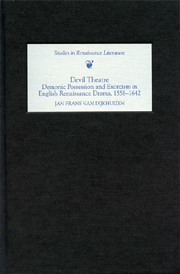
Devil Theatre

-
Select format
-
- Publisher:
- Boydell & Brewer
- Publication date:
- 12 September 2012
- 15 February 2007
- ISBN:
- 9781846155321
- 9781843841142
- Dimensions:
- Weight & Pages:
- 00kg,
- Dimensions:
- Weight & Pages:
You may already have access via personal or institutional login
Show more authors 
You may already have access via personal or institutional login
Book description
The so-called 'Devil Theatre' is here set against its context of non-dramatic texts on possession and exorcism, providing many new insights. Representations of demonic possession and exorcism rituals abound in English Renaissance drama, an area which this book seeks to illuminate by comparison with non-dramatic works. The author investigates stage images of possession in relation to a range of early modern demonological, theological and medical prose texts on the subject, looking specifically at how the theatre responded to these texts. He argues that the stage appropriated debates over demonic possession to explore the competing roles of the inner life and the body in early modern definitions of selfhood. The theatre also employed the contemporary controversy over possession and exorcism to investigate the politics of religion, and to consider the nature of monarchic power. Moreover, because demonic possession cases and exorcism rituals were frequently dismissed by conformist writers as a piece of theatre, they offered an opportunity to reflect on the nature of drama and role-playing. JAN FRANS VAN DIJKHUIZEN is lecturer and research fellow at the University of Leiden.
Reviews
Devil Theatre, which is remarkable for its sheer scope, contributes to a more nuanced and diverse understanding of the theatre's imaginative power, thus requiring a reconsideration of the New Historicist insistence on the culturally productive role of the theatre in general and the theatricality of exorcism in particular.'
Source: English Studies
Contents
Contents
Metrics
Altmetric attention score
Full text views
Full text views helpTotal number of HTML views: 0
Total number of PDF views: 0 *
 Loading metrics...
* Views captured on Cambridge Core between #date#. This data will be updated every 24 hours.
Usage data cannot currently be displayed.
Accessibility standard: Unknown
Why this information is here
This section outlines the accessibility features of this content - including support for screen readers, full keyboard navigation and high-contrast display options. This may not be relevant for you.
Accessibility Information
Accessibility compliance for the PDF of this book is currently unknown and may be updated in the future.