
Skip to main content Accessibility help
×
  • Cited by 2
    • Show more authors
    • You may already have access via personal or institutional login
    • Select format
    • Publisher:
      Cambridge University Press
      Publication date:
      02 August 2019
      03 October 2019
      ISBN:
      9781108674188
      9781108481540
      9781108722919
      Dimensions:
      (228 x 152 mm)
      Weight & Pages:
      0.7kg, 384 Pages
      Dimensions:
      (228 x 152 mm)
      Weight & Pages:
      0.6kg, 408 Pages
    You may already have access via personal or institutional login
  • Selected: Digital
    Add to cart View cart Buy from Cambridge.org

    Book description

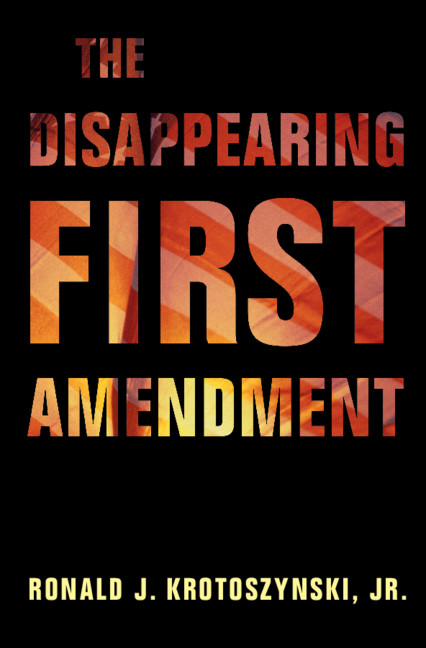
    The standard account of the First Amendment presupposes that the Supreme Court has consistently expanded the scope of free speech rights over time. This account holds true in some areas, but not in others. In this illuminating work, Ronald J. Krotoszynski, Jr acknowledges that the contemporary Supreme Court rigorously enforces the rules against content and viewpoint discrimination for those who possess the wherewithal to speak but when citizens need the government's assistance to speak - for example, access to public property for protest - free speech rights have declined. Instead of using open-ended balancing tests, the Roberts and Rehnquist Courts have opted for bright line, categorical rules that minimize judicial discretion. Opportunities for democratic engagement could be enhanced, however, if the federal courts returned to the Warren Court's balancing approach and vested federal judges with discretionary authority to require government to assist would-be speakers. This book should be read by anyone concerned with free speech and its place in democratic self-government.

    Reviews

    'Krotoszynski, Jr. convincingly advances a powerful thesis while at the same time offering the best available comprehensive account of how the freedom of speech has been interpreted and debated during the last few decades. He demonstrates in riveting detail how certain would-be contributors to public debate such as impecunious protestors, whistleblowers within government, and journalists have seen their First Amendment rights confined or rolled back in recent years even as the Supreme Court has recognized dubious new free speech rights which benefit business entities.'

    Vincent Blasi - Columbia University, New York

    'Ronald J. Krotoszynski, Jr. tells the depressing story of how the Warren Court opened up the possibility for a First Amendment interpreted broadly to advance democracy in a modern society in which private power can dominate politics, only to have later Courts sharply narrow that possibility. Yet he also shows how existing doctrine can be developed to give us a First Amendment better suited to creating and supporting a truly democratic political culture. The argument is provocative and subtle, and deserves close attention.'

    Mark Tushnet - Harvard University, Massachusetts

    'Freedom of speech isn't free, but it should be available to employees, not just employers, to people of modest means, not just the wealthy. So argues Ronald J. Krotoszynski, Jr. in this timely and trenchant critique of the Roberts Court. Krotoszynski, Jr. would reorient First Amendment jurisprudence away from the interests of the rich and powerful and back towards rules and standards that protect what Hugo Black once called 'the poorly financed causes of little people'.'

    Michael C. Dorf - Cornell University, New York

    'This important book from one of the country's leading First Amendment scholars highlights pitfalls in modern First Amendment doctrine and suggests how courts can strengthen protections for our expressive and democratic interests.'

    John Inazu - Washington University

    'Ronald J. Krotoszynski, Jr. has written an important corrective to the misleading narrative that Americans' expressive rights have unfailingly expanded. To the contrary, as he shows, the Supreme Court's rigid doctrines have shrunk our expressive topography, limited opportunities for transborder exchange, and stripped government employees and students of critical First Amendment rights.'

    Timothy Zick - College of William and Mary

    ‘Constitutional scholars will find this text valuable in highlighting important, often ignored Supreme Court cases and in drawing connections between the court’s subtle jurisprudential shifts and the democratic institutions the doctrine is intended to serve.'

    D. E. Smith Source: Choice

    Refine List

    Actions for selected content:

    Select all | Deselect all
    • View selected items
    • Export citations
    • Download PDF (zip)
    • Save to Kindle
    • Save to Dropbox
    • Save to Google Drive

    Save Search

    You can save your searches here and later view and run them again in "My saved searches".

    Please provide a title, maximum of 40 characters.
    ×

    Contents

    Metrics

    Altmetric attention score

    Full text views

    Total number of HTML views: 0
    Total number of PDF views: 0 *
    Loading metrics...

    Book summary page views

    Total views: 0 *
    Loading metrics...

    * Views captured on Cambridge Core between #date#. This data will be updated every 24 hours.

    Usage data cannot currently be displayed.

    Accessibility standard: Unknown

    Why this information is here

    This section outlines the accessibility features of this content - including support for screen readers, full keyboard navigation and high-contrast display options. This may not be relevant for you.

    Accessibility Information

    Accessibility compliance for the PDF of this book is currently unknown and may be updated in the future.
