
Skip to main content Accessibility help
×
  • Cited by 23
    • Show more authors
    • Open Access
      You have digital access to this book
    • Select format
    • Publisher:
      Cambridge University Press
      Publication date:
      21 June 2019
      20 June 2019
      ISBN:
      9781108567084
      9781108475457
      9781108466936
      Creative Commons:
      Creative Common License - CC Creative Common License - BY Creative Common License - NC Creative Common License - ND
      This content is Open Access and distributed under the terms of the Creative Commons Attribution licence CC-BY-NC-ND 4.0.
      https://creativecommons.org/creativelicenses
      Dimensions:
      (228 x 152 mm)
      Weight & Pages:
      0.71kg, 360 Pages
      Dimensions:
      (229 x 152 mm)
      Weight & Pages:
      0.53kg, 364 Pages
    Open Access
    You have digital access to this book
    Selected: Digital
    View content
    Add to cart View cart Buy from Cambridge.org

    Book description

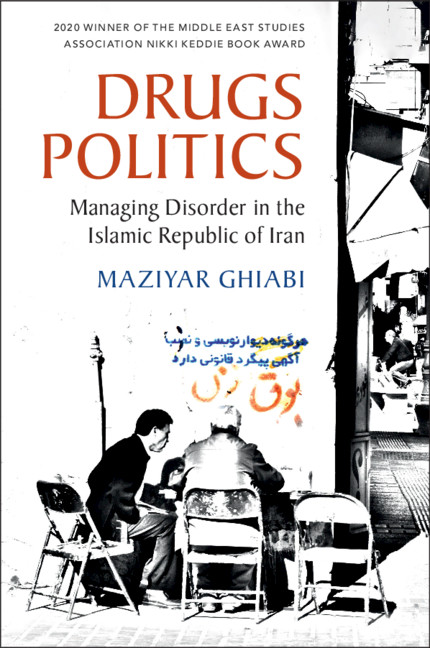
    Iran has one of the world's highest rates of drug addiction: estimated to be between 2 and 7 percent of the entire population. This makes the questions that this book asks all the more salient: what is the place of illegal substances in the politics of modern Iran? How have drugs affected the formation of the Iranian state and its power dynamics? And how have governmental attempts at controlling and regulating illicit drugs affected drug consumption and addiction? By answering these questions, Maziyar Ghiabi suggests that the Islamic Republic of Iran's image as an inherently conservative state is not only misplaced and inaccurate, but in part a myth. In order to dispel this myth, he skilfully combines ethnographic narratives from drug users, vivid field observations from 'under the bridge', with archival material from the pre- and post-revolutionary era, statistics on drug arrests and interviews with public officials. This title is also available as Open Access on Cambridge Core.

    Awards

    Winner, 2020 Nikki Keddie Book Award, Middle East Studies Association

    Reviews

    'Maziyar Ghaibi’s book is a fascinating study of the politics and lifeworld of illicit drugs, one that reveals a great deal about the paradoxical nature of politics in the Islamic Republic. Empirically rich and analytically rigorous, this first comprehensive account of drug politics in Iran is likely to remain a standard text.'

    Asef Bayat - University of Illinois, Urbana-Champaign

    'A refreshing and rare on-the-ground analysis of Iranian lived politics through the prism of drugs. With a rare depth and width of archival research and discourse analysis, Ghiabi brings us a unique combination of exquisite storytelling, inter-disciplinary inquiry, and ethnographic possibilities. Situated in a global perspective, Drugs Politics offers a fresh alternative to exceptionalist and oft-essentializing trends in studying Iran. A tremendous achievement toward a much needed holistic understanding of policy, Iran, and life itself.'

    Orkideh Behrouzan - School of Oriental and African Studies, University of London and author of Prozak Diaries: Psychiatry and Generational Memory in Iran

    'This is a landmark study, an eye-opener for those who still associate the Islamic Republic with a harshly punitive stance on narcotics. Iran, a society in which opium was traditionally integrated into life, has in recent decades been hit by a wave of synthetic drugs - heroin, meth and crack - that are now massively used by the down and out as well as by its globalized, anomic youth. Given wide access to official policy makers, Ghiabi tells the story of how the authorities of the Islamic republic have dealt with this problem by opting for harm reduction rather than criminalization, how they abandoned the shah’s unimaginative American-style 'war on drugs' and, working with NGOs and international organizations, adopted a pragmatic, neo-liberal approach that mixes draconian measures against dealers with a compassionate, welfare-focused approach vis-à-vis users. Anyone curious about Iran’s innovative approach to drugs should read this deeply informed, engaging book.'

    Rudi Matthee - University of Delaware

    'With historical sweep and ethnographic insight, Ghiabi makes the politics of drug consumption and addiction visible to audiences which have preferred to observe these matters from above and afar. His tale of drug politics in the Islamic Republic will not only be surprising for most Iranians, but also crafts a provocative lens with which to rethink our views on state-society dynamics across the world.'

    Kevan Harris - University of California, Los Angeles and author of A Social Revolution: Politics and the Welfare State in Iran

    'In this comparatively informed study, Maziar Ghiabi untangles the ironies and ambiguities of Iranian drug policies before and after the revolution of 1979. Based on rigorous fieldwork, this book is the foundational text for future research on Iran’s drug problems.'

    Houchang Chehabi - Boston University

    'Through rigorous archival investigation and courageous ethnographic inquiry, Maziyar Ghiabi traces the history of public responses to the drug epidemic in Iran and analyzes the current challenges of its management. Illuminating the tensions between punitive and reformist approaches, he provides a fascinating account of the Islamic Republic’s government of crises.'

    Didier Fassin - Princeton University, New Jersey

    ‘[Ghiabi] has done some remarkable field work, interviewing addicts and officials at the highest and lowest levels of society to produce a vivid dissection of the Iranian body politic in all its humanity, its saints and sinners.’

    Antony Wynn Source: Asian Affairs

    Refine List

    Actions for selected content:

    Select all | Deselect all
    • View selected items
    • Export citations
    • Download PDF (zip)
    • Save to Kindle
    • Save to Dropbox
    • Save to Google Drive

    Save Search

    You can save your searches here and later view and run them again in "My saved searches".

    Please provide a title, maximum of 40 characters.
    ×

    Contents

    Full book PDF
    • Drugs Politics
      pp i-ii
    • Drugs Politics - Title page
      pp iii-iii
    • Managing Disorder in the Islamic Republic of Iran
    • Copyright page
      pp iv-iv
    • Dedication
      pp v-vi
    • Contents
      pp vii-viii
    • Acknowledgements
      pp ix-xii
    • Figures
      pp xiii-xiv
    • Tables
      pp xv-xv
    • Note on Transliteration
      pp xvi-xvi
    • Persian Glossary
      pp xvii-xviii
    • English Glossary
      pp xix-xx
    • Prologue
      pp 1-2
    • ‘Not the King but the Minister … Not the Law but the Police … ’
      pp 3-15
    • 1 - The Drug Assemblage
      pp 16-32
    • Part One
      pp 33-34
    • 2 - A Genealogy of Drugs Politics: Opiates under the Pahlavi
      pp 35-70
    • 3 - Drugs, Revolution, War
      pp 71-97
    • 4 - Reformism and Drugs: Formal and Informal Politics of Harm Reduction
      pp 98-136
    • Interregnum
      pp 137-138
    • 5 - Crisis as an Institution: The Expediency Council
      pp 139-162
    • Part Two
      pp 163-164
    • 6 - The Anthropological Mutation of Methamphetamines
      pp 165-188
    • 7 - The Art of Managing Disorder
      pp 189-231
    • 8 - Drugs and Populism: Ahmadinejad and Grassroots Authoritarianism
      pp 232-266
    • Epilogue
      pp 267-268
    • Power, Crisis, Drugs
      pp 269-288
    • Select Bibliography
      pp 289-322
    • Index
      pp 323-344

    Metrics

    Altmetric attention score

    Full text views

    Total number of HTML views: 0
    Total number of PDF views: 0 *
    Loading metrics...

    Book summary page views

    Total views: 0 *
    Loading metrics...

    * Views captured on Cambridge Core between #date#. This data will be updated every 24 hours.

    Usage data cannot currently be displayed.

    Accessibility standard: Unknown

    Why this information is here

    This section outlines the accessibility features of this content - including support for screen readers, full keyboard navigation and high-contrast display options. This may not be relevant for you.

    Accessibility Information

    Accessibility compliance for the HTML of this book is currently unknown and may be updated in the future.