
Skip to main content Accessibility help
×
  • Cited by 4
    • Show more authors
    • Access check Access
      You have digital access to this book
    • Select format
    • Publisher:
      Cambridge University Press
      Publication date:
      27 July 2023
      17 August 2023
      ISBN:
      9781108671132
      9781108476584
      Dimensions:
      (228 x 152 mm)
      Weight & Pages:
      1.07kg, 900 Pages
      Dimensions:
      Weight & Pages:
    Access check Access
    You have digital access to this book
    Selected: Digital
    Add to cart View cart Buy from Cambridge.org

    Book description

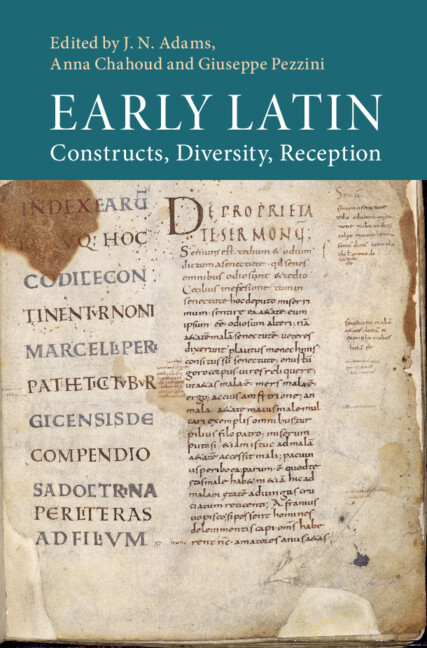
    This is the most detailed and comprehensive study to date of early Latin language, literary and non-literary, featuring twenty-nine chapters by an international team of scholars. 'Early Latin' is interpreted liberally as extending from the period of early inscriptions through to the first quarter of the first century BC. Classical Latin features significantly in the volume, although in a restricted sense. In the classical period there were writers who imitated the Latin of an earlier age, and there were also interpreters of early Latin. Later authors and views on early Latin language are also examined as some of these are relevant to the establishment of the text of earlier writers. A major aim of the book is to define linguistic features of different literary genres, and to address problems such as the limits of periodisation and the definition of the very concept of 'early Latin'.

    Reviews

    ‘It is a great achievement, and I expect it both to be a foundation stone for much further research in this area, and to make a significant intervention into our definition of, and thinking about, Early Latin.’

    Nicholas Zair Source: Bryn Mawr Classical Review

    ‘… one can only congratulate the editors for making this book, full of erudition and sound judgment, available to specialists.’

    Javier Uría Source: Exemplaria Classica

    Refine List

    Actions for selected content:

    Select all | Deselect all
    • View selected items
    • Export citations
    • Download PDF (zip)
    • Save to Kindle
    • Save to Dropbox
    • Save to Google Drive

    Save Search

    You can save your searches here and later view and run them again in "My saved searches".

    Please provide a title, maximum of 40 characters.
    ×

    Contents


    Page 1 of 2


    • Early Latin
      pp i-ii
    • Early Latin - Title page
      pp iii-iii
    • Constructs, Diversity, Reception
    • Copyright page
      pp iv-iv
    • Dedication
      pp v-vi
    • Contents
      pp vii-ix
    • Illustrations
      pp x-x
    • Tables
      pp xi-xii
    • Contributors
      pp xiii-xvii
    • Acknowledgements
      pp xviii-xviii
    • Abbreviations
      pp xix-xxii
    • Chapter 1 - Introduction: What Is ‘Early Latin’?
      pp 1-12
    • Part I - The Epigraphic Material
      pp 13-76
    • Chapter 3 - Identifying Latin in Early Inscriptions
      pp 41-62
    • Chapter 4 - The Egadi Rostra
      pp 63-76
    • A Linguistic Analysis
    • Part II - Drama
      pp 77-272
    • Chapter 5 - Metre
      pp 79-99
    • Chapter 6 - Morphology and Syntax
      pp 100-117
    • Chapter 7 - Support Verb Constructions in Plautus and Terence
      pp 118-137
    • Chapter 8 - Ecquis in ‘Early Latin’
      pp 138-156
    • Aspects of Questions
    • Chapter 9 - Indirect Questions in ‘Early Latin’
      pp 157-205
    • Chapter 10 - Latin edepol ‘by Pollux!’
      pp 206-220
    • Background of a Latin Aduerbium Iuratiuum
    • Chapter 11 - Early Latin Lexicon in Terence (and Plautus)
      pp 221-250
    • Chapter 12 - A Comparison of the Language of Tragedy and Comedy in Early Latin Drama
      pp 251-272
    • Part III - Other Genres and Fragmentary Authors
      pp 273-408
    • Chapter 13 - The Language of Early Latin Epic
      pp 275-291
    • Chapter 14 - Early Latin Prayers and Aspects of Coordination
      pp 292-310
    • Chapter 15 - Some Syntactic Features of Latin Legal Texts
      pp 311-326
    • Chapter 16 - Repetition in the Fragmentary Orators
      pp 327-350
    • From Cato to C. Gracchus
    • Chapter 17 - How ‘Early Latin’ Is Lucilius?
      pp 351-372

    Page 1 of 2


    Metrics

    Altmetric attention score

    Full text views

    Total number of HTML views: 0
    Total number of PDF views: 0 *
    Loading metrics...

    Book summary page views

    Total views: 0 *
    Loading metrics...

    * Views captured on Cambridge Core between #date#. This data will be updated every 24 hours.

    Usage data cannot currently be displayed.

    Accessibility standard: Unknown

    Why this information is here

    This section outlines the accessibility features of this content - including support for screen readers, full keyboard navigation and high-contrast display options. This may not be relevant for you.

    Accessibility Information

    Accessibility compliance for the HTML of this book is currently unknown and may be updated in the future.
