
Skip to main content Accessibility help
×
  • Cited by 136
    • Show more authors
    • You may already have access via personal or institutional login
    • Select format
    • Publisher:
      Cambridge University Press
      Publication date:
      05 June 2012
      12 February 2009
      ISBN:
      9780511805622
      9780521514521
      9780521735513
      Dimensions:
      (228 x 152 mm)
      Weight & Pages:
      0.44kg, 184 Pages
      Dimensions:
      (228 x 152 mm)
      Weight & Pages:
      0.3kg, 182 Pages
    You may already have access via personal or institutional login
  • Selected: Digital
    Add to cart View cart Buy from Cambridge.org

    Book description

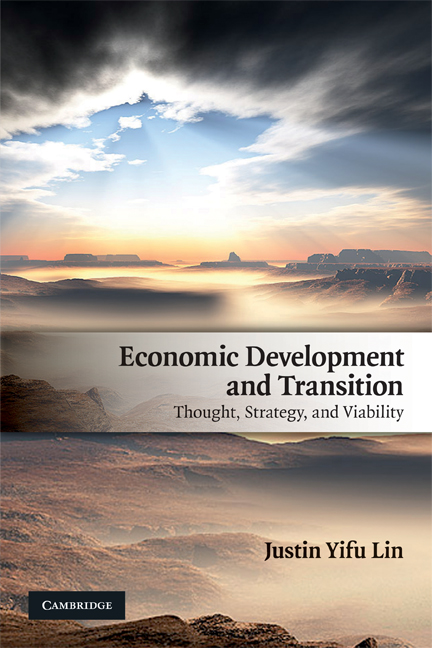
    In Economic Development and Transition, renowned development economist Justin Yifu Lin argues that economic performance in developing countries depends largely on government strategy. If the government plays a facilitating role, enabling firms to exploit the economy's comparative advantages, its economy will develop successfully. However, governments in most developing countries attempt to promote industries that go against their comparative advantages by creating various kinds of distortion to protect nonviable firms in priority industries. Failing to recognize the original intention of many distortions, most governments in transition economies attempt to eliminate those distortions without addressing firms' viability problems, causing economic performance to deteriorate in their transition process. Governments in successful transition economies adopt a pragmatic dual-track approach that encourages firms to enter sectors that were suppressed previously and gives necessary support to firms in priority industries before their viability issue is addressed.

    Reviews

    'Development and transition pose extremely difficult challenges. In these masterly Lectures, Justin Lin, now the World Bank's Chief Economist, brings to these complex subjects a profound understanding of the problems they raise and also unusual insights from his first-hand experience with China's spectacular performance. The Lectures are a tour de force.'

    Jagdish Bhagwati - Columbia University

    'No economist has a deeper understanding of the policies that have given rise to the Chinese economic miracle than Justin Yifu Lin. He has not only influenced the thinking of government and business leaders in China, but also of economic analysts in the United States and Western Europe. This is essential reading for anyone who wants to understand the likely course of the global economy over the next generation.'

    Robert Fogel - Nobel Laureate, University of Chicago

    'Justin Lin, who has been at the centre of the policy debates in China since the 1980s, has provided a masterly account of the economic rationale of the Chinese path of transition from the plan to the market. His book is essential reading for understanding the Chinese economic miracle.'

    Deepak Lal - University of California, Los Angeles

    'Justin Lin's Marshall lectures provide an unrivalled opportunity to both understand the spectacular rise of Asian economics over the past several decades and to cast a jaundiced eye on standard explanations of development by economists. Western training in economics combined with an insider's exposure to China's development has given him both a sceptical view of standard western development economics and an intimate insider's view of the details of the pragmatic approach that has characterized Asian and particularly Chinese spectacular development.'

    Douglass C. North - Nobel Laureate, Washington University, St Louis

    'This is an important book in many ways. Two strike me as central. Professor Lin is a scholar of great insight who has experienced and participated in the policy debate in China, the largest and fastest growing economy thus far. His intimate insight into policy formulation in a transitional economy informs his rigorous theoretical analysis and brings the development part of growth and development back to center stage. Second, the analysis of the consequences of aligning or misaligning the evolving endowments of an economy with its evolving growth strategy is insightful and surely right. It has its roots in trade theory and comparative advantage. But turning that into a body of dynamic analysis of growth strategy and policy is a major achievement.'

    Michael Spence - Nobel Laureate, Stanford University

    'Justin Lin’s study combines economic theory, institutional knowledge, quantitative data, and an appreciation for the importance of starting conditions in determining the success of different plan for economic development. His most unique contribution is the emphasis on how different starting points dictate very different optimal policies, which explains why shock therapy policies have been less than great successes in formerly communist countries like Russia, whereas China’s more gradualist elimination of state enterprises has been working very well. Lin’s point of view is controversial, but highly stimulating. I strongly recommend this book as an insightful study that interprets an impressive amount of actual evidence of attempts at economic development through the powerful lens of economic analysis.'

    Gary Becker - Nobel Laureate, University of Chicago

    'This is a brilliant and revolutionary book explaining why some developing countries have succeeded and others failed. Lin argues that it is ideas, even more than interests, that matter. Those countries that failed attempted to modernize through a strategy of modernization focusing on heavy industry - that he characterizes as defying their comparative advantage. By contrast, governments in the successful countries (mostly in East Asia) facilitated the development of industries and the adoption of technology in a developing country following their comparative advantage determined by their endowment structure at every phase of development. Successful governments did intervene in their economy - the Washington consensus was wrong. But they did so in the right way. The World Bank is lucky to have as its Chief Economist someone willing and able to look at development with fresh eyes, free from the dogmas of the past.'

    Joseph Stiglitz - Nobel Laureate, Columbia University

    Refine List

    Actions for selected content:

    Select all | Deselect all
    • View selected items
    • Export citations
    • Download PDF (zip)
    • Save to Kindle
    • Save to Dropbox
    • Save to Google Drive

    Save Search

    You can save your searches here and later view and run them again in "My saved searches".

    Please provide a title, maximum of 40 characters.
    ×

    Contents

    Metrics

    Altmetric attention score

    Full text views

    Total number of HTML views: 0
    Total number of PDF views: 0 *
    Loading metrics...

    Book summary page views

    Total views: 0 *
    Loading metrics...

    * Views captured on Cambridge Core between #date#. This data will be updated every 24 hours.

    Usage data cannot currently be displayed.

    Accessibility standard: Unknown

    Why this information is here

    This section outlines the accessibility features of this content - including support for screen readers, full keyboard navigation and high-contrast display options. This may not be relevant for you.

    Accessibility Information

    Accessibility compliance for the PDF of this book is currently unknown and may be updated in the future.
