Skip to main content Accessibility help
×
  • Cited by 179
    • Show more authors
    • You may already have access via personal or institutional login
    • Select format
    • Publisher:
      Cambridge University Press
      Publication date:
      11 May 2018
      24 May 2018
      ISBN:
      9781108348867
      9781108425742
      9781108443340
      Dimensions:
      (228 x 152 mm)
      Weight & Pages:
      0.57kg, 254 Pages
      Dimensions:
      (229 x 152 mm)
      Weight & Pages:
      0.4kg, 258 Pages
    You may already have access via personal or institutional login
  • Selected: Digital
    Add to cart View cart Buy from Cambridge.org

    Book description

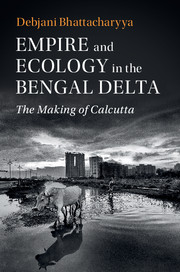
    What happens when a distant colonial power tries to tame an unfamiliar terrain in the world's largest tidal delta? This history of dramatic ecological changes in the Bengal Delta from 1760 to 1920 involves land, water and humans, tracing the stories and struggles that link them together. Pushing beyond narratives of environmental decline, Bhattacharyya argues that 'property-thinking', a governing tool critical in making land and water discrete categories of bureaucratic and legal management, was at the heart of colonial urbanization and the technologies behind the draining of Calcutta. The story of ecological change is narrated alongside emergent practices of land speculation and transformation in colonial law. Bhattacharyya demonstrates how this history continues to shape our built environments with devastating consequences, as shown in the Bay of Bengal's receding coastline.

    Awards

    Honourable Mention, 2017–18 Best Book in Non-North American History Award, Urban History Association

    Reviews

    ‘Debjani Bhattacharyya resurrects Calcutta's forgotten watery origins to recuperate an entirely riveting account of the city and its real estate market. The book shows how the fictitious capital of property value relies on an enduring amnesia about the intractable and transient texture of ecological landscapes. Deeply researched and brilliantly conceived, it offers a path-breaking account of the urban ecological crisis and its uncertain future.'

    Bhavani Raman - University of Toronto

    ‘In this fascinating study of the emergence of the metropolis of Calcutta out of the swampy landscape of the Bengal delta, Bhattacharyya shows how the production of a modern urban property regime entailed a forgotten transformation of the very earth upon which it was constructed.'

    Andrew Sartori - New York University

    'Empire and Ecology has immense potential to shape conversations across a range of disciplinary and interdisciplinary concerns. … This is a book to keep ready to hand on shelves and to place prominently on syllabi.'

    Jeremy J. Schmidt Source: Environmental Values

    'Empire and Ecology in the Bengal Delta is path-breaking and makes a compelling case for drawing urban studies in South Asia into the deepening folds of environmental history. This is an original effort that brims with theoretical insights and helps us recover ways for 'remembering' contemporary Kolkata’s many entanglements with the Bengal delta’s soaking ecology.'

    Rohan D'Souza Source: H-Water

    'In her innovative new book, Empire and Ecology in the Bengal Delta, Debjani Bhattacharyya, a professor of history at Drexel University, describes how Bengalis had their own story about Calcutta’s origins. 'Legend has it that the city was born when the ocean started churning, and a tortoise', pressed between the mountains and the force of Ananta, the infinite, 'gasped out a deep breath'. Its breath made the Bengal Delta, a vast 40,000 square mile area where the Ganges and Brahmaputra rivers seep into the Bay of Bengal. This legend … carries an element of truth: Calcutta rests on shifting ground. It should be no surprise that its fortunes have shifted too.'

    Maya Jasanoff Source: The New York Review of Books

    'Beyond its clear importance to scholars of rivers, swamps, bogs, and other aqueous spaces and waterscapes, Empire and Ecology is brilliant and foundational reading for historians of environment, law, and empire in global contexts.'

    Benjamin Siegel Source: Environmental History

    '… Debjani Bhattacharyya’s innovative, ecologically minded study takes the mobile character of the Bengal Delta as its central dynamic and aligns this with an unfolding narrative of land, law and profit … Bhattacharyya builds an effective lineage for modern India’s ‘technologies of property’ and makes a case for Calcutta that is both unique and yet highly relevant to imperilled deltas and endangered wetlands around the globe.'

    David Arnold Source: The English Historical Review

    Refine List

    Actions for selected content:

    Select all | Deselect all
    • View selected items
    • Export citations
    • Download PDF (zip)
    • Save to Kindle
    • Save to Dropbox
    • Save to Google Drive

    Save Search

    You can save your searches here and later view and run them again in "My saved searches".

    Please provide a title, maximum of 40 characters.
    ×

    Contents

    • 1 - Power and Silt
      pp 45-76

    Metrics

    Altmetric attention score

    Full text views

    Total number of HTML views: 0
    Total number of PDF views: 0 *
    Loading metrics...

    Book summary page views

    Total views: 0 *
    Loading metrics...

    * Views captured on Cambridge Core between #date#. This data will be updated every 24 hours.

    Usage data cannot currently be displayed.

    Accessibility standard: Unknown

    Why this information is here

    This section outlines the accessibility features of this content - including support for screen readers, full keyboard navigation and high-contrast display options. This may not be relevant for you.

    Accessibility Information

    Accessibility compliance for the HTML of this book is currently unknown and may be updated in the future.