Skip to main content Accessibility help
×
    Show more authors
  • Open Access
    You have digital access to this book
  • Select format
  • Publisher:
    Cambridge University Press
    Publication date:
    27 November 2025
    11 December 2025
    ISBN:
    9781009675819
    9781009675802
    9781009675772
    Creative Commons:
    Creative Common License - CC Creative Common License - BY Creative Common License - NC
    This content is Open Access and distributed under the terms of the Creative Commons Attribution licence CC-BY-NC 4.0.
    https://creativecommons.org/creativelicenses
    Dimensions:
    (229 x 152 mm)
    Weight & Pages:
    0.888kg, 484 Pages
    Dimensions:
    (229 x 152 mm)
    Weight & Pages:
    0.694kg, 484 Pages
Open Access
You have digital access to this book
Selected: Digital
View content
Add to cart View cart Buy from Cambridge.org

Book description

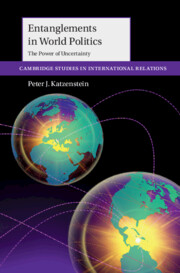
In this seminal study, Peter J. Katzenstein drags the analysis of world politics from the Newtonian humanism of the nineteenth century into a new post-Newtonianism of the twenty-first. The key concept is entanglement. By examining differences in context, process, and language, Katzenstein specifies how risk and uncertainty intertwine. Three deeply researched case studies – finance and political economy, nuclear crisis politics and war, and global warming and AI – support his original arguments. A chapter on power further illustrates the risk-uncertainty conundrum. Entanglements in World Politics calls for humility and eclectic pragmatism, emphasizing the unity of knowledge of the natural and humanistic sciences and the complementarities of science and religion. Katzenstein's engaging writing and innovative approach make this a must-read for anyone interested in the complexities of global politics. This book is also available as Open Access on Cambridge Core.

Reviews

‘International Relations has found its Tolstoy! The hard problem of uncertainty in world politics has found its match. Dancing nimbly on the cutting edge of the sciences and humanities, jumping deftly from the subatomic to the geopolitical, Katzenstein constructs a protean world view for navigating the political, financial and environmental uncertainties and risks of the twenty-first century. He does so with a humility and humour uncommon in academic treatises. If you are looking for a ray of hope in a time of dark fears and creeping nihilism, read this wickedly smart book.’

James Der Derian - Michael Hintze Chair of International Security, University of Sydney

‘This book changes how we study global politics. Katzenstein makes an original and seminal contribution by joining the Newtonian and post-Newtonian worlds to those of risk and uncertainty. Our politics are shaped simultaneously by linear, additive worlds and by dynamic non-linear worlds where they are entangled in complex ways. Knowing which world we are in when matters. This book speaks to the moment with a unique, important, and defining voice.’

Janice Gross Stein - Belzberg Professor of Conflict Management, University of Toronto

‘The third in his masterful trilogy, Entanglements in World Politics is Katzenstein at his best. This ambitious and powerful reimagining of international relations theory dares us to abandon long held ideas and embrace new political imaginaries. With his trademark erudition and skill, Katzenstein lays bare ‘conundrums’ at the heart of our thinking about politics and challenges the foundations on which we build our understandings of the world. Readers will come away rethinking many long-held assumptions about how we know what we know, and with new ideas about paths forward.’

Martha Finnemore - University Professor of Political Science and International Affairs, George Washington University

‘This important book about ubiquitous uncertainty and interpretation of risk in international relations demonstrates that Katzenstein remains among the most creative and erudite scholars in political science. Who else can illuminate current and historical crises in political economy, security studies, and climate change with equal depth and insight? This plea for empathy for others and humility about ourselves should be widely-read and debated.’

Scott D. Sagan - Caroline S.G. Munro Professor, Department of Political Science, Stanford University

‘Katzenstein’s highly readable tour de force calls out the overwhelming tendency of social scientists to conflate calculable risk and incalculable uncertainty. Invoking Tolstoy’s warning against the false lure of ‘an imaginary knowledge of the perfect truth,’ his penetrating insights on theories and myths of political economy are essential to understanding the crisis of our times. He calls for a philosophically self-aware pragmatism treating theories as stories in a distinctive merger of science and humanistic thought.’

Jack Snyder - Robert and Renée Belfer Professor of International Relations, Columbia University

‘Katzenstein is political sciences' great re-framer of problems. He once turned a world of empire into a world of regions. Now he turns worlds of risk and uncertainty into worlds of mutual entanglement where the certain and the unexpected uneasily cohabit. Rather than treat worlds of finance and security as separate and fully knowable, Katzenstein shows us how they mutually imbricate, reinforcing and fracturing as they move forward. Keynes sought to show us how the once general theory of competitive equilibrium was but a special case of a more general class of possible states of the world where calculability and risk were but fleeting companions. Taking up Keynes’ concern with the structuring role of conventions in a world that is both risky and uncertain, Katzenstein rethinks what power is and how it is exercised in such a fleeting world.’

Mark Blyth - The William R. Rhodes ’57 Professor of International Economics, The Watson Institute for International and Public Affairs, Brown University

‘Katzenstein contrasts risk - where probabilities can be calculated - with uncertainty, where such calculations are impossible. For issue after issue, he shows that uncertainty is pervasive: worldviews and theories that deny or overlook ‘the risk-uncertainty conundrum’ fail. Erudite and challenging, Entanglements in World Politics will profoundly affect its readers’ worldviews.’

Robert O. Keohane - Professor of International Affairs, Princeton University

‘Whereas uncertainty is an enduring condition of world politics, Katzenstein’s book is groundbreaking for embracing it, contra the social scientific impulse to mitigate or control it. As he reminds us, ‘there is no simple … path through the complexities of contemporary crisis.’ By creating conceptual space for a social science that accounts for both (knowable) risk and (unknowable) uncertainty, this book provides not a compass, but a pragmatic and sagacious guide.’

Steven Bernstein - Distinguished Professor of Global Environmental and Sustainability Governance, University of Toronto

Refine List

Actions for selected content:

Select all | Deselect all
  • View selected items
  • Export citations
  • Download PDF (zip)
  • Save to Kindle
  • Save to Dropbox
  • Save to Google Drive

Save Search

You can save your searches here and later view and run them again in "My saved searches".

Please provide a title, maximum of 40 characters.
×

Contents

Full book PDF
  • Entanglements in World Politics
    pp i-i
  • Cambridge Studies in International Relations: 168 - Series page
    pp ii-ii
  • Reviews
    pp iii-iv
  • Entanglements in World Politics - Title page
    pp v-v
  • The Power of Uncertainty
  • Copyright page
    pp vi-vi
  • Contents
    pp vii-viii
  • Figures
    pp ix-ix
  • Tables
    pp x-x
  • Preface
    pp xi-xiv
  • Introduction: “An Imaginary Knowledge of the Perfect Truth” Meets the Risk-Uncertainty Conundrum
    pp 1-30
  • Chapter 1 - Worldviews and Small and Large Worlds
    pp 31-62
  • Chapter 2 - Small and Large Worlds, Post-Newtonianism and Para-Humanism
    pp 63-102
  • Chapter 3 - Theories, Models, and Methods
    pp 103-132
  • Chapter 4 - Risk and Uncertainty in Finance
    pp 133-174
  • Chapter 5 - The Missiles of 1962
    pp 175-221
  • Chapter 6 - Global Warming and Artificial Intelligence
    pp 222-271
  • Chapter 7 - Control and Protean Power in Small and Large Worlds
    pp 272-308
  • Conclusion: Re-sizing Worlds
    pp 309-357
  • References
    pp 358-446
  • Index
    pp 447-458
  • Cambridge Studies in International Relations - Series page
    pp 459-470

Metrics

Altmetric attention score

Full text views

Total number of HTML views: 0
Total number of PDF views: 0 *
Loading metrics...

Book summary page views

Total views: 0 *
Loading metrics...

* Views captured on Cambridge Core between #date#. This data will be updated every 24 hours.

Usage data cannot currently be displayed.

Accessibility standard: WCAG 2.1 AA

Why this information is here

This section outlines the accessibility features of this content - including support for screen readers, full keyboard navigation and high-contrast display options. This may not be relevant for you.

Accessibility Information

The PDF of this book complies with version 2.1 of the Web Content Accessibility Guidelines (WCAG), covering newer accessibility requirements and improved user experiences and achieves the intermediate (AA) level of WCAG compliance, covering a wider range of accessibility requirements.

Content Navigation
Table of contents navigation

Allows you to navigate directly to chapters, sections, or non‐text items through a linked table of contents, reducing the need for extensive scrolling.

Index navigation

Provides an interactive index, letting you go straight to where a term or subject appears in the text without manual searching.

Reading Order and Textual Equivalents
Single logical reading order

You will encounter all content (including footnotes, captions, etc.) in a clear, sequential flow, making it easier to follow with assistive tools like screen readers.

Short alternative textual descriptions

You get concise descriptions (for images, charts, or media clips), ensuring you do not miss crucial information when visual or audio elements are not accessible.

Visual Accessibility
Use of colour is not sole means of conveying information

You will still understand key ideas or prompts without relying solely on colour, which is especially helpful if you have colour vision deficiencies.

Structural and Technical Features
ARIA roles provided

You gain clarity from ARIA (Accessible Rich Internet Applications) roles and attributes, as they help assistive technologies interpret how each part of the content functions.