
Skip to main content Accessibility help
×
  • Cited by 31
    • You may already have access via personal or institutional login
    • Select format
    • Publisher:
      Cambridge University Press
      Publication date:
      15 July 2019
      17 October 2019
      ISBN:
      9781108767811
      9781108738002
      Dimensions:
      Weight & Pages:
      Dimensions:
      (229 x 152 mm)
      Weight & Pages:
      0.15kg, 64 Pages
    • Series:
      Elements in Evolutionary Economics
    You may already have access via personal or institutional login
  • Selected: Digital
    Add to cart View cart Buy from Cambridge.org
    Series:
    Elements in Evolutionary Economics

    Book description

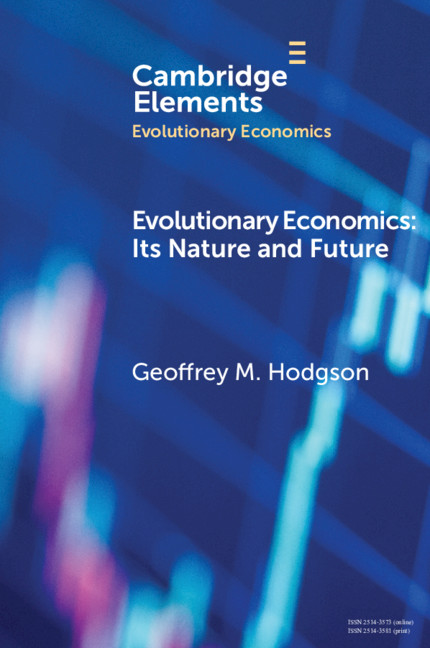
    This Element examines the historical emergence of evolutionary economics, its development into a strong research theme after 1980, and how it has hosted a diverse set of approaches. Its focus on complexity, economic dynamics and bounded rationality is underlined. Its core ideas are compared with those of mainstream economics. But while evolutionary economics has inspired research in a number of areas in business studies and social science, these have become specialized and fragmented. Evolutionary economics lacks a sufficiently-developed core theory that might promote greater conversation across these fields. A possible unifying framework is generalized Darwinism. Stronger links could also be made with other areas of evolutionary research, such as with evolutionary anthropology and evolutionary psychology. As evolutionary economics has migrated from departments of economics to business schools, institutes of innovation studies and elsewhere, it also needs to address the problem of its lack of a single disciplinary location within academia.

    References

    Alchian, Armen A. (1950) ‘Uncertainty, Evolution, and Economic Theory’, Journal of Political Economy, 58(2), June, pp. 211–22.
    Aldrich, Howard E. (1999) Organizations Evolving (London: Sage).
    Aldrich, Howard E., Hodgson, Geoffrey M., Hull, David L., Knudsen, Thorbjørn, Mokyr, Joel and Vanberg, Viktor J. (2008) ‘In Defence of Generalized Darwinism’, Journal of Evolutionary Economics, 18(5), October, pp. 577–96.
    Aldrich, Howard E. and Ruef, Martin (2006) Organizations Evolving, second edition. (London: Sage).
    Alexander, J. McKenzie (2007) The Structural Evolution of Morality (Cambridge: Cambridge University Press).
    Arrow, Kenneth J. (1995) ‘Viewpoint: the Future’, Science, 267, 17 March, p. 1617.
    Axelrod, Robert M. (1984) The Evolution of Cooperation (New York: Basic Books).
    Axelrod, Robert M. (1986) ‘An Evolutionary Approach to Norms’, American Political Science Review, 80(4), December, pp. 1095–111.
    Ayres, Clarence E. (1932) Huxley (New York: Norton).
    Becker, Gary S. (1976) The Economic Approach to Human Behavior (Chicago: University of Chicago Press).
    Bergstrom, Theodore C. (2002) ‘Evolution of Social Behavior: Individual and Group Selection’, Journal of Economic Perspectives, 16(2), Spring, pp. 6788.
    Bicchieri, Cristina (2006) The Grammar of Society (Cambridge and New York: Cambridge University Press).
    Binmore, Kenneth and Samuelson, Larry (1994) ‘An Economist’s Perspective on the Evolution of Norms’, Journal of Institutional and Theoretical Economics, 150(1), March, pp. 4563.
    Blau, Peter J. (1994) The Organization of Academic Work (New Brunswick, NJ: Transaction).
    Blaug, Mark (1997) ‘Ugly Currents in Modern Economics’, Options Politiques, 18(17), September, pp. 38. Reprinted in Mäki, Uskali (ed.) (2002) Fact and Fiction in Economics: Models, Realism and Social Construction (Cambridge and New York: Cambridge University Press).
    Blaug, Mark (1999) ‘The Formalist Revolution or What Happened to Orthodox Economics After World War II?’, in Backhouse, Roger E. and Creedy, John (eds.) (1999) From Classical Economics to the Theory of the Firm: Essays in Honour of D. P. O’Brien (Cheltenham: Edward Elgar), pp. 257–80.
    Boehm, Christopher (2012) Moral Origins: the Evolution of Virtue, Altruism and Shame (New York: Basic Books).
    Boulding, Kenneth E. (1981) Evolutionary Economics (Beverly Hills, CA: Sage Publications).
    Bowles, Samuel and Gintis, Herbert (eds.) (2005) Moral Sentiments and Material Interests: the Foundations of Cooperation in Economic Life (Cambridge: Massachusetts Institute of Technology Press).
    Bowles, Samuel and Gintis, Herbert (2011) A Cooperative Species: Human Reciprocity and Its Evolution (Princeton, NJ: Princeton University Press).
    Boyd, Robert and Richerson, Peter J. (1985) Culture and the Evolutionary Process (Chicago: University of Chicago Press).
    Breslin, Dermot (2011) ‘Reviewing a Generalized Darwinist Approach to Studying Socio-Economic Change’, International Journal of Management Reviews, 13(2), pp. 218–35.
    Bunge, Mario A. (1959) Causality: the Place of the Causal Principle in Modern Science (Cambridge, MA: Harvard University Press).
    Buss, David M. (1999) Evolutionary Psychology: the New Science of the Mind (Needham Heights, MA: Allyn and Bacon).
    Camic, Charles and Hodgson, Geoffrey M. (eds.) (2011) Essential Writings of Thorstein Veblen (London and New York: Routledge).
    Camerer, Colin (2003) Behavioral Game Theory: Experiments in Strategic Interaction (Princeton, NJ: Princeton University Press).
    Camerer, Colin F. and Fehr, Ernst (2006) ‘When Does “Economic Man” Dominate Social Behavior?Science, 311, 6 January, pp. 4752.
    Campbell, Donald T. (1965) ‘Variation, Selection and Retention in Sociocultural Evolution’, in Barringer, H. R., Blanksten, G. I. and Mack, R. W. (eds.), Social Change in Developing Areas: a Reinterpretation of Evolutionary Theory (Cambridge, MA: Schenkman), pp. 1949.
    Case, Donald O. and Higgins, Georgeann M. (2000) ‘How Can We Investigate Citation Behavior? A Study of Reasons for Citing Literature in Communication’, Journal of the American Society for Information Science and Technology, 51(7), pp. 635–45.
    Coase, Ronald H. (1937) ‘The Nature of the Firm’, Economica, 4, New Series, November, pp. 386405.
    Cohen, Wesley M. and Levinthal, Daniel A. (1990) ‘Absorptive Capacity: a New Perspective on Learning and Innovation’, Administrative Science Quarterly, 35(1), pp. 128–52.
    Cordes, Christian (2006) ‘Darwinism in Economics: from Analogy to Continuity’, Journal of Evolutionary Economics, 16(5), December, pp. 529–41.
    Cosmides, Leda and Tooby, John (1994a) ‘Beyond Intuition and Instinct Blindness: towards an Evolutionary Rigorous Cognitive Science’, Cognition, 50(13), April–June, pp. 4177.
    Cosmides, Leda and Tooby, John (1994b) ‘Better than Rational: Evolutionary Psychology and the Invisible Hand’, American Economic Review (Papers and Proceedings), 84(2), May, pp. 327–32.
    Crane, Diana (1972) Invisible Colleges. Diffusion of Knowledge in Scientific Communities (Chicago: University of Chicago Press).
    Cyert, Richard M. and March, James G. (1963) A Behavioral Theory of the Firm (Englewood Cliffs, NJ: Prentice-Hall).
    Cziko, Gary (1995) Without Miracles: Universal Selection Theory and the Second Darwinian Revolution (Cambridge: Massachusetts Institute of Technology Press).
    Darwin, Charles R. (1859) On the Origin of Species by Means of Natural Selection, or the Preservation of Favoured Races in the Struggle for Life (London: Murray).
    Darwin, Charles R. (1871) The Descent of Man, and Selection in Relation to Sex, 2 vols. (London: Murray and New York: Hill).
    Dawes, Robyn M. and Thaler, Richard H. (1988) ‘Anomalies: Cooperation’, Journal of Economic Perspectives, 2(3), Summer, pp. 187–97.
    Dawkins, Richard (1986) The Blind Watchmaker. Harlow: Longman.
    De Waal, Frans B. M. (2006) Primates and Philosophers: How Morality Evolved (Princeton, NJ: Princeton University Press).
    Degler, Carl N. (1991) In Search of Human Nature: the Decline and Revival of Darwinism in American Social Thought (Oxford and New York: Oxford University Press).
    Dennett, Daniel C. (1995) Darwin’s Dangerous Idea: Evolution and the Meanings of Life (London and New York: Allen Lane, and Simon and Schuster).
    Dollimore, Denise E. and Hodgson, Geoffrey M. (2014) ‘Four Essays on Economic Evolution: an Introduction’, Journal of Evolutionary Economics, 24(1), January, pp. 110.
    Dopfer, Kurt, Foster, John and Potts, Jason (2004) ‘Micro-Meso-Macro’, Journal of Evolutionary Economics, 14(3), pp. 263–79.
    Dosi, Giovanni (1982) ‘Technological Paradigms and Technological Trajectories: a Suggested Interpretation of the Determinants and Directions of Technical Change’, Research Policy, 11(3), pp. 147–62.
    Dosi, Giovanni, Freeman, Christopher, Nelson, Richard, Silverberg, Gerald and Soete, Luc L. G. (eds.) (1988) Technical Change and Economic Theory (London: Pinter).
    Dosi, Giovanni, Levinthal, Daniel A. and Marengo, Luigi (2003) ‘Bridging Contested Terrain: Linking Incentive‐Based and Learning Perspectives on Organizational Evolution’, Industrial and Corporate Change, 12(2), pp. 413–36.
    Dosi, Giovanni, Orietta, Marsili, Orsenigo, Luigi and Salvatore, Roberta (1995) ‘Technological Regimes, Selection and Market Structures’, Small Business Economics, 7, pp. 411–36
    Dosi, Giovanni and Metcalfe, J. Stanley (1991) ‘On Some Notions of Irreversibility in Economics’, in Saviotti, Pier Paolo and Metcalfe, J. Stanley (eds.) (1991) Evolutionary Theories of Economic and Technological Change: Present Status and Future Prospects (Reading: Harwood), pp. 133–59.
    Dunning, John H. (1989) ‘The Study of International Business: a Plea for a More Interdisciplinary Approach’, Journal of International Business Studies, 20(3), Fall, pp. 411–36.
    Economist (1996) ‘Dons and Dollars’, The Economist, July 20, pp. 53–4.
    Edgeworth, Francis Y. (1881) Mathematical Psychics: an Essay on the Application of Mathematics to the Moral Sciences (London: Kegan Paul).
    Fletcher, Jeffrey A. and Zwick, Martin (2007). “The Evolution of Altruism: Game Theory in Multilevel Selection and Inclusive Fitness,” Journal of Theoretical Biology, 245(1), pp. 2636.
    Foss, Nicolai Juul (1994), ‘Realism and Evolutionary Economics’, Journal of Social and Evolutionary Systems, 17(1), 2140.
    Foster, John (1997) ‘The Analytical Foundations of Evolutionary Economics: from Biological Analogy to Economic Self-Organisation’, Structural Change and Economic Dynamics, 8(4), October, pp. 427–51.
    Friedman, Milton (1953) ‘The Methodology of Positive Economics’, in Friedman, M., Essays in Positive Economics (Chicago: University of Chicago Press), pp. 343.
    Geisendorf, Sylvie (2009) ‘The Economic Concept of Evolution – Self-Organization or Universal Darwinism?’ Journal of Economic Methodology, 16(4), December, pp. 359–73.
    Georgescu-Roegen, Nicholas (1971) The Entropy Law and the Economic Process (Cambridge, MA: Harvard University Press).
    Gintis, Herbert (2003) ‘The Hitchhiker’s Guide to Altruism: Genes, Culture, and the Internalization of Norms’, Journal of Theoretical Biology, 220(4), pp. 407–18.
    Gintis, Herbert, Bowles, Samuel, Boyd, Robert and Fehr, Ernst (eds.) (2003) ‘Explaining Altruistic Behavior in Humans’, Evolution and Human Behavior, 24(2), pp. 153–72.
    Gintis, Herbert, Bowles, Samuel, Boyd, Robert and Fehr, Ernst (eds.) (2005) Moral Sentiments and Material Interests: the Foundations of Cooperation in Economic Life (Cambridge: Massachusetts Institute of Technology Press).
    Godfrey-Smith, Peter (2009) Darwinian Populations and Natural Selection (Oxford: Oxford University Press).
    Gowdy, John M. (2004) ‘Altruism, Evolution, and Welfare Economics’, Journal of Economic Behavior and Organization, 53(1), February, pp. 6973.
    Hahn, Frank H. (1991) ‘The Next Hundred Years’, Economic Journal, 101(1), January, pp. 4750.
    Haidt, Jonathan (2012) The Righteous Mind: Why Good People are Divided by Politics and Religion (London: Penguin).
    Haltiwanger, John and Waldman, Michael (1985) ‘Rational Expectations and the Limits of Rationality: an Analysis of Heterogeneity’, American Economic Review 75.3: 159–73.
    Hammerstein, Peter (ed.) (2003) Genetic and Cultural Evolution of Cooperation (Cambridge: Massachusetts Institute of Technology Press).
    Hannan, Michael T. and Freeman, John (1989) Organizational Ecology (Cambridge, MA: Harvard University Press).
    Hare, Richard M. (1952) The Language of Morals (Oxford: Oxford University Press).
    Hargreaves Heap, Shaun P. and Varoufakis, Yanis (1995) Game Theory: a Critical Introduction, Routledge, London and New York.
    Hayek, Friedrich A. (1967) ‘Notes on the Evolution of Systems of Rules of Conduct’, from Hayek, Friedrich A. (1967) Studies in Philosophy, Politics and Economics (London: Routledge and Kegan Paul), pp. 6681.
    Hayek, Friedrich A. (1948) Individualism and Economic Order (London and Chicago: George Routledge and University of Chicago Press).
    Hayek, Friedrich A. (1973) Law, Legislation and Liberty; Volume 1: Rules and Order (London: Routledge and Kegan Paul).
    Hayek, Friedrich A. (1979) Law, Legislation and Liberty; Volume 3: The Political Order of a Free People (London: Routledge and Kegan Paul).
    Hayek, Friedrich A. (1988) The Fatal Conceit: the Errors of Socialism. The Collected Works of Friedrich August Hayek, Vol. I, ed. Bartley III, William W. (London: Routledge).
    Henrich, Joseph (2004) ‘Cultural Group Selection, Coevolutionary Processes and Large-Scale Cooperation’, Journal of Economic Behavior and Organization, 53(1), February, pp. 335.
    Henrich, Joseph, Boyd, Robert, Bowles, Samuel, Camerer, Colin, Fehr, Ernst, Gintis, Herbert and McElreath, Richard (2001) ‘In Search of Homo Economicus: Behavioral Experiments in 15 Small-Scale Societies’, American Economic Review (Papers and Proceedings), 91(2), May, pp. 7384.
    Henrich, Joseph, Boyd, Robert, Bowles, Samuel, Camerer, Colin, Fehr, Ernst, and Gintis, Herbert (2004) Foundations of Human Sociality: Economic Experiments and Ethnographic Evidence from Fifteen Small-Scale Societies (Oxford and New York: Oxford University Press).
    Higher Education Student Statistics UK (2018) HESA, ‘Higher Education Student Statistics: UK, 2016/17 – Qualifications Achieved’. www.hesa.ac.uk/news/11–01-2018/sfr247-higher-education-student-statistics/qualifications. (Retrieved 14 July 2018.)
    Hobson, John A. (1929) Wealth and Life: a Study in Values (London: Macmillan).
    Hodgson, Geoffrey M. (1993) Economics and Evolution: Bringing Life Back Into Economics (Cambridge, UK and Ann Arbor, MI: Polity Press and University of Michigan Press).
    Hodgson, Geoffrey M. (1997) ‘The Ubiquity of Habits and Rules’, Cambridge Journal of Economics, 21(6), November, pp. 663–84.
    Hodgson, Geoffrey M. (2004a) The Evolution of Institutional Economics: Agency, Structure and Darwinism in American Institutionalism (London and New York: Routledge).
    Hodgson, Geoffrey M. (2004b) ‘Darwinism, Causality and the Social Sciences’, Journal of Economic Methodology, 11(2), June, pp. 175–94.
    Hodgson, Geoffrey M. (2007a) ‘The Revival of Veblenian Institutional Economics’, Journal of Economic Issues, 41(2), June, pp. 325–40.
    Hodgson, Geoffrey M. (2007b) ‘Taxonomizing the Relationship between Biology and Economics: a Very Long Engagement’, Journal of Bioeconomics, 9(2), August, pp. 169–85.
    Hodgson, Geoffrey M. (2007c) ‘Evolutionary and Institutional Economics as the New Mainstream?’, Evolutionary and Institutional Economics Review, 4(1), September 2007, pp. 725.
    Hodgson, Geoffrey M. (2009) ‘On the Institutional Foundations of Law: the Insufficiency of Custom and Private Ordering’, Journal of Economic Issues, 43(1), March, pp. 143–66.
    Hodgson, Geoffrey M. (2011) ‘Organizational Evolution versus the Cult of Change’, Corporate Finance Review, January–February, 16(1), pp. 510.
    Hodgson, Geoffrey M. (2013a) ‘Understanding Organizational Evolution: toward a Research Agenda using Generalized Darwinism’, Organization Studies, 34(7), July 2013, pp. 973–92.
    Hodgson, Geoffrey M. (2013b) From Pleasure Machines to Moral Communities: an Evolutionary Economics without Homo Economicus (Chicago: University of Chicago Press).
    Hodgson, Geoffrey M. (2014) ‘The Evolution of Morality and the End of Economic Man’, Journal of Evolutionary Economics, 24(1), January, pp. 83106.
    Hodgson, Geoffrey M. (2015) Conceptualizing Capitalism: Institutions, Evolution, Future (Chicago: University of Chicago Press).
    Hodgson, Geoffrey M. (2019) Is There a Future for Heterodox Economics? Institutions, Ideology and a Scientific Community (Cheltenham, UK and Northampton, MA: Edward Elgar).
    Hodgson, Geoffrey M., Herman, Stephen and Dollimore, Denise E. (2017) ‘Adaptability and Survival in Small- and Medium-Sized Firms’, Industrial and Corporate Change, published online.
    Hodgson, Geoffrey M. and Huang, Kainan (2012) ‘Evolutionary Game Theory and Evolutionary Economics: Are They Different Species?’ Journal of Evolutionary Economics, 22, pp. 345–66.
    Hodgson, Geoffrey M. and Knudsen, Thorbjørn (2006) ‘Why We Need a Generalized Darwinism: and Why a Generalized Darwinism Is Not Enough’, Journal of Economic Behavior and Organization, 61(1), September, pp. 119.
    Hodgson, Geoffrey M. and Knudsen, Thorbjørn (2010) Darwin’s Conjecture: the Search for General Principles of Social and Economic Evolution (Chicago: University of Chicago Press).
    Hodgson, Geoffrey M. and Lamberg, Juha-Antti (2018) ‘The Past and Future of Evolutionary Economics: Some Reflections Based on New Bibliometric Evidence’, Evolutionary and Institutional Economics Review, 15(1), pp. 167–87.
    Hodgson, Geoffrey M. and Stoelhorst, J. W. (2014) ‘Introduction to the Special Issue on the Future of Institutional and Evolutionary Economics’, Journal of Institutional Economics, 10(4), December, pp. 513–40.
    Hull, David L. (1988) Science as a Process: an Evolutionary Account of the Social and Conceptual Development of Science (Chicago: University of Chicago Press).
    Hurd, Peter L. (1995) ‘Communication in Discrete Action-Response Games’, Journal of Theoretical Biology, 174(2), pp. 217–22.
    Jäger, Gerhard (2008) ‘Evolutionary Stability Conditions for Signalling Games with Costly Signals’, Journal of Theoretical Biology, 253(2), pp. 131–41.
    Jevons, William Stanley (1871) The Theory of Political Economy (London: Macmillan).
    Jones, Lamar B. (1995) ‘C. E. Ayres’s Reliance on T. H. Huxley: Did Darwin’s Bulldog Bite?’ American Journal of Economics and Sociology, 54(4), October, pp. 413–20.
    Joyce, Richard (2006) The Evolution of Morality (Cambridge: Massachusetts Institute of Technology Press).
    Kameda, Tatsuya and Nakanishi, Daisuke (2003) ‘Does Social/Cultural Learning Increase Human Adaptability? Rogers’s Question Revisited’, Evolution and Human Behavior, 24(4), pp. 242–60.
    Kauffman, Stuart A. (1993) The Origins of Order: Self-Organization and Selection in Evolution (Oxford and New York: Oxford University Press).
    Kauffman, Stuart A. (1995) At Home in the Universe: the Search for Laws of Self-Organization and Complexity (Oxford and New York: Oxford University Press).
    Kitcher, Philip (1993) The Advancement of Science: Science without Legend, Objectivity without Illusions (Oxford and New York: Oxford University Press).
    Klaes, Matthias (2004) ‘Evolutionary Economics: in Defence of “Vagueness”’, Journal of Economic Methodology, 11(3), September, pp. 359–76.
    Klamer, Arjo and Colander, David (1990) The Making of an Economist (Boulder: Westview Press).
    Knorr-Cetina, Karin D. (1981) The Manufacture of Knowledge: an Essay on the Constructivist and Contextual Nature of Science (Oxford: Pergamon).
    Koestler, Arthur (1964) The Act of Creation (London: Hutchinson).
    Kornai, János (1971) Anti-Equilibrium: on Economic Systems Theory and the Tasks of Research (Amsterdam: North-Holland). Reprinted 1991 (New York: Augustus Kelley).
    Krueger, Anne O. (1991) ‘Report on the Commission on Graduate Education in Economics’, Journal of Economic Literature, 29(3), September, pp. 1035–53.
    Kuhn, Thomas S. (1962) The Structure of Scientific Revolutions (Chicago: University of Chicago Press).
    Lakatos, Imre (1970) ‘Falsification and the Methodology of Scientific Research Programmes’, in Lakatos, Imre and Musgrave, Alan (eds.) (1970) Criticism and the Growth of Knowledge (Cambridge: Cambridge University Press) pp. 91195.
    Lamarck, Jean Baptiste de (1963) Zoological Philosophy: an Exposition with Regard to the Natural History of Animals, translated from the 1st French edn. of 1809 (New York: Hafner).
    Laudan, Larry (1977) Progress and Its Problems: towards a Theory of Scientific Growth (London: Routledge and Kegan Paul).
    Levinthal, Daniel A. (1992) ‘Surviving Schumpeterian Environments: an Evolutionary Perspective’, Industrial and Corporate Change, 1, pp. 427–43.
    Lewin, Arie Y. and Mitchell, P. Koza (2001) ‘Editorial’, Organization Studies, 22(6), November, pp. vxii.
    Lewin, Arie Y. and Volberda, Henk W. (1999) ‘Prolegomena on Coevolution: a Framework for Research on Strategy and New Organizational Forms’, Organization Science, 10(5), September–October, pp. 519–34.
    Lewontin, Richard C. (1961) ‘Evolution and the Theory of Games’, Journal of Theoretical Biology, 1, pp. 382403.
    Lopes, Helena, Santos, Ana C. and Teles, Nuno (2009) ‘The Motives for Cooperation in Work Organisations’, Journal of Institutional Economics, 5(3), December, pp. 259–88.
    Lucio-Arias, Diana and Leydesdorff, Loet (2008) ‘Main-Path Analysis and Path-Dependent Transitions in HistCite™-Based Historiograms’, Journal of the American Society for Information Science and Technology, 59(12), pp. 1948–62.
    Lundvall, Bengt-Åke (ed.) (1992) National Systems of Innovation: towards a Theory of Innovation and Interactive Learning (London: Pinter).
    Mackie, John Leslie (1977) Ethics: Inventing Right and Wrong (Harmondsworth: Penguin).
    Malerba, Franco, Nelson, Richard R., Orsenigo, Luigi and Winter, Sidney G. (1999) ‘“History Friendly” Models of Industry Evolution: the Computer Industry’, Industrial and Corporate Change, 8(1), pp. 340.
    Malerba, Franco and Orsenigo, Luigi (2002) ‘Innovation and Market Structure in the Dynamics of the Pharmaceutical Industry and Biotechnology: towards a History-Friendly Model’ Industrial and Corporate Change, 11(4), pp. 667703.
    March, James G. (1991). ‘Exploration and Exploitation in Organizational Learning’, Organization Science, 2(1), pp. 7187.
    March, James G. and Simon, Herbert A. (1958) Organizations (New York: Wiley).
    Marshall, Alfred (1890) Principles of Economics: An Introductory Volume (London: Macmillan).
    Marx, Karl (1976) Capital, vol. 1, translated by Ben Fowkes from the fourth German edition of 1890 (Harmondsworth: Pelican).
    Maynard Smith, John (1972) ‘Game Theory and the Evolution of Fighting’, in Maynard Smith, John, On Evolution (Edinburgh: Edinburgh University Press) pp. 828.
    Maynard Smith, John (1982) Evolutionary Game Theory (Cambridge: Cambridge University Press).
    Maynard Smith, John and Price, George R. (1973) ‘The Logic of Animal Conflict’, Nature, 246, pp. 1518.
    Mayr, Ernst (1991) One Long Argument: Charles Darwin and the Genesis of Modern Evolutionary Thought (Cambridge, MA and London: Harvard University Press and Allen Lane).
    McCloskey, Deirdre N. (2006) The Bourgeois Virtues: Ethics for an Age of Commerce (Chicago: Chicago University Press).
    McKelvey, Maureen (1996) Evolutionary Innovations: the Business of Biotechnology (Oxford: Oxford University Press).
    Menger, Carl (1871) Grundsätze der Volkwirtschaftslehre, 1st edn. (Tübingen: J. C. B. Mohr). Published in English in 1981 as Principles of Economics (New York: New York University Press).
    Metcalfe, J. Stanley (1998) Evolutionary Economics and Creative Destruction (London and New York: Routledge).
    Minkler, Lanse P. (2008) Integrity and Agreement: Economics When Principles Also Matter (Ann Arbor, MI: University of Michigan Press).
    Murmann, Johann Peter (2003) Knowledge and Competitive Advantage: the Coevolution of Firms, Technology and National Institutions (Cambridge and New York: Cambridge University Press).
    Murmann, Johann Peter, Aldrich, Howard E., Levinthal, Daniel and Winter, Sidney G. (2003) ‘Evolutionary Thought in Management and Organization Theory at the Beginning of the New Millennium: a Symposium on the State of the Art and Opportunities for Future Research’, Journal of Management Inquiry, 12(1), March, pp. 2240.
    Nakahashi, Wataru (2007) ‘The Evolution of Conformist Transmission in Social Learning when the Environment Changes Periodically’, Theoretical Population Biology, 72(1), pp. 5266.
    National Centre for Education Statistics (2017) Digest of Education Statistics. https://nces.ed.gov/fastfacts/display.asp?id=37. (Retrieved 14 July 2018.)
    Nelson, Richard R. (ed.) (1993) National Innovation Systems: a Comparative Analysis (Oxford: Oxford University Press).
    Nelson, Richard R. (2008) ‘Factors Affecting the Power of Technological Paradigms’, Industrial and Corporate Change, 17(3), pp. 485–97.
    Nelson, Richard R. and Winter, Sidney G. (1982) An Evolutionary Theory of Economic Change (Cambridge, MA: Harvard University Press).
    Noam, Eli M. (1995) ‘Electronics and the Dim Future of the University’, Science, Vol. 270, October 13, pp. 247–9.
    Nowak, Martin A., Plotkin, Joshua B. and Krakauer, David C. (1999) ‘The Evolutionary Language Game’, Journal of Theoretical Biology, 200(2), pp. 147–62.
    Nowak, Martin A. and Sigmund, Karl (2005) ‘Evolution of Indirect Reprocity’, Nature, 437, 27 October, pp. 1291–8.
    Ostrom, Elinor (2000) ‘Collective Action and the Evolution of Social Norms’, Journal of Economic Perspectives, 14(3), Summer, pp. 137–58.
    Pawlowitsch, Christina (2007) ‘Finite Populations Choose an Optimal Language’, Journal of Theoretical Biology, 249(3), pp. 606–16.
    Pawlowitsch, Christina (2008) ‘Why Evolution Does Not Always Lead to an Optimal Signaling System’, Games and Economic Behavior, 63(1), pp. 203–26.
    Peirce, Charles Sanders (1958) Selected Writings (Values in a Universe of Chance), edited with an introduction by Wiener, Philip P. (New York: Doubleday).
    Pessali, Huascar F. (2006) ‘The Rhetoric of Oliver Williamson’s Transaction Cost Economics’, Journal of Institutional Economics, 2(1), April, pp. 4565.
    Polanyi, Michael (1962) ‘The Republic of Science: Its Political and Economic Theory’, Minerva, 1, pp. 5473.
    Potts, Jason (2000) The New Evolutionary Microeconomics: Complexity, Competence and Adaptive Behaviour (Cheltenham: Edward Elgar).
    Price, George R. (1970) ‘Selection and Covariance’, Nature, 227, pp. 520–1.
    Price, George R. (1995) ‘The Nature of Selection’, Journal of Theoretical Biology, 175, pp. 389–96.
    Richards, Robert J. (1992) The Meaning of Evolution: the Morphological Construction and Ideological Reconstruction of Darwin’s Theory (Chicago: University of Chicago Press).
    Richerson, Peter J. and Boyd, Robert (2004) Not by Genes Alone: How Culture Transformed Human Evolution (Chicago: University of Chicago Press).
    Richiardi, Matteo and Leombruni, Roberto (2005) ‘Why Are Economists Sceptical about Agent-Based Simulations?’ Physica A, 355(1), pp. 103–9.
    Rizvi, S. Abu Turab (1994a) ‘The Microfoundations Project in General Equilibrium Theory’, Cambridge Journal of Economics, 18(4), August, pp. 357–77.
    Rizvi, S. Abu Turab (1994b) ‘Game Theory to the Rescue?’, Contributions to Political Economy, 13, pp. 128.
    Rutherford, Malcolm H. (2011) The Institutionalist Movement in American Economics, 1918–1947: Science and Social Control (Cambridge and New York: Cambridge University Press).
    Sally, David (1995) ‘Conversation and Cooperation in Social Dilemmas: a Meta-Analysis of Experiments from 1958–1992’, Rationality and Society, 7(1), pp. 5892.
    Sánchez, Angel and Cuesta, José A. (2005) ‘Altruism May Arise from Individual Selection’, Journal of Theoretical Biology, 235(2), pp. 233–40.
    Saviotti, Pier Paolo (1996) Technological Evolution, Variety and the Economy (Aldershot: Edward Elgar).
    Schumpeter, Joseph A. (1934) The Theory of Economic Development: An Inquiry into Profits, Capital, Credit, Interest, and the Business Cycle, translated by Redvers Opie from the second German edition of 1926, first edition 1911 (Cambridge, MA: Harvard University Press).
    Schumpeter, Joseph A. (1939) Business Cycles: a Theoretical Statistical and Historical Analysis of the Capitalist Process, 2 vols. (New York: McGraw-Hill).
    Schumpeter, Joseph A. (1942) Capitalism, Socialism and Democracy, 1st edn. (London: George Allen and Unwin).
    Sen, Amartya K. (1977) ‘Rational Fools: a Critique of the Behavioral Foundations of Economic Theory’, Philosophy and Public Affairs, 6(4), pp. 317–44.
    Sen, Amartya K. (1987) On Ethics and Economics (Oxford and New York: Basil Blackwell).
    Silva, Sandra Tavares and Teixeira, Aurora A. C. (2009) ‘On the Divergence of Evolutionary Research Paths in the Past 50 years: a Comprehensive Bibliometric Account’, Journal of Evolutionary Economics, 19(5), October, pp. 605–42.
    Silverberg, Gerald, Dosi, Giovanni and Orsenigo, Luigi (1988) ‘Innovation, Diversity and Diffusion: a Self-Organization Model’, Economic Journal, 98(4), December, pp. 1032–54.
    Simon, Herbert A. (1957) Models of Man: Social and Rational. Mathematical Essays on Rational Human Behavior in a Social Setting (New York: Wiley).
    Skyrms, Brian (1996) Evolution of the Social Contract (Cambridge and New York: Cambridge University Press).
    Skyrms, Brian (2004). The Stag Hunt and the Evolution of Social Structure (Cambridge and New York: Cambridge University Press).
    Small, Henry (2004) ‘On the Shoulders of Robert Merton: towards a Normative Theory of Citation’, Scientometrics, 60(1), pp. 71–9.
    Sober, Elliott and Wilson, David Sloan (1998) Unto Others: the Evolution and Psychology of Unselfish Behavior (Cambridge, MA: Harvard University Press).
    Spencer, Herbert (1862) First Principles (London: Williams and Norgate).
    Sperber, Dan (2000) ‘An Objection to the Memetic Approach to Culture’, in Aunger, Robert (ed.) (2000) Darwinizing Culture: the Status of Memetics as a Science (Oxford and New York: Oxford University Press), pp. 162–73.
    Starkey, Ken and Madan, Paula (2001) ‘Bridging the Relevance Gap: Aligning Stakeholders in the Future of Management Research’, British Journal of Management, 12 (Supplement S1), December, pp. S3S26.
    Sterelny, Kim, Smith, Kelly C. and Dickison, Michael (1996) ‘The Extended Replicator’, Biology and Philosophy, 11, pp. 377403.
    Stoelhorst, J. W. (2008) ‘The Explanatory Logic and Ontological Commitments of Generalized Darwinism’, Journal of Economic Methodology, 15(4), December, pp. 343–63.
    Stoelhorst, J. W. (2014) ‘The Future of Evolutionary Economics Is in a Vision from the Past: a Comment on the Essays on Evolutionary Economics by Sidney Winter and Ulrich Witt’, Journal of Institutional Economics, 10(4), December, pp. 665–82.
    Sugden, Robert (1986) The Economics of Rights, Co-operation and Welfare (Oxford: Basil Blackwell).
    Sugden, Robert (2000) ‘Credible Worlds: the Status of Theoretical Models in Economics’, Journal of Economic Methodology, 7(1), March, pp. 131.
    Usher, John M. and Evans, Martin G. (1996) ‘Life and Death along Gasoline Alley: Darwinian and Lamarckian Processes in a Differentiating Population’, Academy of Management Journal, 39(5), October, pp. 1428–66.
    Vanberg, Viktor J. (1986) ‘Spontaneous Market Order and Social Rules: a Critique of F. A. Hayek’s Theory of Cultural Evolution’, Economics and Philosophy, 2(1), April, pp. 75100.
    Vanberg, Viktor J. (2004) ‘The Rationality Postulate in Economics: Its Ambiguity, Its Deficiency and Its Evolutionary Alternative’, Journal of Economic Methodology 11.1: 129.
    Veblen, Thorstein B. (1898) ‘Why Is Economics Not an Evolutionary Science?’, Quarterly Journal of Economics, 12(3), July, pp. 373–97. Reprinted in Camic and Hodgson (2011).
    Veblen, Thorstein B. (1899) The Theory of the Leisure Class: an Economic Study in the Evolution of Institutions (New York: Macmillan).
    Veblen, Thorstein B. (1906) ‘The Socialist Economics of Karl Marx and His Followers I: the Theories of Karl Marx’, Quarterly Journal of Economics, 20(3), August, pp. 578–95. Reprinted in Camic and Hodgson (2011).
    Veblen, Thorstein B. (1907) ‘The Socialist Economics of Karl Marx and His Followers II: the Later Marxism’, Quarterly Journal of Economics, 21(1), February, pp. 299322. Reprinted in Camic and Hodgson (2011).
    Veblen, Thorstein B. (1919) The Place of Science in Modern Civilisation and Other Essays (New York: Huebsch).
    Verspagen, Bart and Werker, Claudia (2003) ‘The Invisible College of the Economics of Innovation and Technological Change’, Estudios de Economía Aplicada, 21(3), pp. 393419.
    Villena, Mauricio G. and Villena, Marcelo J. (2004) ‘Evolutionary Game Theory and Thorstein Veblen’s Evolutionary Economics: Is EGT Veblenian?’, Journal of Economic Issues, 38(3), September, pp. 585610.
    Wakano, Joe Yuichiro, Aoki, Kenichi and Feldman, Marcus W. (2004) ‘Evolution of Social Learning: a Mathematical Analysis’, Theoretical Population Biology, 66(3), pp. 249–58.
    Wakano, Joe Yuichiro and Aoki, Kenichi (2006) ‘A Mixed Strategy Model for the Emergence and Intensification of Social Learning in a Periodically Changing Natural Environment’, Theoretical Population Biology, 70(4), pp. 486–97.
    Walras, Léon (1874) Éléments d’économie politique pure, ou théorie de la richesse sociale (Lausanne: Rouge).
    Weingart, Peter and Stehr, Nico (eds.) (2000) Practicising Interdisciplinarity (Toronto: University of Toronto Press).
    Wenger, Etienne (1998) Communities of Practice: Learning, Memory and Identity (Cambridge: Cambridge University Press).
    Wicksteed, Philip H. (1910) The Commonsense of Political Economy, Including a Study of the Human Basis of Economic Law (London: Macmillan).
    Williamson, Oliver E. (1975) Markets and Hierarchies: Analysis and Anti-Trust Implications: a Study in the Economics of Internal Organization (New York: Free Press).
    Williamson, Oliver E. (1985) The Economic Institutions of Capitalism: Firms, Markets, Relational Contracting (London and New York: Free Press and Macmillan).
    Wilson, David Sloan (2002) Darwin’s Cathedral: Evolution, Religion, and the Nature of Society (Chicago: University of Chicago Press).
    Winter, Sidney G. Jr (1987) ‘Natural Selection and Evolution’, in Eatwell, John, Milgate, Murray and Newman, Peter (eds.) (1987) The New Palgrave Dictionary of Economics (London: Macmillan), vol. 3, pp. 614–17.
    Witt, Ulrich (ed.) (1992) Explaining Process and Change: Approaches to Evolutionary Economics, Ann Arbor, MI: University of Michigan Press.
    Witt, Ulrich (1997) ‘Self-Organisation and Economics – What Is New?’ Structural Change and Economic Dynamics, 8, pp. 489507.
    Witt, Ulrich (2002) ‘How Evolutionary Is Schumpeter’s Theory of Economic Development?’, Industry and Innovation, 9(1/2), pp. 722.
    Witt, Ulrich (2003) The Evolving Economy: Essays on the Evolutionary Approach to Economics (Cheltenham, UK and Northampton, MA: Edward Elgar).
    Witt, Ulrich (2008) ‘What Is Specific about Evolutionary Economics?’ Journal of Evolutionary Economics, 18, pp. 547–75.
    Zak, Paul J. (ed.) (2008) Moral Markets: the Critical Role of Values in the Economy (Princeton: Princeton University Press).
    Zollman, Kevin J. S. (2005) ‘Talking to Neighbors: the Evolution of Regional Meaning’, Philosophy of Science, 72(1), pp. 6985.

    Metrics

    Altmetric attention score

    Full text views

    Total number of HTML views: 0
    Total number of PDF views: 0 *
    Loading metrics...

    Book summary page views

    Total views: 0 *
    Loading metrics...

    * Views captured on Cambridge Core between #date#. This data will be updated every 24 hours.

    Usage data cannot currently be displayed.

    Accessibility standard: Unknown

    Why this information is here

    This section outlines the accessibility features of this content - including support for screen readers, full keyboard navigation and high-contrast display options. This may not be relevant for you.

    Accessibility Information

    Accessibility compliance for the PDF of this book is currently unknown and may be updated in the future.
