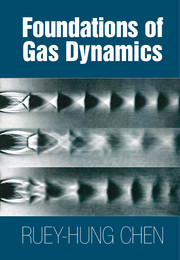

Foundations of Gas Dynamics covers supersonic and subsonic flow phenomena where compressibility of the fluid cannot be ignored. It finds application in jet and rocket propulsion systems as well as handling industrial gas flow at high speeds. Students and engineers in the mechanical, aerospace, and chemical disciplines will find it useful. It begins with basic concepts such as isentropic flows, shock, and supersonic expansion waves in one dimension. These are followed by one-dimensional flows with friction and heat exchange. Two-dimensional theory with small perturbations is presented, with its applications illustrated by supersonic airfoils. Method of characteristics is used for flows with two independent variables, either with two spatial coordinates or with time variations in one dimension. In later chapters, acoustic wave propagation, supersonic flow combustion, and unsteady shock formation are treated thoroughly. The book ends with a chapter on basic hypersonic flow, with a discussion of similarity rules.
'… the book can be attractive for lecturers, in particular because it contains numerous examples.'
Sergey Utyuzhnikov Source: The Aeronautical Journal
Loading metrics...
* Views captured on Cambridge Core between #date#. This data will be updated every 24 hours.
Usage data cannot currently be displayed.
This section outlines the accessibility features of this content - including support for screen readers, full keyboard navigation and high-contrast display options. This may not be relevant for you.
Accessibility compliance for the PDF of this book is currently unknown and may be updated in the future.
