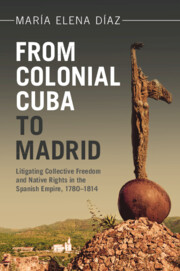
From Colonial Cuba to Madrid examines the largest and most complex freedom suit litigated in the highest court of the Spanish empire at the end of the eighteenth century. Filed by hundreds of re-enslaved Afro descendant people who had lived in quasi-freedom in eastern Cuba for more than a century, this action drew on local customary practices and broader cultural, political, and legal discourses rooted in the Spanish Atlantic world to put forward novel claims to collective freedom and native based rights at a time when questions of slavery, freedom, and citizenship were igniting in many parts of the Atlantic world. Intersecting law, society studies, and the history of slavery, María Elena Díaz offers a carefully researched study of one of the few communities of Afro descendants that managed to secure freedom and political and legal recognition from the Spanish crown during the colonial period.
'A startlingly original study of more than a thousand freed persons, former royal slaves who were re-enslaved and then litigated for their liberty. Díaz investigates the unusual legal arguments these men and women, through their Black advisors and representatives, deployed to present themselves as a free people, native to a free Black town, within the context of the Bourbon Enlightenment. Continuing her compelling microhistory of the people of El Cobre, Díaz reminds us that there is still much to learn from enslaved and free Black litigants in the Spanish empire.'
Karen Graubart - author of Republics of Difference: Religious and Racial Self-Governance in the Spanish Atlantic World
‘Nine content chapters explore tensions over collective freedom, pueblo rights, and who could claim ‘nativeness’ - a concept dating as far back as the Siete Partidas and elsewise with applicability in cases with Indigenous communities … This is a thorough, amply archival study that benefited from a collection of primary sources that is of quite atypical depth for a single community almost anywhere in this era. This account of how El Cobre used ‘triangulation of the conflict through litigation at the colonial and imperial levels’ to enable ‘a more complex political dynamic beyond the usual binary of colonizers and colonized or masters and slaves’ is a unique, tightly focused contribution.’
Charlton W. Yingling Source: Colonial Latin American Review
‘From Cuba to Madrid is an impressive contribution to the field of Latin American and Caribbean history, representing both a deepening and culmination of her life’s work. … The source material is extraordinary, and Díaz’s profound understanding of the context and characters results in a thorough analysis poised to make a lasting impact by pointing to new avenues in research on colonial and revolutionary Spanish America. … Díaz masterfully synthesizes, unpacks the discursive layers, and provides a deep reading of the memorials, the Council’s rulings, and their afterlives in Cuban local politics … Díaz’s book offers sharp insights into the historiographical implications concerning native rights, the abolition of slavery, and the emergence of Afro-descendant polities within the Spanish empire.’
Marcela Echeverri Source: The Americas
‘This is a remarkable book not only because of the events and materials it covers, but also because of the historian's decisions about how to structure and present them … Díaz's chapters make sure we are aware of the decisive factors that tipped the balance in the cobreros’ favor, the price they paid for it and the ambiguous aftermath of their victory (in a great final chapter) … the cobreros demanded the right to be a community, to land and to freedom by claiming being native to a place - a simple but daring gesture that threw a wrench into colonial Spanish legislation … Her closing with the work of Francia Márquez in Colombia is a reminder of the imperial and economic cycles that will continue to be challenged.’
Ivonne del Valle Source: International Journal of Maritime History
Loading metrics...
* Views captured on Cambridge Core between #date#. This data will be updated every 24 hours.
Usage data cannot currently be displayed.
This section outlines the accessibility features of this content - including support for screen readers, full keyboard navigation and high-contrast display options. This may not be relevant for you.
Accessibility compliance for the HTML of this book is currently unknown and may be updated in the future.
