Gateway to the Mediterranean

-
Select format
-
- Publisher:
- Cambridge University Press
- Publication date:
- 04 December 2025
- 16 October 2025
- ISBN:
- 9781009607292
- 9781009607261
- Dimensions:
- (229 x 152 mm)
- Weight & Pages:
- 0.476kg, 250 Pages
- Dimensions:
- Weight & Pages:
You may already have access via personal or institutional login
Show more authors 
You may already have access via personal or institutional login
Book description
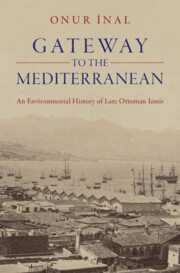
This in-depth exploration of Ottoman Izmir is the first book to study a Mediterranean port city through an environmental historical lens. Onur İnal documents the development of this major Eastern Mediterranean port-city from small coastal town, to transport hub, to a gateway linking the river valleys of Western Anatolia to worldwide markets. Key to this evolution, he argues, was the relationship between a city and countryside which not only shared a common past, but fundamentally reshaped each other during the years of the late Ottoman Empire. Introducing a cast of both human and non-human historical actors, including camels, horses and micro-organisms, İnal demonstrates the transformative impact of their interaction on the city and its hinterlands. By proposing the 'gateway city' model, this rich analysis provides an alternative way to understand the creation of an integrated economic and ecological space in Western Anatolia.
Reviews
‘This engaging study breathes life into Izmir’s rich history, inviting readers to savor the social and environmental aspects of this key port-city while exposing its regional significance. It is a welcome addition to Ottoman history and a valuable resource for anyone studying the historical dimensions of environment and empire.’
Andrea Duffy - Colorado State University
‘Onur İnal deftly recounts Izmir’s blossoming as a port city. He reveals how the sun-drenched slopes of its hinterland, fragrant with fig and grape, nurtured its growth and emanated its influence across the Mediterranean. A masterful exploration of the intricate dance between city and countryside.’
Faisal H. Husain - Penn State University
‘Izmir teems with life and possibility in this major new study. Onur İnal persuasively argues for viewing the late Ottoman city as an hourglass. Expansive trade with its all-important hinterland funnelled resources to the coast that then fanned out across Europe and the world, integrating Izmir into the nineteenth century’s globalizing currents and making it one of the most crucial entrepôts of the Eastern Mediterranean.’
Alan Mikhail - Yale University
Contents
Contents
Metrics
Full text views
Full text views helpTotal number of HTML views: 0
Total number of PDF views: 0 *
 Loading metrics...
* Views captured on Cambridge Core between #date#. This data will be updated every 24 hours.
Usage data cannot currently be displayed.
Accessibility standard: WCAG 2.2 AAA
Why this information is here
This section outlines the accessibility features of this content - including support for screen readers, full keyboard navigation and high-contrast display options. This may not be relevant for you.
Accessibility Information
The PDF of this book complies with version 2.2 of the Web Content Accessibility Guidelines (WCAG), offering more comprehensive accessibility measures for a broad range of users and attains the highest (AAA) level of WCAG compliance, optimising the user experience by meeting the most extensive accessibility guidelines.
Content Navigation
Table of contents navigation
Allows you to navigate directly to chapters, sections, or non‐text items through a linked table of contents, reducing the need for extensive scrolling.
Index navigation
Provides an interactive index, letting you go straight to where a term or subject appears in the text without manual searching.
Reading Order and Textual Equivalents
Single logical reading order
You will encounter all content (including footnotes, captions, etc.) in a clear, sequential flow, making it easier to follow with assistive tools like screen readers.
Short alternative textual descriptions
You get concise descriptions (for images, charts, or media clips), ensuring you do not miss crucial information when visual or audio elements are not accessible.
Full alternative textual descriptions
You get more than just short alt text: you have comprehensive text equivalents, transcripts, captions, or audio descriptions for substantial non‐text content, which is especially helpful for complex visuals or multimedia.
Visual Accessibility
Use of colour is not sole means of conveying information
You will still understand key ideas or prompts without relying solely on colour, which is especially helpful if you have colour vision deficiencies.
Use of high contrast between text and background colour
You benefit from high‐contrast text, which improves legibility if you have low vision or if you are reading in less‐than‐ideal lighting conditions.