
Skip to main content Accessibility help
×
  • Cited by 10
    • Show more authors
    • Access check Access
      You have digital access to this book
    • Select format
    • Publisher:
      Cambridge University Press
      Publication date:
      09 July 2024
      27 June 2024
      ISBN:
      9781108983624
      9781316518229
      Dimensions:
      (229 x 152 mm)
      Weight & Pages:
      0.572kg, 318 Pages
      Dimensions:
      Weight & Pages:
    Access check Access
    You have digital access to this book
    Selected: Digital
    Add to cart View cart Buy from Cambridge.org

    Book description

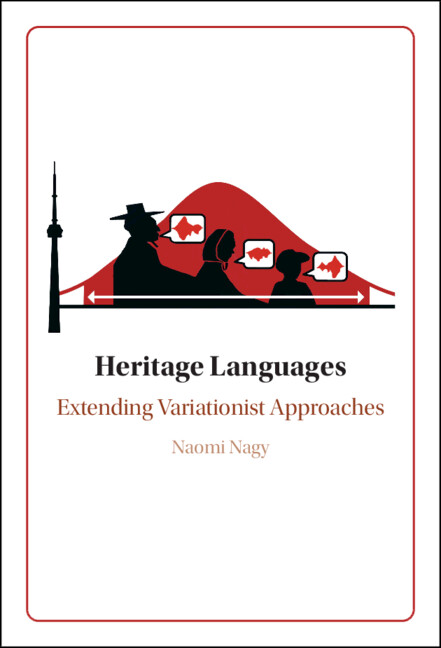
    Heritage language speakers often feel discouraged from using their heritage language because they are told they do not speak it well. This book offsets such views by investigating heritage language variation and change across generations in eight languages spoken in Toronto. It introduces new methodology to help readers understand and apply variationist sociolinguistic approaches to quantitatively analyze spontaneous speech. This approach, based on a corpus of 400+ speakers, shows that variation and change across the grammar of heritage languages resemble the patterns in hegemonic majority languages, contrasting with the simplification/attrition patterns in experimental heritage language studies. Chapters compare patterns across generations, across languages, across ten variables in Cantonese, and between indexical and non-indexical patterns. Heritage language speakers are quoted, showing that this research increases heritage language usage and pride. Providing a tool for language revitalization, this book is essential reading for anyone interested in learning about and/or conducting research on heritage languages.

    Refine List

    Actions for selected content:

    Select all | Deselect all
    • View selected items
    • Export citations
    • Download PDF (zip)
    • Save to Kindle
    • Save to Dropbox
    • Save to Google Drive

    Save Search

    You can save your searches here and later view and run them again in "My saved searches".

    Please provide a title, maximum of 40 characters.
    ×

    Contents

    • Heritage Languages
      pp i-ii
    • Heritage Languages - Title page
      pp iii-iii
    • Extending Variationist Approaches
    • Copyright page
      pp iv-iv
    • Epigraph
      pp v-vi
    • Contents
      pp vii-xii
    • Figures
      pp xiii-xiv
    • Tables
      pp xv-xvii
    • Acknowledgements
      pp xviii-xxi
    • Abbreviations
      pp xxii-xxiv
    • 1 - What Are Heritage Languages and Why Should We Study Them?
      pp 1-19
    • 2 - Experimental and Variationist Research on Heritage Languages
      pp 20-28
    • 3 - The Toronto Context
      pp 29-36
    • 4 - HLVC Methods and Tools
      pp 37-91
    • 5 - Cross-Variety Comparisons
      pp 92-158
    • 6 - Cross-Language Comparisons
      pp 159-166
    • 7 - Heritage Cantonese
      pp 167-191
    • A Case Study
    • 8 - Indexicality in Heritage Languages
      pp 192-205
    • 9 - Working with Heritage Languages in Linguistics Classes
      pp 206-241
    • 10 - What Heritage Language Speakers Tell Us about Language Variation and Change
      pp 242-254
    • Bibliography
      pp 255-282
    • Index
      pp 283-293

    Metrics

    Altmetric attention score

    Full text views

    Total number of HTML views: 0
    Total number of PDF views: 0 *
    Loading metrics...

    Book summary page views

    Total views: 0 *
    Loading metrics...

    * Views captured on Cambridge Core between #date#. This data will be updated every 24 hours.

    Usage data cannot currently be displayed.

    Accessibility standard: Unknown

    Why this information is here

    This section outlines the accessibility features of this content - including support for screen readers, full keyboard navigation and high-contrast display options. This may not be relevant for you.

    Accessibility Information

    Accessibility compliance for the HTML of this book is currently unknown and may be updated in the future.
