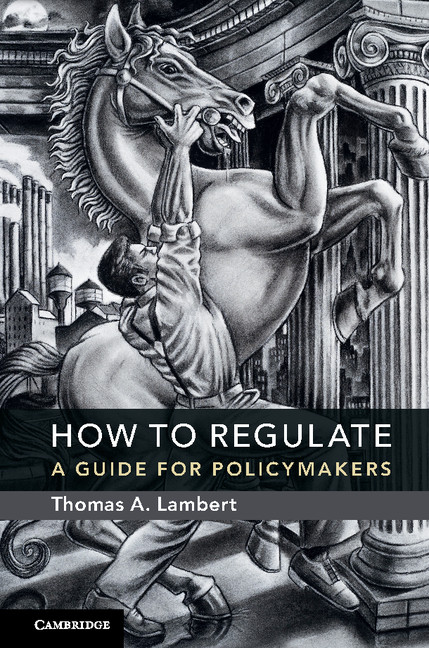

Markets sometimes fail. But so do regulatory efforts to correct market failures. Sometimes regulations reach too far, condemning good activities as well as bad, and sometimes they don't reach far enough, allowing bad behavior to persist. In this highly instructive book, Thomas A. Lambert explains the pitfalls of both extremes while offering readers a manual of effective regulation, showing how the best regulation maximizes social welfare and minimizes social costs. Working like a physician, Lambert demonstrates how regulators should diagnose the underlying disease and identify its symptoms, potential remedies for it, and their side effects before selecting the regulation that offers the greatest net benefit. This book should be read by policymakers, students, and anyone else interested in understanding how the best regulations are crafted and why they work.
'This may well be the best guide, ever, to the regulatory state. It’s brilliant, sharp, witty, and even-handed - and it’s so full of insights that it counts as a major contribution to both theory and practice. Indispensable reading for policymakers all over the world, and also for teachers, students, and all those interested in what the shouting is really about.'
Cass R. Sunstein - Robert Walmsley University Professor, Harvard University, Massachusetts, and former Administrator, White House Office of Information and Regulatory Affairs
'The title notwithstanding, this book will be valuable for all policy wonks, not just policymakers. It provides an organized and rigorous framework for analyzing whether and how inevitably imperfect regulation is likely to improve upon inevitably imperfect market outcomes.'
Douglas H. Ginsburg - Chief Judge, United States Court of Appeals for the District of Columbia Circuit
Loading metrics...
* Views captured on Cambridge Core between #date#. This data will be updated every 24 hours.
Usage data cannot currently be displayed.
This section outlines the accessibility features of this content - including support for screen readers, full keyboard navigation and high-contrast display options. This may not be relevant for you.
Accessibility compliance for the PDF of this book is currently unknown and may be updated in the future.
