
Skip to main content Accessibility help
×
  • Cited by 13
    • Show more authors
    • You may already have access via personal or institutional login
    • Select format
    • Publisher:
      Cambridge University Press
      Publication date:
      29 May 2019
      23 May 2019
      ISBN:
      9781108582995
      9781108730716
      Dimensions:
      Weight & Pages:
      Dimensions:
      (229 x 152 mm)
      Weight & Pages:
      0.15kg, 66 Pages
    • Series:
      Elements in Perception
    You may already have access via personal or institutional login
  • Selected: Digital
    Add to cart View cart Buy from Cambridge.org
    Series:
    Elements in Perception

    Book description

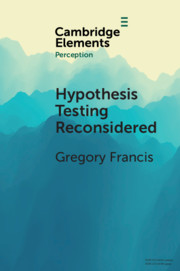
    Hypothesis testing is a common statistical analysis for empirical data generated by studies of perception, but its properties and limitations are widely misunderstood. This Element describes several properties of hypothesis testing, with special emphasis on analyses common to studies of perception. The author also describes the challenges and difficulties with using hypothesis testing to interpret empirical data. Many common applications of hypothesis testing inflate the intended Type I error rate. Other aspects of hypothesis tests have important implications for experimental design. Solutions are available for some of these difficulties, but many issues are difficult to deal with.

    References

    Banerjee, P., Chatterjee, P., & Sinha, J. (2012). Is it light or dark? Recalling moral behavior changes perception of brightness. Psychological Science, 23(4), 407409.
    Bem, D. J. (2011). Feeling the future: Experimental evidence for anomalous retroactive influences on cognition and affect. Journal of Personality and Social Psychology, 100, 407425.
    Benjamin, D. J., Berger, J. O., Johannesson, M., Nosek, B. A., Wagenmakers, E.-J., Berk, R.Johnson, V. E. (2018). Redefine statistical significance. Nature Human Behavior, 2, 610.
    Burnham, K. P., & Anderson, D. R. (2002). Model selection and multimodel inference: A practical information-theoretic approach (2nd ed.). New York: Springer.
    Chambers, C. D. (2013). Registered reports: A new publishing initiative at Cortex. Cortex, 49, 609610.
    Champely, S., Ekstrom, C., Dalgaard, P., Gill, J., Weibelzahl, S., Ford, C., & Volcic, R. (2018). Package ‘pwr’: Basic functions for power analysis.
    Cohen, J. (1988). Statistical power analysis for the behavioral sciences (2nd ed.). Hillsdale, NJ: Erlbaum.
    Cramer, D. J., van Ravenzwaaij, D., Matzke, D., Steingroever, H., Wetzels, R., Grasman, R. P.Wagenmakers, E.-J. (2016). Hidden multiplicity in exploratory multiway ANVOA: Prevalence and remedies. Psychonomic Bulletin & Review, 23(2), 640647.
    Cumming, G. (2014). The new statistics: Why and how. Psychological Science, 25(1), 729.
    Faul, F., Erdfelder, E., Lang, A.-G., & Buchner, A. (2007). G*Power3: A flexible statistical power analysis program for the social, behavioral, and biomedical sciences. Behavioral Research Methods, 39, 175191.
    Firestone, C., & Scholl, B. J. (2014). “Top-down” effects where none should be found: The El Greco fallacy in perception research. Psychological Science, 25(1), 3846.
    Francis, G. (2012). Too good to be true: Publication bias in two prominent studies from experimental psychology. Psychonomic Bulletin & Review, 19, 151156.
    Francis, G. (2014). The frequency of excess success for articles in Psychological Science. Psychonomic Bulletin & Review, 21, 11801187.
    Francis, G. (2018). IntroStats Online 2. Sage Publications. https://introstatsonline.com/
    Francis, G., & Neath, I. (2018). CogLab 5. Cengage Publishing. https://coglab.cengage.com/
    Francis, G., Tanzman, J., & Matthews, W. J. (2014). Excess success for psychology articles in the journal Science, PLOS One, 9(12), e114255. doi:10.1371/journal.pone.0114255
    Frick, R. W. (1998). A better stopping rule for conventional statistical tests. Behavior Research Methods, Instruments & Computers, 30, 690697.
    Gelman, A., & Loken, E. (2014). The statistical crisis in science. American Scientist 102, 460. doi:10.1511/2014.111.460
    Herzog, M. H., Francis, G., & Clarke, A. (in press). How to not lie with statistics: The essentials of statistics and experimental design for everyone with many examples from medicine and bioengineering. New York: Springer.
    Kerr, N. L. (1998). HARKing: Hypothesizing after the results are known. Personality and Social Psychology Review, 2, 196217.
    Kruschke, J. K. (2010). Bayesian data analysis. Wiley Interdisciplinary Reviews: Cognitive Science, 1(5), 658676. doi:10.1002/wcs.72
    Macmillan, N. A., & Creelman, C. D. (1991). Detection theory: A user’s guide. Cambridge: Cambridge University Press.
    McElreath, R. (2016). Statistical rethinking. Boca Raton, FL: CRC Press.
    Open Science Collaboration. (2015). Estimating the reproducibility of psychological science. Science, 349 0.1126/science.aac4716
    R core team. (2017). R: A language and environment for statistical computing. Vienna, Austria: R Foundation for Statistical Computing. www.r-project.org/
    Rouder, J. N., & Haaf, J. M. (2018). Power, dominance, and constraint: A note on the appeal of different design traditions. Advances in Methods and Practices in Psychological Science, 1(1), 1926.
    Schimmack, U. (2012). The ironic effect of significant results on the credibility of multiple study articles. Psychological Methods, 17(4), 551566.
    Simonsohn, U., Nelson, L. D., & Simmons, J. P. (2014). p-curve and effect size: Correcting for publication bias using only significant results. Perspectives on Psychological Science, 9(6) 666681.
    Smith, P. L., & Little, D. R. (2018). Small is beautiful: In defense of the small-N design. Psychonomic Bulletin & Review, 25(6), 20832101.
    Stefanucci, J. K., & Geuss, M. N. (2009). Big people, little world: The body influences size perception. Perception, 38, 17821795.
    Ueno, T., Fastrich, G. M., & Murayama, K. (2016). Meta-analysis to integrate effect sizes within an article: Possible misuse and Type I error inflation. Journal of Experimental Psychology: General, 5, 643654.
    van Assen, M. A. L. M., van Aert, R. C. M., & Wicherts, J. M. (2015). Meta-analysis using effect size distributions of only statistically significant studies. Psychological Methods, 20(3), 293309.
    Wagenmakers, E.-J., Wetzels, R., Borsboom, D., van der Maas, H. L. J., & Kievit, R. A. (2012). An agenda for purely confirmatory research. Perspectives on Psychological Science, 7, 632638.
    Wolfe, J. M. (2013). Registered reports and replications in Attention, Perception, & Psychophysics [Editorial]. Attention, Perception, & Psychophysics, 75, 781783.

    Metrics

    Altmetric attention score

    Full text views

    Total number of HTML views: 0
    Total number of PDF views: 0 *
    Loading metrics...

    Book summary page views

    Total views: 0 *
    Loading metrics...

    * Views captured on Cambridge Core between #date#. This data will be updated every 24 hours.

    Usage data cannot currently be displayed.

    Accessibility standard: Unknown

    Why this information is here

    This section outlines the accessibility features of this content - including support for screen readers, full keyboard navigation and high-contrast display options. This may not be relevant for you.

    Accessibility Information

    Accessibility compliance for the PDF of this book is currently unknown and may be updated in the future.
