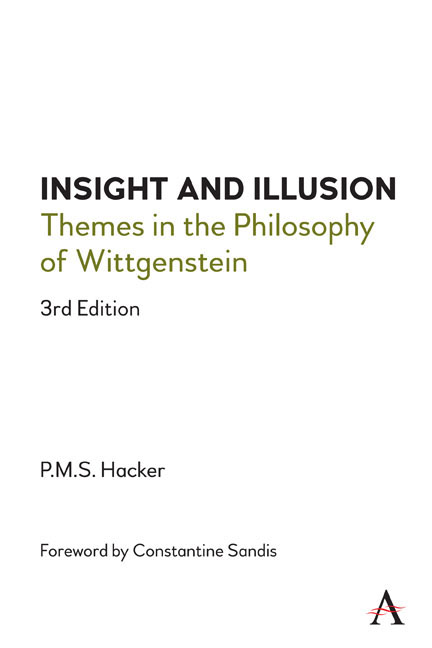
Insight and Illusion

-
Select format
-
- Publisher:
- Anthem Press
- Publication date:
- 24 February 2022
- 26 February 2021
- ISBN:
- 9781785276842
- 9781785276835
- Dimensions:
- Weight & Pages:
- Dimensions:
- Weight & Pages:
- Subjects:
- Twentieth-Century Philosophy, Philosophy
You may already have access via personal or institutional login- Subjects:
- Twentieth-Century Philosophy, Philosophy
Show more authors 
You may already have access via personal or institutional login
Book description
Insight and Illusion is a thoroughly comprehensive examination of the evolution of Wittgenstein's thought from the Tractatus to his later 'mature' phase. This is a reprint of the revised and corrected 1989 edition, with a new foreword by Constantine Sandis. Hacker’s book is now widely regarded as the best single volume study covering both the 'early' and the 'later' Wittgenstein. Until this third edition, the book had been out of print for twenty-five years.
The portable guide takes the reader through the major themes and concepts in Wittgenstein's works. In the name of exhaustiveness, these include: the so-called picture theory of meaning; the say/show distinction; the principle of verification; anti-metaphysics; anti-scientism; tautologies; the nature of mathematical propositions; ordinary language and nonsense; the law of the excluded middle; the Augustinian picture of language; knowledge and certainty; explanation and understanding; volition and the will; the relation of meaning to use; ostensive definition; ownership of experience; the first-person pronoun; the inner/outer; philosophical psychology; anti-solipsism; forms of life; the so-called private language argument; the autonomy of grammar; language games; and rule-following.
In so doing, Hacker gives us a picture of Wittgenstein's intellectual development: from his early conception of philosophy (influenced by thinkers as varied as the likes of Schopenhauer, Hertz, Boltzmann, Frege, and Russell), through the 'middle period', which began with his return to philosophy in 1929, to his later work.
Contents
Contents
Metrics
Full text views
Full text views helpTotal number of HTML views: 0
Total number of PDF views: 0 *
 Loading metrics...
* Views captured on Cambridge Core between #date#. This data will be updated every 24 hours.
Usage data cannot currently be displayed.
Accessibility standard: Unknown
Why this information is here
This section outlines the accessibility features of this content - including support for screen readers, full keyboard navigation and high-contrast display options. This may not be relevant for you.
Accessibility Information
Accessibility compliance for the PDF of this book is currently unknown and may be updated in the future.