
Skip to main content Accessibility help
×
  • Cited by 6
    • Show more authors
    • You may already have access via personal or institutional login
    • Select format
    • Publisher:
      Cambridge University Press
      Publication date:
      05 October 2014
      29 September 2014
      ISBN:
      9781139093569
      9781107018921
      9781108455268
      Dimensions:
      (228 x 152 mm)
      Weight & Pages:
      0.51kg, 268 Pages
      Dimensions:
      (229 x 152 mm)
      Weight & Pages:
      0.43kg, 270 Pages
    You may already have access via personal or institutional login
  • Selected: Digital
    Add to cart View cart Buy from Cambridge.org

    Book description

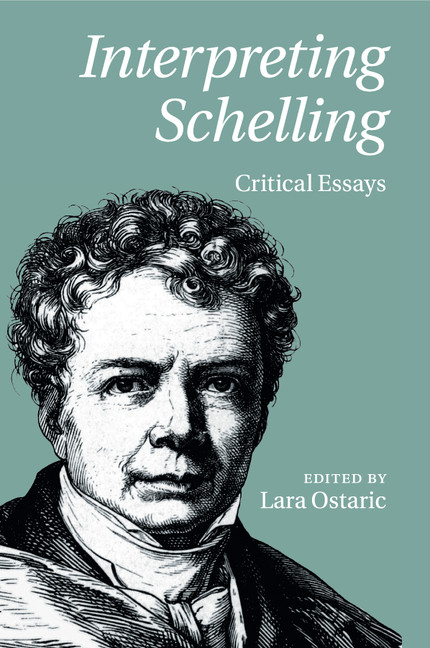
    This book is the first collection of essays on Schelling in English that systematically explores the historical development of his philosophy. It addresses all four periods of Schelling's thought: his Transcendental Philosophy and Philosophy of Nature, his System of Identity [Identitätsphilosophie], his System of Freedom, and his Positive Philosophy. The essays examine the constellation of philosophical ideas that motivated the formation of Schelling's thought, as well as those later ones for which his philosophy laid the foundation. They therefore relate Schelling's philosophy to a broad range of systematic issues that are of importance to us today: metaphysics, epistemology, aesthetics, ethics, our modern conceptions of individual autonomy, philosophy of history, philosophy of religion, political philosophy, and theology. The result is a new interpretation of Schelling's place in the history of German Idealism as an inventive and productive thinker.

    Reviews

    'Ostaric’s is a commendable, valuable source of thought-provoking interpretations of many of the philosophical topics with which Schelling engages. It is thus a welcome addition to the continuing Anglophone renaissance of German idealist studies.'

    G. Anthony Bruno Source: Critique

    Refine List

    Actions for selected content:

    Select all | Deselect all
    • View selected items
    • Export citations
    • Download PDF (zip)
    • Save to Kindle
    • Save to Dropbox
    • Save to Google Drive

    Save Search

    You can save your searches here and later view and run them again in "My saved searches".

    Please provide a title, maximum of 40 characters.
    ×

    Contents

    • Chapter 6 - “Identity of identity and non-identity”: Schelling’s path to the “absolute system of identity”
      pp 120-144
    • View abstract

      Summary

      This chapter presents an outline of Immanuel Kant's project in the Critique of Pure Reason and his views of reason and the unconditioned. It provides a sketch of the most basic features of Schelling's project as it is developed in the Form-Schrift, focusing on how his argument for several specific features of the first principle he identifies is based on Kant's considerations concerning the unconditioned. The chapter then focuses on the Ich-Schrift, noting the main ways in which it represents an advance over the Form-Schrift. It provides a closer analysis and evaluation of central features of Schelling's argument by responding to a series of objections raised by Dieter Henrich. Finally, the chapter shows that Kant's specific views on the unconditioned play a crucial and underappreciated role in the development of fundamental aspects of Schelling's early philosophy.
    • Chapter 7 - Idealism and freedom in Schelling’sFreiheitsschrift
      pp 145-159
    • View abstract

      Summary

      F.W.J. Schelling's precise ways of thinking about skepticism and about its relation to philosophy went through several rather dramatic shifts over the course of his career. This chapter sketches three different positions that Schelling adopted on this subject at different periods. The first of these is a Fichte-inspired position, during the period 1794-1800; the second a Hegel-inspired position, which he held briefly in 1802-3; and the third a Romanticism-inspired position, which he adopted around 1821. Schlegel's initial development of the ideas in question occurred mainly in the Lectures on Transcendental Philosophy that he delivered in Jena in 1800-1, and which Hegel attended. It is an interesting question to what extent Schelling's final philosophical position, the so-called Positive Philosophy that he developed during the last two decades of his life, is continuous with the quasi-Romantic position just described.
    • Chapter 8 - Beauty reconsidered: freedom and virtue in Schelling’s aesthetics
      pp 160-179
    • View abstract

      Summary

      This chapter summarizes section II of Immanuel Kant's dynamic conception of matter in the Metaphysical Foundations of Natural Science. It also summarizes Schelling's metaphysical construction of matter in the Ideas, which represents Schelling's initial thoughts on the concept of life. In the transcendental doctrine of method, Kant distinguishes philosophical cognition, which is rational cognition from concepts, from mathematical cognition, which follows from the construction of concepts. According to Kant, the Cartesian mathematical-mechanical mode of explanation seeks to explain all the properties and actions of matter by its purely geometrical properties. If Schelling's solution in the First Outline subdued his much stronger dogmatic claims in the Ideas and the World-Soul, it brought forth a new problem, namely, the conception of science as a body of knowledge not grounded on self-evident and absolutely necessary principles.
    • Chapter 9 - Nature and freedom inSchelling and Adorno
      pp 180-199
    • View abstract

      Summary

      Friedrich Schelling transformed Immanuel Kant's conception of aesthetic ideas as a form of free play with truth back into a more traditional conception of an apprehension of truth that is certainly different from other forms of cognition, but does not really involve an element of free play. Schelling's System of Transcendental Idealism of 1800 completed his first philosophical system, in which he presented the parallel disciplines of Philosophy of Nature and Transcendental Philosophy as coinciding and culminating in the philosophy of art. The task for uniting the two forms of thought conceived by Schelling to underlie nature on the one hand and our own knowledge and action on the other is to find something that makes manifest the original identity of the conscious with the unconscious activity. Schelling claims that beauty is the basic feature of every work of art.
    • Chapter 10 - Church and state: Schelling’s political philosophy of religion
      pp 200-215
    • View abstract

      Summary

      Reflection upon the relationship between the essence, the being, and the form of absolute identity reveals a crucial difference between the essential qualitative indifference of subjective and objective factors in absolute identity considered with respect to its Wesen or essence and the quantitative difference of these same factors that is implicit in its very form or mode of being. The uncompromising abolition of the opposition between thought and being, which is and has always been the goal of both theoretical cognition and practical striving is the starting point of F.W.J. Schelling's new Philosophy of Identity. Philosophy displays the same unity that mathematics does, the unity of the finite and the infinite, of being and of thinking, but it has the more difficult task of intuiting this unity immediately in the essence of the eternal itself and exhibiting it in reason.
    • Chapter 11 - Schelling’s critique of Hegel
      pp 216-237
    • View abstract

      Summary

      This chapter discusses which problem of modern philosophy Hegel and F.W.J. Schelling claim to have solved with their formula "the identity of identity and non-identity". It also discusses the stages through which Schelling's thinking, and following him that of Hegel, progressed, until he eventually reached his mature position, and which of the insights of his predecessors he incorporated into that position. It connects all the strands to bring out clearly the basic structure of Schelling's mature Philosophy of Identity. The chapter describes the reasons that eventually made Schelling unwilling to associate himself with the interpretation of his position his friend Hegel proposed. Plato's discussion of the world-soul and Immanuel Kant's concept of an organism were equally influential models for Schelling's theory of absolute spirit. Schelling didn't yet realize that Kant really took "being-at-the-same-time-cause-and-effect of itself" to be an idea, not a category.
    • Bibliography
      pp 238-250
    • View abstract

      Summary

      At the most general level of description, formal freedom as spontaneous self-determination on the basis of concepts of ends, the account that Schelling attributes to idealism is in fact common to Immanuel Kant and Fichte. Kant and Fichte shared a conception of substantive freedom as the autonomy of the rational will. The distinction between Kant's account and Fichte's is that the former understood substantive self-determination in terms of a law that rational agency gives itself, whereas the latter understood it in terms of an end that rational agency sets for itself. The idea that the exercise of human freedom is actually responsible for the introduction of chaos into the order of things, prefigured in Philosophy and Religion, is a staple of Schelling's late philosophy. But this view becomes dominant only with the Ages of the World drafts, and coexists in the Freiheitsschrift alongside remnants of Schelling's earlier view.

    Metrics

    Altmetric attention score

    Full text views

    Total number of HTML views: 0
    Total number of PDF views: 0 *
    Loading metrics...

    Book summary page views

    Total views: 0 *
    Loading metrics...

    * Views captured on Cambridge Core between #date#. This data will be updated every 24 hours.

    Usage data cannot currently be displayed.

    Accessibility standard: Unknown

    Why this information is here

    This section outlines the accessibility features of this content - including support for screen readers, full keyboard navigation and high-contrast display options. This may not be relevant for you.

    Accessibility Information

    Accessibility compliance for the HTML of this book is currently unknown and may be updated in the future.
