The Islamic Welfare State

-
Select format
-
- Publisher:
- Cambridge University Press
- Publication date:
- 30 April 2024
- 04 July 2024
- ISBN:
- 9781009268455
- 9781009268431
- Dimensions:
- (229 x 152 mm)
- Weight & Pages:
- 0.685kg, 320 Pages
- Dimensions:
- Weight & Pages:
You may already have access via personal or institutional login
Show more authors 
You may already have access via personal or institutional login
Book description
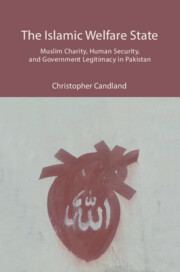
The Islamic Welfare State explains the relationship between government legitimacy, everyday security, and lived Islam in Pakistan—a major Muslim-majority country. Its humanitarian spirit makes Islam a compelling, community-strengthening faith that motivates people to provide essential services to the needy, to foster moral sentiments that build social solidarity, and to thereby challenge the legitimacy of government with its focus on 'protecting Islam' and 'national security' rather than enhancing the lives of ordinary people. The book surveys four kinds of Islamic charities—traditional, professional, partisan, and state. The focus is on ground realities, on the activities of welfare workers and beneficiaries, mostly patients and students from low-income families. The attention to the different political sentiments that different kinds of charity foster allows us to better understand politics and political change in Pakistan and across the Muslim world.
Reviews
‘Candland takes us on a transformative journey, weaving together heartfelt stories, deep research, and political understanding.’
Noryn Ali - former Secretary, Baithak Schools Network
‘Candland’s goodwill and sincerity gave him access to charitable activities across Pakistan, allowing him to see humanitarianism in practice.’
Qibla Ayaz - Chairman, Council of Islamic Ideology, Islamic Republic of Pakistan
‘A groundbreaking, thorough case study of Pakistan’s charitable work sector.’
Justin Christensen Source: Kirkus Reviews
‘… an important contribution to the study of charity, humanitarianism, and development in Pakistan. Candland rightfully pinpoints the fascinating contradictions between religious charity and state legitimacy, while leaving ample room for further inquiry. The book is a useful guide for scholars seeking a broad overview of Pakistan’s developmental context and prominent welfare organizations. It serves as a catalyst to provoke further discussion on the politics of charity in Pakistan and beyond.’
Salwa Tareen Source: Critical Pakistan Studies
‘This book is an important contribution to the study of charity, humanitarianism, and development in Pakistan. Candland rightfully pinpoints the fascinating contradictions between religious charity and state legitimacy, while leaving ample room for further inquiry. The book is a useful guide for scholars seeking a broad overview of Pakistan’s developmental context and prominent welfare organizations. It serves as a catalyst to provoke further discussion on the politics of charity in Pakistan and beyond.’
Salwa Tareen Source: Critical Pakistan Studies
Contents
Contents
Metrics
Altmetric attention score
Full text views
Full text views helpTotal number of HTML views: 0
Total number of PDF views: 0 *
 Loading metrics...
* Views captured on Cambridge Core between #date#. This data will be updated every 24 hours.
Usage data cannot currently be displayed.
Accessibility standard: Unknown
Why this information is here
This section outlines the accessibility features of this content - including support for screen readers, full keyboard navigation and high-contrast display options. This may not be relevant for you.
Accessibility Information
Accessibility compliance for the PDF of this book is currently unknown and may be updated in the future.