
Skip to main content Accessibility help
×
  • Cited by 7
    • Show more authors
    • You may already have access via personal or institutional login
    • Select format
    • Publisher:
      Cambridge University Press
      Publication date:
      05 December 2011
      01 December 2011
      ISBN:
      9781139015684
      9780521767811
      9781107676527
      Dimensions:
      (228 x 152 mm)
      Weight & Pages:
      0.64kg, 328 Pages
      Dimensions:
      (229 x 152 mm)
      Weight & Pages:
      0.479kg, 328 Pages
    • Subjects:
      Psychology, Cognition
    You may already have access via personal or institutional login
  • Selected: Digital
    Add to cart View cart Buy from Cambridge.org
    Subjects:
    Psychology, Cognition

    Book description

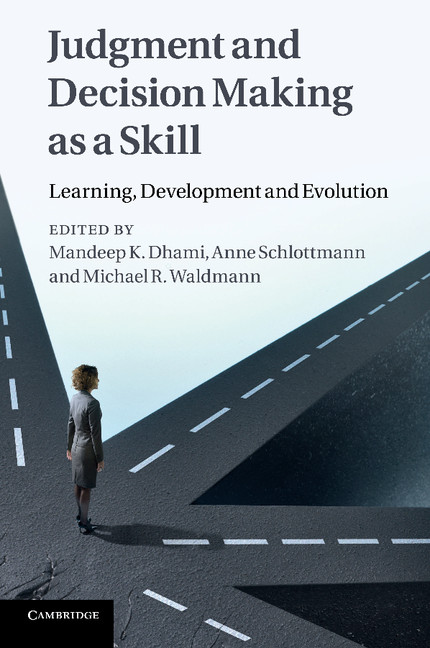
    This book presents a comprehensive review of both theories and research on the dynamic nature of human judgment and decision making (JDM). Leading researchers in the fields of JDM, cognitive development, human learning and neuroscience discuss short-term and long-term changes in JDM skills. The authors consider how such skills increase and decline on a developmental scale in children, adolescents and the elderly; how they may be learned; and how JDM skills can be improved and aided. In addition, beyond these behavioral approaches to understanding JDM as a skill, the book provides fascinating new insights from recent evolutionary and neuropsychological approaches. The authors identify opportunities for future research on the acquisition and changing nature of JDM. In a concluding chapter, eminent past presidents of the Society for Judgment and Decision Making provide personal reflections and perspectives on the notion of JDM as a dynamic skill.

    Reviews

    ‘Research on judgment and decision-making has been limited by a narrow focus on the content-blind rules of probability and utility with their assumptions of certainty. Exploring far beyond these limits, this informative volume demonstrates that there is more to good judgment than probability: it investigates rules of conversation, evolved capacities, smart heuristics, and other skills that can deal effectively with the uncertainty in our world.’

    Gerd Gigerenzer - Director of the Center for Adaptive Behavior and Cognition (ABC) and Director of the Harding Center for Risk Literacy, Max Planck Institute for Human Development

    ‘This work presents pioneering chapters on an emerging perspective of Judgment Decision as a learned skill that begins early in childhood and keeps developing throughout the life span. This conceptual liberation from the long-dominant static concepts of rationality and biases leads into the real world of Judgment Decision - motivated and dynamic.’

    Norman Henry Anderson - Distinguished Professor Emeritus, University of California, San Diego

    '… Dhami, Schlottmann and Waldmann have produced an important [book]. There is a lot of original thinking and new evidence here that has the potential to move the field of JDM into the front line of psychological science …'

    Joachim I. Krueger Source: American Journal of Psychology

    Refine List

    Actions for selected content:

    Select all | Deselect all
    • View selected items
    • Export citations
    • Download PDF (zip)
    • Save to Kindle
    • Save to Dropbox
    • Save to Google Drive

    Save Search

    You can save your searches here and later view and run them again in "My saved searches".

    Please provide a title, maximum of 40 characters.
    ×

    Contents

    Metrics

    Altmetric attention score

    Full text views

    Total number of HTML views: 0
    Total number of PDF views: 0 *
    Loading metrics...

    Book summary page views

    Total views: 0 *
    Loading metrics...

    * Views captured on Cambridge Core between #date#. This data will be updated every 24 hours.

    Usage data cannot currently be displayed.

    Accessibility standard: Unknown

    Why this information is here

    This section outlines the accessibility features of this content - including support for screen readers, full keyboard navigation and high-contrast display options. This may not be relevant for you.

    Accessibility Information

    Accessibility compliance for the PDF of this book is currently unknown and may be updated in the future.
