
Skip to main content Accessibility help
×
  • Cited by 16
    • Show more authors
    • You may already have access via personal or institutional login
    • Select format
    • Publisher:
      Cambridge University Press
      Publication date:
      30 May 2022
      23 June 2022
      ISBN:
      9781009037013
      9781009016971
      Dimensions:
      Weight & Pages:
      Dimensions:
      (229 x 152 mm)
      Weight & Pages:
      0.12kg, 76 Pages
    You may already have access via personal or institutional login
  • Selected: Digital
    Add to cart View cart Buy from Cambridge.org

    Book description

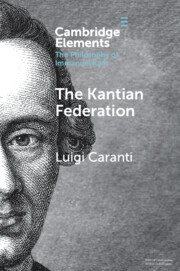
    This Element introduces the reader to Kant's theory of peace and to its place in the broader context of the critical philosophy. It also delves into one aspect of the model that has generated much debate among interpreters, given Kant's changing thoughts on the matter. This aspect relates to the nature and powers of the international federation. Defending the idea that national sovereignty is indissolubly linked to states' full autonomy regarding the use of military power, this Element offers an interpretation and defense of the Kantian federation that, in many regards, departs from the mainstream reading. Special emphasis is placed on the problematic coexistence of two conflicting theoretical desiderata: on the one hand, the necessity of establishing an international institution with coercive powers for securing peace; on the other hand, the necessity of avoiding the risk of an excessive erosion of states' sovereignty.

    References

    Anderson-Gold, S. (2006). Cosmopolitan Right Kant’s Key to Perpetual Peace. In Caranti, L., ed., Kant’s Perpetual Peace: New Interpretative Essays. Rome: Luiss University Press, pp. 137–47.
    Archibugi, D. (1995). Immanuel Kant, Cosmopolitan Law, and Peace. European Journal of International Relations, 1(4), 429–56.
    Archibugi, D. (2008). The Global Commonwealth of Citizens: Toward Cosmopolitan Democracy. Princeton, NJ: Princeton University Press.
    Archibugi, D. & Beetham, D. (1998). Diritti umani e democrazia cosmopolita. Milan: Feltrinelli.
    Axinn, S. (1989). Kant on World Government. In Funcke, G. and Seebohm, T. M., eds., Proceedings: Sixth International Kant Congress: Washington, DC: University Press of America, pp. 243–51.
    Bobbio, N. (2005). Introduzione. In Kant, I, ed., Per la pace perpetua. Rome: Editori Riuniti, pp. xxxv.
    Brito Vieira, M. (2017). Introduction. In Brito Vieira, M, ed., Reclaiming Representation. London: Routledge, pp. 121.
    Brown, G. W. (2005). State Sovereignty, Federation and Kantian Cosmopolitanism. European Journal of International Relations, 11(4), 495522. DOI:https://doi.org/10.1177/1354066105057898.
    Brown, G. W. (2009). Grounding Cosmopolitanism: From Kant to the Idea of a Cosmopolitan Constitution. Edinburgh: Edinburgh University Press.
    Bull, H. (1977). The Anarchical Society: A Study of Order in World Politics. London: Macmillan.
    Byrd, B. S. & Hruschka, J. (2010). Kant’s Doctrine of Right: A Commentary. Cambridge: Cambridge University Press.
    Caranti, L. (2006). Perpetual War for Perpetual Peace? Reflections on the Realist Critique of Kant’s Project. Journal of Human Rights, 18(3), 2345.
    Caranti., L. (2012). Kant’s Theory of Human Rights. In Cushman, T., ed., Handbook of Human Rights. Abingdon: Routledge, pp. 3544.
    Caranti, L. (2014). The Guarantee of Perpetual Peace: Three Concerns. In Goldman, A, Patrone, T.TT, & Formosa, P, eds., Politics and Teleology in Kant. Cardiff: University of Wales Press, pp. 145–62.
    Caranti, L. (2016). Kantian Peace and Liberal Peace: Three Concerns. Journal of Political Philosophy, 24(4), 446–69.
    Caranti, L. (2017a). Kant’s Politics Today: Human Rights, Peace, Progress. Cardiff: University of Wales Press.
    Caranti, L. (2017b). How Cosmopolitanism Reduces Conflict: Narrow and Broad Readings of Kant’s Third Ingredient for Peace. Journal of International Political Theory, 14(1), 118.
    Caranti, L. (2018). The Kantian Federation: Two Hermeneutical Problems. In Klemme, H. & Falduto, A., eds., Kant und seine Kritiker. Hildesheim: Olms Weidemann, pp. 347–62.
    Caranti, L. (2022). Kant via Rousseau against Democracy. In Caranti, L. & Pinzani, A., eds., Kant and the Problem of Politics in the Contemporary World. London: Routledge.
    Carson, Thomas L. (1988). Perpetual Peace. What Kant Should Have Said. Social Theory and Practice 14(2) (Summer), 173214.
    Cavallar, G. (1999). Kant and the Theory of Practice. Vienna: Böhlau.
    Cavallar, G. (2002). The Rights of Strangers: Theories of International Hospitality. New York: Routledge.
    Cavallar, G. (2015). Kant’s Embedded Cosmopolitanism: History, Philosophy and Education for World Citizens. Berlin: De Gruyter.
    Cavallar, G. (2020). Kant and the Theory and Practice of International Right. Cardiff: University of Wales Press.
    Cheneval, F. (2002). Philosophie in Weltbürgerlicher Bedeutung: Über die Entstehung und die Philosophischen Grundlagen des Supranationalen und Kosmopolitischen Denkens der Moderne. Basel: Schwabe.
    Christiano, T. (2015). Self-Determination and the Human Right to Democracy. In Cruft, R., Liao, M. S., & Renzo, M., eds., Philosophical Foundations of Human Rights. Oxford: Oxford University Press, pp. 459–80.
    Covell, C. (1998). Kant and the Law of Peace: A Study in the Philosophy of Law and International Relations, Houndmills: Macmillan-Saint Martin’s Press.
    Derrida, J. (2000). Of Hospitality. Stanford, CA: Stanford University Press.
    Doyle, M. W. (1983a). Kant, Liberal Legacies, and Foreign Affairs (Part I). Philosophy and Public Affairs, 12(3), 205–35.
    Doyle, M. W. (1983b). Kant, Liberal Legacies, and Foreign Affairs (Part II). Philosophy and Public Affairs, 12(4), 323–53.
    Doyle, M. W. (2012). Liberal Peace. Abingdon: Routledge.
    Ebbinghaus, J. (1968). Kants Lehre vom ewigen Frieden und die Kriegsschuldfrage. In Ebbinghaus, J, Gesammelte Aufsätze, Vorträge und Reden. Hildesheim: Olms.
    Eberl, O. & Niesen, P. (2011). Immanuel Kant: Zum ewigen Frieden und Auszüge aus der Rechtslehre: Kommentar. Berlin: Suhrkamp.
    Ferrara, A. & Michelman, F. I. (2022). Legitimation by Constitution. Oxford: Oxford University Press.
    Fichte, J. G. (1845–6). Zum Ewigen Frieden: Ein Philosophischer Entwurf von Immanuel Kant. In Fichte, I. H., ed., Sämmtliche Werke, 4 vols. Berlin: Veit & Comp.
    Fleischacker, S. (1996). Values behind the Market: Kant’s Response to the Wealth of Nations. History of Political Thought, 57, 379407.
    Flikschuh, K. (2010). Kant’s Sovereignty Dilemma: A Contemporary Analysis. The Journal of Political Philosophy, 18(4), 469–93.
    Friedrich, Carl J. (1948). Inevitable Peace. Cambridge, MA: Harvard University Press.
    Gallie, W. B. (1978). Philosophers of Peace and War: Kant, Clausewitz, Marx, Engels and Tolstoy. Cambridge: Cambridge University Press.
    Geismann, G. (1996). Kant on Eternal Peace. In Ballestrem, K. G., Gerhardt, V., Ottmann, H., and Thompson, M. P., eds., Politisches Denken Jahrbuch 1995/96. Stuttgart: J.B. Metzler. DOI:https://doi.org/10.1007/978-3-476-03633-9_11.
    Gerhardt, V. (1995). Immanuel Kants Entwurf “Zum Ewigen Frieden.” Darmstadt: Wissenschaftliche Buchgesellschaft.
    Gilens, M. & Page, B. I. (2017). Democracy in America? What Has Gone Wrong and What We Can Do About It. Chicago: University of Chicago Press.
    Gutmann, A. & Thompson, D. (2004). Why Deliberative Democracy? Princeton, NJ: Princeton University Press.
    Guyer, P. (2006). The Possibility of Perpetual Peace. In Caranti, L., ed., Kant’s Perpetual Peace: New Interpretative Essays. Rome: Luiss University Press, pp. 161–82.
    Guyer, P. (2019). Luigi Caranti’s Kant’s Political Legacy. Kantian Review, 24(2), 275–88.
    Habermas, J. (1998). The Inclusion of the Other: Studies in Political Theory. Cambridge, MA: MIT Press.
    Habermas, J. (2006). The Divided West. Cambridge, MA: Polity Press.
    Held, D. (1995). Democracy and the Global Order. Cambridge, MA: Polity Press.
    Hinsley, F. H. (1963). Power and Pursuit of Peace: Theory and Practice in the History of Relations between the States. Cambridge: Cambridge University Press.
    Höffe, O. (2004). Völkerbund oder Weltrepublik? In Höffe, O.. ed., Immanuel Kant: Zum Ewigen Frieden. Berlin: Akademie Verlag, pp. 109–32.
    Höffe, O. (2006). Kant’s Cosmopolitan Theory of Law and Peace. Cambridge: Cambridge University Press.
    Hueglin, T.O. & Fenna, A. (2015). Comparative Federalism. A Systematic Inquiry. Toronto: University of Toronto Press.
    International Commission on Intervention and State Sovereignty (ICISS). (2001). The Responsibility to Protect: Report of the International Commission on Intervention and State Sovereignty. Ottawa: International Development Research Centre for ICISS.
    Kersting, W. (1996). Weltfriedensordnung und globale Verteilungsgerechtigkeit: Kants Konzeption eines vollständigen Rechtsfriedens und diegegenwärtige politische Philosophie der internationalen Beziehungen. In Merkel, R. and Wittmann, R., eds., Zum ewigen Frieden: Grundlagen, Aktualität und Aussichten einer Idee von Immanuel Kant. Frankfurt: Suhrkamp, pp. 172212.
    Kleingeld, P. (2006). Kant’s Argument’s for the League of States. In Caranti, L., ed., Kant’s Perpetual Peace: New Interpretative Essays. Rome: Luiss University Press, pp. 5574.
    Kleingeld, P. (2011). Kant and Cosmopolitanism. Cambridge: Cambridge University Press.
    Losurdo, D. (1983). Autocensura e Compromesso nel Pensiero Politico di Kant. Naples: Istituto Italiano per gli Studi Filosofici, Bibliopolis.
    Ludwig, B. (2006). Condemned to Peace: What Does Nature Guarantee in Kant’s Treatise of Eternal Peace? In Caranti, L. (ed.), Kant’s Perpetual Peace: New Interpretative Essays. Rome: Luiss University Press, pp. 183–95.
    Lutz-Bachmann, M. (1997). Kant’s Idea of Peace and the Philosophical Conception of a World Republic. In Bohman, J. & Lutz-Bachman, M., eds., Perpetual Peace: Essays on Kant’s Cosmopolitan Ideal. Cambridge, MA: MIT University Press, pp. 5977.
    MacMillan, J. (1995). A Kantian Protest Against the Peculiar Discourse of Inter-Liberal State Peace. Millennium, 24(3), 549–62.
    Majone, G. (2009). Europe As the Would-Be World Power: The EU at Fifty. Cambridge, MA: Cambridge University Press.
    Manin, B. (1997). The Principles of Representative Government. Cambridge: Cambridge University Press.
    Marini, G. (1998). Il diritto cosmopolitico nel progetto kantiano per la pace perpetua con particolare riferimento al secondo articolo definitivo. In Marini, G, Tre studi sul cosmopolitismo. Pisa: Istituti Editoriali e Poligrafici Internazionali, pp. 2539.
    Marini, G. (2001). Per una repubblica federale mondiale. In Chiodi, G. M., Gatti, R., and Marini, G., eds., La filosofia politica di Kant: Seminarioperugino per lo studio dei classici. Milan: Angeli, pp. 1934.
    Mikalsen, K. K. (2019). Kantian Republicanism in the International Sphere: Equal Sovereignty As a Condition of Global Justice. In G. Brown, Wallace & Telegdi-Csetri, Á, eds., Kant’s Cosmopolitics: Contemporary Issues and Global Debates. Edinburgh: Edinburgh University Press, pp. 1526.
    Mori, M. (2008). La Pace e la Ragione: Kant e le Relazioni Internazionali. Politica, Diritto, Storia. Bologna: Il Mulino.
    Mulholland, L. A. (1987). Kant on War and International Justice. Kant Studien, 78, 2541.
    Nida-Rümelin, J. (1996). Ewiger Friede zwischen Moralismus und Hobbesianismus. In Merkel, R. & Wittmann, R., eds., Zum Ewiger Frieden: Grundlagen, Aktualität und Aussichten einer Idee von Immanuel Kant. Frankfurt: Suhrkamp, pp. 239–55.
    Philonenko, A. (1988). Kant et le problème de la paix. In Philonenko, A. (ed.), Essais sur la philosophie de la guerre. Paris: Vrin, pp. 2642.
    Pinzani, A. (2008). Representation in Kant’s Political Theory. In Joerden, J., Byrd, S., & Hruschka, J., eds., Jahrbuch für Recht und Ethik 16. Berlin: Duncker & Humblot, pp. 203–26.
    Pitkin, Hanna F. (1967). The Concept of Representation. Berkeley: University of California Press.
    Pogge, T. (2006). Kant’s Vision, Europe, and a Global Federation. In Caranti, L., ed., Kant’s Perpetual Peace: New Interpretative Essays. Rome: LUISS University Press, pp. 7596.
    Rawls, J. (1999). The Law of Peoples. Cambridge, MA: Harvard University Press.
    Ripstein, A. (2009). Force and Freedom. Totowa, NJ: Rowman & Littlefield.
    Ripstein, A. (2016). Just War, Regular War, and Perpetual Peace. Kant-Studien, 107(1), 179–95. DOI: https://doi.org/10.1515/kant-2016-0009
    Ripstein, A. (2021). Rules for Wrongdoers: Law, Morality, War. Oxford: Oxford University Press.
    Roff, H. M. (2015). Global Justice, Kant and the Responsibility to Protect: A Provisional Duty. London: Routledge.
    Rosato, S. (2011). Europe’s Troubles: Power Politics and the State of the European Project. International Security, 35(4), 4586.
    Rosen, A. D. (1993). Kant’s Theory of Justice. Ithaca, NY: Cornell University Press.
    Rosenbaum, D. E. (2004). A Closer Look at Cheney and Halliburton. The New York Times, September 28. www.nytimes.com/2004/09/28/us/a-closer-look-at-cheney-and-halliburton.html
    Russett, B. (2005). Bushwhacking the Democratic Peace. International Studies Perspectives, 6(4), 395408.
    Ruyssen, T. (1924). Les origines kantiennes de la société Des nations. Revue de Métaphysique et de Morale 31(2), 355–71.
    Taraborrelli, A. (2006). Reflections on Kant’s Third Definitive Article of “Perpetual Peace.” In Caranti, L., ed., Kant’s Perpetual Peace: New Interpretative Essays. Rome: LUISS University Press, pp. 133–42.
    Tesòn, F. (1992). The Kantian Theory of International Law. Columbia Law Review, 53, 53102.
    Thompson, K. (2008). Sovereignty, hospitality, and commerce: Kant and cosmopolitan right. Jahrbuch fur Recht und Ethik 16, 305–19.
    Urbinati, N. (2000). Representation as Advocacy: A Study of Democratic Deliberation. Political Theory, 28(6), 758–86.
    Williams, H. (1986). Kant’s Political Philosophy. New York: St. Martin’s Press.
    Williams, H. (1992). Kant’s Optimism in his Social and Political Theory. In Williams, H., ed., Essays on Kant’s Political Philosophy. Cardiff: University of Wales Press, pp. 114.
    Waldron, J. (2000) What is Cosmopolitan? Journal of Political Philosophy 8(2), 227–43.
    Wood, A. (1995). Kant’s Project for Perpetual Peace. In Robinson, H, ed., Proceedings of the Eighth International Kant Congress, Vol. 1. Milwaukee, WI: Marquette University Press, pp. 318.

    Metrics

    Altmetric attention score

    Full text views

    Total number of HTML views: 0
    Total number of PDF views: 0 *
    Loading metrics...

    Book summary page views

    Total views: 0 *
    Loading metrics...

    * Views captured on Cambridge Core between #date#. This data will be updated every 24 hours.

    Usage data cannot currently be displayed.

    Accessibility standard: Unknown

    Why this information is here

    This section outlines the accessibility features of this content - including support for screen readers, full keyboard navigation and high-contrast display options. This may not be relevant for you.

    Accessibility Information

    Accessibility compliance for the HTML of this book is currently unknown and may be updated in the future.
