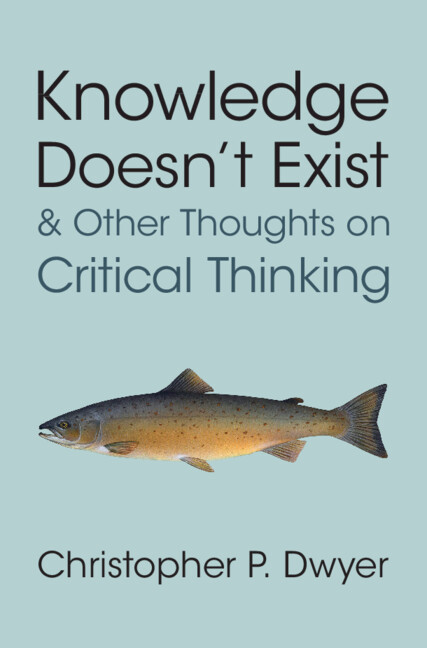
Knowledge Doesn't Exist and Other Thoughts on Critical Thinking

-
Select format
-
- Publisher:
- Cambridge University Press
- Publication date:
- 22 October 2025
- 21 August 2025
- ISBN:
- 9781009602754
- 9781009602730
- 9781009602723
- Dimensions:
- (229 x 152 mm)
- Weight & Pages:
- 0.441kg, 200 Pages
- Dimensions:
- (229 x 152 mm)
- Weight & Pages:
- 0.31kg, 200 Pages
- Subjects:
- Psychology, Cognition, Educational Psychology
You may already have access via personal or institutional login- Subjects:
- Psychology, Cognition, Educational Psychology
Show more authors 
You may already have access via personal or institutional login
Book description
Critical thinking (CT) is essential in education, the workplace, and everyday life, yet many struggle to understand or apply it effectively. This book breaks down the 'what, how, and when' of CT in a clear, accessible way, making it practical for readers from all walks of life. Drawing on over fifteen years of researching CT, Dwyer presents accessible evidence-based lessons and strategies for using CT in real-world situations, helping readers navigate the overwhelming flood of information we face daily. Written in an informal, engaging tone, this book makes CT approachable for anyone looking to improve their decision-making skills.
Reviews
Dwyer's book covers so much necessary information in such a compact format that one ends up thinking, ‘It really can't be that easy.' But it is. Dwyer goes right to the heart of the major issues involved in critical thinking, ranging into cognitive science, social psychology, the media, creativity, and more. It truly is a tour de force by an author who has thought long and hard about the knottiest problems in critical thinking.
John Eigenauer - Professor of Philosophy, Taft College
Contents
Contents
References
Metrics
Full text views
Full text views helpTotal number of HTML views: 0
Total number of PDF views: 0 *
 Loading metrics...
* Views captured on Cambridge Core between #date#. This data will be updated every 24 hours.
Usage data cannot currently be displayed.
Accessibility standard: Missing or limited accessibility features
Why this information is here
This section outlines the accessibility features of this content - including support for screen readers, full keyboard navigation and high-contrast display options. This may not be relevant for you.
Accessibility Information
The HTML of this book is known to have missing or limited accessibility features. We may be reviewing its accessibility for future improvement, but final compliance is not yet assured and may be subject to legal exceptions. If you have any questions, please contact accessibility@cambridge.org.
Content Navigation
Table of contents navigation
Allows you to navigate directly to chapters, sections, or non‐text items through a linked table of contents, reducing the need for extensive scrolling.
Index navigation
Provides an interactive index, letting you go straight to where a term or subject appears in the text without manual searching.
Reading Order and Textual Equivalents
Single logical reading order
You will encounter all content (including footnotes, captions, etc.) in a clear, sequential flow, making it easier to follow with assistive tools like screen readers.
Short alternative textual descriptions
You get concise descriptions (for images, charts, or media clips), ensuring you do not miss crucial information when visual or audio elements are not accessible.
Full alternative textual descriptions
You get more than just short alt text: you have comprehensive text equivalents, transcripts, captions, or audio descriptions for substantial non‐text content, which is especially helpful for complex visuals or multimedia.
Visual Accessibility
Use of colour is not sole means of conveying information
You will still understand key ideas or prompts without relying solely on colour, which is especially helpful if you have colour vision deficiencies.
Use of high contrast between text and background colour
You benefit from high‐contrast text, which improves legibility if you have low vision or if you are reading in less‐than‐ideal lighting conditions.