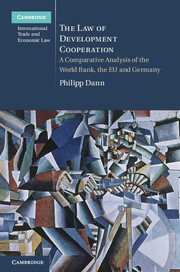
The Law of Development Cooperation

-
Select format
-
- Publisher:
- Cambridge University Press
- Publication date:
- 05 December 2013
- 07 November 2013
- ISBN:
- 9781139097130
- 9781107020290
- Dimensions:
- (228 x 152 mm)
- Weight & Pages:
- 0.97kg, 604 Pages
- Dimensions:
- Weight & Pages:
You may already have access via personal or institutional login
Show more authors 
You may already have access via personal or institutional login
Book description
Development interventions are agreed by states and international organisations which administer public development funds of huge proportions. They have done so with debatable success, but, unlike the good governance of recipients, the rules applying to donors have hitherto received little scrutiny. This analysis of the normative structures and conceptual riddles of development co-operation argues that development co-operation is increasingly structured by legal rules and is therefore no longer merely a matter of politics, economics or ethics. By focusing on the rules of development co-operation, it puts forward a new perspective on the institutional law dealing with the process, instruments and organisation of this co-operation. Placing the law in its theoretical and political context, it provides the first comparative study on the laws of foreign aid as a central field of global public policy and asks how accountability, autonomy and human rights can be preserved while combating poverty.
Reviews
'The Law of Development Cooperation can justly be celebrated as the ‘state of art’ of legal reasoning. Every single page of the book is stimulating and full of insights valuable to both development practitioners and legal scholars alike. On the conceptual level, the construction of a multi-layered legal field of development cooperation from an institutional perspective that focuses on the legal norms of donors seems highly plausible. It presents academics with a rich yet workable area for further research.'
Giedre Jokubauskaite Source: European Journal of International Law
Contents
Contents
Metrics
Altmetric attention score
Full text views
Full text views helpTotal number of HTML views: 0
Total number of PDF views: 0 *
 Loading metrics...
* Views captured on Cambridge Core between #date#. This data will be updated every 24 hours.
Usage data cannot currently be displayed.
Accessibility standard: Unknown
Why this information is here
This section outlines the accessibility features of this content - including support for screen readers, full keyboard navigation and high-contrast display options. This may not be relevant for you.
Accessibility Information
Accessibility compliance for the PDF of this book is currently unknown and may be updated in the future.