
Skip to main content Accessibility help
×
  • Cited by 73
    • Show more authors
    • You may already have access via personal or institutional login
    • Select format
    • Publisher:
      Cambridge University Press
      Publication date:
      05 June 2012
      09 February 2009
      ISBN:
      9780511809934
      9780521896474
      9780521721080
      Dimensions:
      (228 x 152 mm)
      Weight & Pages:
      0.66kg, 336 Pages
      Dimensions:
      (228 x 152 mm)
      Weight & Pages:
      0.45kg, 334 Pages
    You may already have access via personal or institutional login
  • Selected: Digital
    Add to cart View cart Buy from Cambridge.org

    Book description

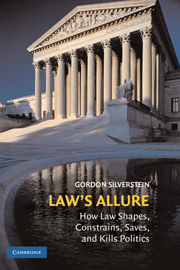
    Judicial and political power are inextricably linked in America, but by the time John Roberts and Samuel Alito joined the Supreme Court, that link seemed more important, more significant, and more pervasive than ever before. From war powers to abortion, from tobacco to integration, from the environment to campaign finance, Americans increasingly turn away from the political tools of negotiation, bargaining, and persuasion to embrace what they have come to believe is a more effective, more efficient, and even more just world of formal rules, automated procedures, litigation, and judicial decision-making. Using more than ten controversial policy case studies, Law's Allure: How Law Shapes, Constrains, Saves, and Kills Politics draws a roadmap to help politicians, litigators, judges, policy advocates, and those who study them understand the motives and incentives that encourage efforts to legalize, formalize, and judicialize the political process and American public policy, as well as the risks and rewards these choices can generate.

    Reviews

    Law’s Allure is a masterful treatment of the causes and consequences of the juridification of American politics. Beautifully written and displaying Silverstein’s encyclopedic knowledge of American constitutional law and practice, the book helps us understand how the courts can both enable and disable our politics under different circumstances. Silverstein integrates both abstract principle and bare-knuckle politics into the account, resulting in a volume that is at the same time profound and accessible. A major contribution that will enlighten both scholars and the informed public.”
    -- Tom Ginsburg, The University of Chicago Law School

    “Professor Silverstein provides an original and compelling analysis of the complex relationships between law and politics. His insights that juridification in the United States is on the rise, that juridification is more than government by judiciary, and that escaping from politics has numerous hidden costs are interesting, important and likely to provoke a good deal of conversation both within and without political science.”
    -- Mark Graber, University of Maryland

    “Gordon Silverstein has given us a superb analysis of juridification, the messy interaction of supposedly objective legal rules with partisan interests that often produce public policy. Through both general reasoning and close studies of specific cases, he demonstrates how these forces noisily, and sometimes angrily, engage to create not a seamless web but a jig-saw puzzle whose jagged pieces never fit neatly together. Neither students of public law nor public policy can afford to miss this splendid book.”
    -- Walter F. Murphy, Princeton University

    Law’s Allure is a breathtakingly good book. Tracing through a substantial number of important case studies ranging from abortion and school desegregation through campaign finance and environmental litigation to the tobacco cases and more, Gordon Silverstein gives us a new paradigm for thinking about the role of courts in American politics, one that is more complete, convincing, and persuasive than we have ever had before in a single volume.”
    -- Kim Lane Scheppele, Princeton University

    “A valuable contribution to the next generation of studies on constitutional politics. With well-chosen case studies and a useful analytical framework, Gordon Silverstein helps identify the whys, hows, and so-whats of interactions between politicians and judges in shaping public policy.”
    -- Mark Tushnet, Harvard Law School

    Law’s Allure: How Law Shapes, Contrains, Saves and Kills Politics provides an original and compelling analysis of the complex relationships between law and politics. Professor Silverstein’s insights that juridification in the United States is on the rise, that juridification is more than government by judiciary, and that this escape from politics has numerous hidden costs are interesting and important. The case studies are well written and informative, the research is solid, and the conclusions likely to provoke a good deal of conversation both within and without political science…Professor Silverstein provides a far more nuanced account of the relationship between law and politics than found in the existing political science literature.”
    Mark Graber, Balkinization blog

    "Students of both judicial process and public policy will find this well-written, fully documented book to be a worthwhile addition to their libraries. Recommended." - CHOICE

    "Silverstein ends his book by observing that the failure to fully recognize and understand the phenomenon of juridification and its consequences is in part a product of the "artificial divide that has grown up between those who study law and those who study government and politics"'5 (283). He argues that this divide has narrowed, but the two schools are still running on parallel tracks rather than working together to understand "how law and politics interact, shape, and frame each other" (284). Law's Allure does a fine job of bridging the gap between the two. It is not, as Silverstein rightly observes, "meant to be the last word on the subject" of juridification (285). And as Tocqueville's words illustrate, it is not the first word on the subject either. But it is a valuable addition to the conversation."
    Journal of Legal Education, Paul Horwitz

    "Through a discussion of the Supreme Court’s growing breadth of engagement with political policy-making and a series of careful case studies, Silverstein provides an insightful “roadmap” for future scholars interested in exploring the causes and consequences of judicial policy-making. Indeed, the analyses in this book should provide considerable grist for the mill as this line of literature moves forward."
    -Tom S. Clark, Emory University

    "Gordon Silverstein, a political scientist at Berkeley, has written a fine book about the “juridification” of American politics—the resort to Courts to settle issues that the political process, through electoral action, persuasion, bargaining and compromise, might have resolved...He does not take a simple view, falling prey to a one-dimensional judgment of which Branch is overreaching or displaced from its natural functions."
    -Bob Bauer, Chair of the Political Law Group of Perkins Coie LLP

    Refine List

    Actions for selected content:

    Select all | Deselect all
    • View selected items
    • Export citations
    • Download PDF (zip)
    • Save to Kindle
    • Save to Dropbox
    • Save to Google Drive

    Save Search

    You can save your searches here and later view and run them again in "My saved searches".

    Please provide a title, maximum of 40 characters.
    ×

    Contents

    Metrics

    Altmetric attention score

    Full text views

    Total number of HTML views: 0
    Total number of PDF views: 0 *
    Loading metrics...

    Book summary page views

    Total views: 0 *
    Loading metrics...

    * Views captured on Cambridge Core between #date#. This data will be updated every 24 hours.

    Usage data cannot currently be displayed.

    Accessibility standard: Unknown

    Why this information is here

    This section outlines the accessibility features of this content - including support for screen readers, full keyboard navigation and high-contrast display options. This may not be relevant for you.

    Accessibility Information

    Accessibility compliance for the PDF of this book is currently unknown and may be updated in the future.
