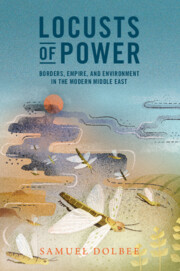
In this highly original environmental history, Samuel Dolbee sheds new light on borders and state formation by following locusts and revealing how they shaped both the environment and people's imaginations from the late Ottoman Empire to the Second World War. Drawing on a wide range of archival research in multiple languages, Dolbee details environmental, political, and spatial transformations in the region's history by tracing the movements of locusts and their intimate relationship to people in motion, including Arab and Kurdish nomads, Armenian deportees, and Assyrian refugees, as well as states of the region. With locusts and moving people at center stage, surprising continuities and ruptures appear in the Jazira, the borderlands of today's Iraq, Syria, and Turkey. Transcending approaches focused on the collapse of the Ottoman Empire or the creation of nation states, Dolbee provides a new perspective on the modern Middle East grounded in environmental change, state violence, and popular resistance.
Co-winner, 2024 Ottoman and Turkish Studies Book Prize, Ottoman and Turkish Studies Association
‘It turns out that the locust can speak and Samuel Dolbee tells us how. Grounded firmly in the fertile intersection of Ottoman, post-Ottoman and environmental studies, this book demonstrates how human-pesticide relationships shaped the transformation of Ottoman Jazira: from ‘desert’ to agricultural land; from a place for the sedenterization of nomads to one for the forced nomadization of sedentary populations for genocidal purposes, and how the same land then became parts of post-Ottoman Turkey, Iraq, and Syria. It will become a classic and deservedly so.’
Lerna Ekmekcioglu - Massachusetts Institute of Technology
‘In this deeply empirical and eloquent book, Samuel Dolbee offers a history of a part of the Middle East that scholars have missed (or ignored)-the Jazira. Following Dolbee following locusts across this landscape opens up modes of political and environmental analyses that point the way for future studies.’
Alan Mikhail - Yale University
‘A fascinating and compelling book that takes seriously both the neglected space of the Jazira and the locusts as actors.’
Jeanine E. Dağyeli Source: Agricultural History
‘… by tracing the movement of peoples and insects across this geographic region from 1858 to 1939, Dolbee reveals the Jazira’s place in Ottoman and Middle Eastern history while also describing the limits of state power, the increasing influence of market forces, and the productiveand destructive qualities of borders … Locusts of Power succeeds, and brilliantly so, in evoking the first terms of its subtitle - borders and empire.’
Dale J. Stahl Source: American Historical Review
‘A model for the integration of ecological and spatial themes with questions of nineteenth- and twentieth-century population movements, borders, and state making. Any of the chapters would be an excellent addition to syllabi on the late Ottoman Empire and interwar period, and the first chapter is a particularly strong illustration of how pastoralism as a socio-ecology interacted with broader economic and political currents of the mid-nineteenth century.’
Ethan Mefford Source: H-Net: Humanities and Social Science Online
Loading metrics...
* Views captured on Cambridge Core between #date#. This data will be updated every 24 hours.
Usage data cannot currently be displayed.
This section outlines the accessibility features of this content - including support for screen readers, full keyboard navigation and high-contrast display options. This may not be relevant for you.
Accessibility compliance for the PDF of this book is currently unknown and may be updated in the future.