Mediating Multiculturalism

-
Select format
-
- Publisher:
- Anthem Press
- Publication date:
- 21 August 2020
- 04 August 2020
- ISBN:
- 9781785273919
- 9781785273902
- Dimensions:
- Weight & Pages:
- Dimensions:
- Weight & Pages:
You may already have access via personal or institutional login
Show more authors 
You may already have access via personal or institutional login
Book description
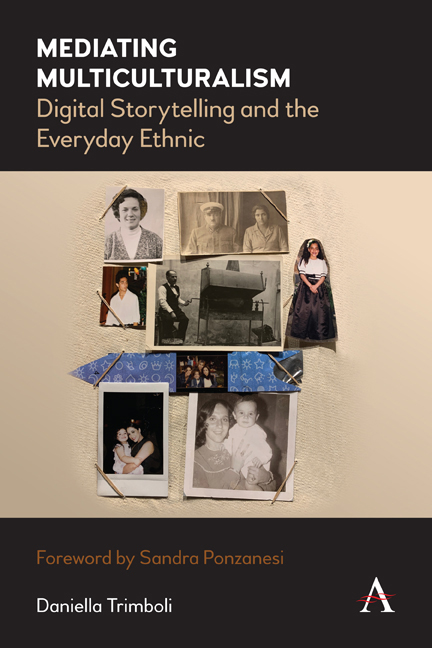
Using digital storytelling—a new media genre that began in California in the late 1990s and that proliferated across ‘the West’ in the 2000s—as a site of analysis, this book asks, ‘What is done in the name of the everyday?’ Like everyday multiculturalism, digital storytelling is promoted as an accessible, enabling, and ordinary phenomenon that represents cultural experience more accurately than official sites. As such, the genre frequently houses stories of migration, community, and ethnic and racial differences. In turn, digital story collections often act as digital monuments or repositories of multiculturalism, giving a digital life to narratives of migration, cultural difference, and national belonging. This is evidenced in one of the world’s largest public collections of digital stories, found in the Australian Centre for the Moving Image (ACMI) and referenced throughout this book.
Contents
Contents
Metrics
Full text views
Full text views helpTotal number of HTML views: 0
Total number of PDF views: 0 *
 Loading metrics...
* Views captured on Cambridge Core between #date#. This data will be updated every 24 hours.
Usage data cannot currently be displayed.
Accessibility standard: Unknown
Why this information is here
This section outlines the accessibility features of this content - including support for screen readers, full keyboard navigation and high-contrast display options. This may not be relevant for you.
Accessibility Information
Accessibility compliance for the PDF of this book is currently unknown and may be updated in the future.