
Skip to main content Accessibility help
×
  • Cited by 23
    • Show more authors
    • You may already have access via personal or institutional login
    • Select format
    • Publisher:
      Cambridge University Press
      Publication date:
      12 September 2019
      03 October 2019
      ISBN:
      9781108696517
      9781108498418
      9781108736022
      Dimensions:
      (228 x 152 mm)
      Weight & Pages:
      0.53kg, 292 Pages
      Dimensions:
      (228 x 152 mm)
      Weight & Pages:
      0.43kg, 292 Pages
    You may already have access via personal or institutional login
  • Selected: Digital
    Add to cart View cart Buy from Cambridge.org

    Book description

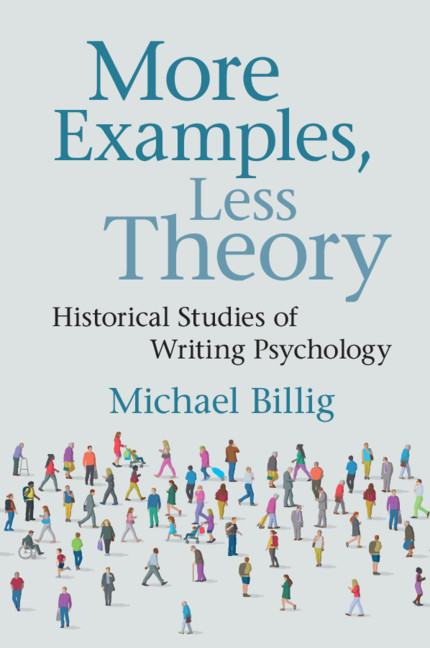
    In his new book, Michael Billig uses psychology's past to argue that nowadays, when we write about the mind, we should use more examples and less theory. He provides a series of historical studies, analysing how key psychological writers used examples. Billig offers new insights about famous analysts of the mind, such as Locke, James, Freud, Tajfel and Lewin. He also champions unfairly forgotten figures, like the Earl of Shaftesbury and the eccentric Abraham Tucker. There is a cautionary chapter on Lacan, warning what can happen when examples are ignored. Marie Jahoda is praised as the ultimate example: a psychologist from the twentieth century with a social and rhetorical imagination fit for the twenty-first. More Examples, Less Theory is an easy-to-read book that will inform and entertain academics and their students. It will particularly appeal to those who enjoy the details of examples rather than the simplifications of big theory.

    Reviews

    'In this highly readable work, Michael Billig makes a compelling argument that good examples do far more to advance and enliven theory than fancy jargon ever could. Students and seasoned writers of psychology will find inspiration in his engaging investigation into some of the most effective communicators in psychology's past.'

    Alexandra Rutherford - York University, Toronto

    'A common tendency of psychologists is to describe phenomena through the lens of their own pre-existing theories, thus making phenomena resemble their theories rather than vice versa. In this book, Michael Billig argues for a fundamental reversal of psychology’s methodological habits, emphasising the value of ‘particularising’ psychological insights through the use of richly detailed examples, thus subsuming the general within the specific rather than the opposite. It is a lesson that could invigorate psychology, underscoring how the use of concrete examples helps us see and empathise and remember in ways that theoretical accounts rarely do. Through various case studies, Billig shows how we can learn as well as teach by example.'

    David E. Leary - University of Richmond

    'The truth is in the details, not in abstract theory. In his new book, Michael Billig shows us how examples can lead to a better understanding of psychological issues. Analysing the thinking and writing of eminent psychologists, he offers the reader a rich and intriguing alternative history of psychology.'

    Ruud Abma - Universiteit Utrecht, the Netherlands

    'This thought-provoking and important book by one of the principal scholars in contemporary psychology and social science makes a strong case for investigating human lives as they are lived, rather than searching for universally applicable theories by means of narrowly controlled experimental research.'

    Christine Griffin - University of Bath

    'Billig insists that examples are in rhetorical tension to theory. Here there is something gently subversive about More Examples, [Less Theory]. For the book is not just about writing or the use of examples. It is also a scornful critique of that most sacred of modern academic shibboleths: doing theory and being theoretical.'

    Michael Marinetto Source: Times Higher Education

    ‘Michael Billig’s book puts many basic psychological ideas and approaches in their time and place and describes the minds, personalities, situations and histories of their protagonists. It helps the reader to see where psychology had come from, and why it is like it is. At the end Billig adds a few modest but welcome recommendations for young psychologists. I hope this book becomes a standard text for psychologists early in their studies. I for one should have been greatly helped if Michael Billig’s book had been available when I started out.'

    John Richer Source: Human Ethology

    ‘Starting with the examples of nine very different writers, he selects an exemplary work from each of them and discusses the use (or sometimes neglect) of examples within that work. Furthermore, since most of the chapters are based on material presented in Billig's previously published works, they provide examples of one thoughtful scholar's concerns and interests over a long and productive career.’

    Raymond E. Fancher Source: Journal of the History of the Behavioral Sciences

    Refine List

    Actions for selected content:

    Select all | Deselect all
    • View selected items
    • Export citations
    • Download PDF (zip)
    • Save to Kindle
    • Save to Dropbox
    • Save to Google Drive

    Save Search

    You can save your searches here and later view and run them again in "My saved searches".

    Please provide a title, maximum of 40 characters.
    ×

    Contents

    Metrics

    Altmetric attention score

    Full text views

    Total number of HTML views: 0
    Total number of PDF views: 0 *
    Loading metrics...

    Book summary page views

    Total views: 0 *
    Loading metrics...

    * Views captured on Cambridge Core between #date#. This data will be updated every 24 hours.

    Usage data cannot currently be displayed.

    Accessibility standard: Unknown

    Why this information is here

    This section outlines the accessibility features of this content - including support for screen readers, full keyboard navigation and high-contrast display options. This may not be relevant for you.

    Accessibility Information

    Accessibility compliance for the PDF of this book is currently unknown and may be updated in the future.
