
Skip to main content Accessibility help
×
  • Cited by 72
    • Show more authors
    • You may already have access via personal or institutional login
    • Select format
    • Publisher:
      Cambridge University Press
      Publication date:
      04 May 2010
      30 November 2009
      ISBN:
      9780511691850
      9780521895255
      9781107403239
      Dimensions:
      (228 x 152 mm)
      Weight & Pages:
      0.63kg, 376 Pages
      Dimensions:
      (229 x 152 mm)
      Weight & Pages:
      0.5kg, 376 Pages
    You may already have access via personal or institutional login
  • Selected: Digital
    Add to cart View cart Buy from Cambridge.org

    Book description

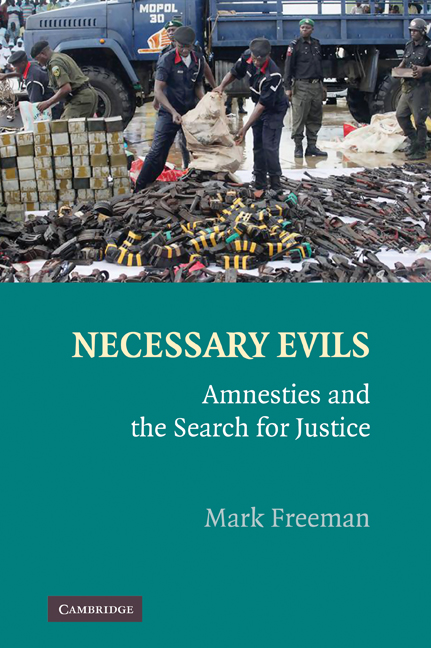
    This book is about amnesties for grave international crimes that states adopt in moments of transition or social unrest. The subject is naturally controversial, especially in the age of the International Criminal Court. The goal of this book is to reframe and revitalise the global debate on the subject and to offer an original framework for resolving amnesty dilemmas when they arise. Most literature and jurisprudence on amnesties deal with only a small subset of state practice and sidestep the ambiguity of amnesty's position under international law. This book addresses the ambiguity head on and argues that amnesties of the broadest scope are sometimes defensible when adopted as a last recourse in contexts of mass violence. Drawing on an extensive amnesty database, the book offers detailed guidance on how to ensure that amnesties extend the minimum leniency possible, while imposing the maximum accountability on the beneficiaries.

    Reviews

    "The widespread myth that amnesty is contrary to international law is convincingly debunked by Mark Freeman in this fine study. An experienced practitioner of transitional justice, his analysis is compelling, constructive and, above all, practical.
    --William A. Schabas, Director, Irish Centre for Human Rights, National University of Ireland, Galway

    ‘Necessary evils’ is an original, daring, deep and inventive account of what is currently seen as a devil’s choice in dealing with a painful past. The book makes a dramatic difference in our understanding of amnesty in the aftermath of civil war and brutal repression. It forces practitioners and academics alike to forge a new model of transitional justice in our times."
    --Luc Huyse, Professor Emeritus of Leuven University (Belgium)

    "To call publicly for amnesty in the aftermath of mass atrocity is anathema to international human rights NGOs, whose activists demand extensive criminal prosecutions. Freeman’s field experience in many countries enables him to build a compelling case for greater legal flexibility in accommodating a variety of post-conflict contingencies; these often display moral ambiguities, he shows, resistant to the simpler, earnest urgings of international treaties. A valuable read for anyone concerned with the moral, legal, and political complexities of transitional justice throughout the world..."
    --Mark Osiel, Aliber Family Chair in Law, University of Iowa

    "In Necessary Evils, Mark Freeman draws on his considerable experience as both a scholar and practitioner of transitional justice to produce a detailed, original and thought-provoking account of the role of amnesties in responding to mass atrocity. His meticulous research, drawing on a large selection of amnesty laws, provides one of the most well-reasoned and nuanced analyses of the international legal regime relating to amnesties that I have read. His book is particularly valuable, however, as it goes beyond legalistic investigations to explore the current international political landscape in which decisions on amnesty laws are being made, and in particular, it provides an in-depth and fascinating critique of the position of the United Nations on amnesties. I have no doubt Necessary Evils will become a valuable resource for academics and practitioners working in the fields of transitional justice, conflict transformation and international criminal law."
    --Dr Louise Mallinder, Lecturer in Human Rights and International Law, Transitional Justice Institute, University of Ulster

    "Freeman is an engaging writer who, while clearly an advocate for amnesties, provides a holistic analysis of current amnesty trends. He carefully constructs a book that links the academic insights to thorough and insightful application."
    Human Rights Brief, Anna Maitland, American University

    Refine List

    Actions for selected content:

    Select all | Deselect all
    • View selected items
    • Export citations
    • Download PDF (zip)
    • Save to Kindle
    • Save to Dropbox
    • Save to Google Drive

    Save Search

    You can save your searches here and later view and run them again in "My saved searches".

    Please provide a title, maximum of 40 characters.
    ×

    Contents

    Metrics

    Altmetric attention score

    Full text views

    Total number of HTML views: 0
    Total number of PDF views: 0 *
    Loading metrics...

    Book summary page views

    Total views: 0 *
    Loading metrics...

    * Views captured on Cambridge Core between #date#. This data will be updated every 24 hours.

    Usage data cannot currently be displayed.

    Accessibility standard: Unknown

    Why this information is here

    This section outlines the accessibility features of this content - including support for screen readers, full keyboard navigation and high-contrast display options. This may not be relevant for you.

    Accessibility Information

    Accessibility compliance for the PDF of this book is currently unknown and may be updated in the future.
