
Skip to main content Accessibility help
×
  • Cited by 42
    • Show more authors
    • Open Access
      You have digital access to this book
    • Select format
    • Publisher:
      Cambridge University Press
      Publication date:
      10 December 2020
      21 January 2021
      ISBN:
      9781108866804
      9781108791908
      Creative Commons:
      Creative Common License - CC Creative Common License - BY Creative Common License - NC Creative Common License - ND
      This content is Open Access and distributed under the terms of the Creative Commons Attribution licence CC-BY-NC-ND 4.0.
      https://creativecommons.org/creativelicenses
      Dimensions:
      Weight & Pages:
      Dimensions:
      (178 x 127 mm)
      Weight & Pages:
      0.14kg, 128 Pages
    Open Access
    You have digital access to this book
    Selected: Digital
    View content
    Add to cart View cart Buy from Cambridge.org

    Book description

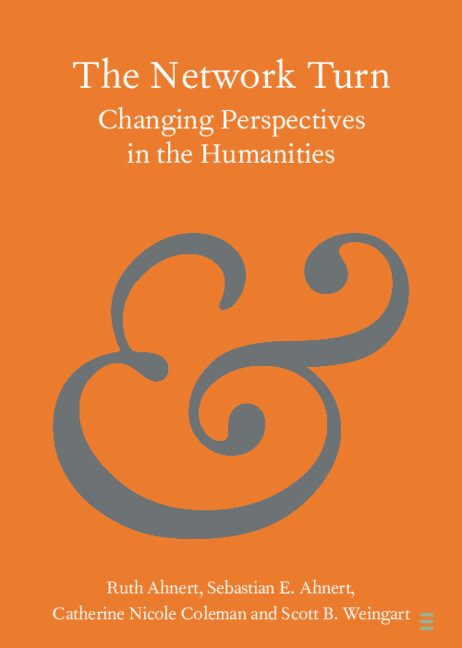
    We live in a networked world. Online social networking platforms and the World Wide Web have changed how society thinks about connectivity. Because of the technological nature of such networks, their study has predominantly taken place within the domains of computer science and related scientific fields. But arts and humanities scholars are increasingly using the same kinds of visual and quantitative analysis to shed light on aspects of culture and society hitherto concealed. This Element contends that networks are a category of study that cuts across traditional academic barriers, uniting diverse disciplines through a shared understanding of complexity in our world. Moreover, we are at a moment in time when it is crucial that arts and humanities scholars join the critique of how large-scale network data and advanced network analysis are being harnessed for the purposes of power, surveillance, and commercial gain. This title is also available as Open Access on Cambridge Core.

    Bibliography

    Abbot, A. (2014). Humanity’s cultural history captured in 5-minute film. Nature News, 31 July. Available at: www.nature.com/news/humanity-s-cultural-history-captured-in-5-minute-film-1.15650.
    Adamic, L., Lento, T., Adar, E., & Ng, P. C. (2016). Information evolution in social networks. Proceedings of the Ninth ACM International Conference on Web Search and Data Mining, 473–82.
    Ahn, Y., Ahnert, S. E., Bagrow, J. P., & Barabási, A. (2011). Flavor network and the principles of food pairing. Scientific Reports, 1, article 196.
    Ahnert, R. & Ahnert, S. E. (2015). Protestant letter networks in the reign of Mary I: A quantitative approach. English Literary History, 82, 133.
    Ahnert, R. & Ahnert, S. E. (2019). Metadata, surveillance and the Tudor state. History Workshop Journal, 87, 2751.
    Ahnert, R. & Ahnert, S. E. (forthcoming). Tudor Networks of Power. Oxford: Oxford University Press.
    Ariew, R. (1992). Descartes and the Tree of Knowledge. Synthese, 92, 101–16.
    Bacon, F. (1640). Of the Advancement and Proficiencie of Learning, or, The Partitions of Sciences, IX Bookes. Oxford: Printed by Leon Lichfield printer to the University, for Robert Young and Edward Forrest.
    Ball, J., Borger, J., & Greenwald, G. (2013). Revealed: How US and UK spy agencies defeat internet privacy and security. Guardian, 6 September. Available at: www.theguardian.com/world/2013/sep/05/nsa-gchq-encryption-codes-security.
    Barabási, A. (2002). Linked: The New Science of Networks. Cambridge, MA: Perseus.
    Barabási, A. & Albert, R. (1999). Emergence of scaling in random networks. Science, 286, 5439.
    Bastian, M., Heymann, S., & Jacomy, M. (2009). Gephi: An open source software for exploring and manipulating networks. Proceedings of the Third International ICWSM Conference, 361–2.
    Boldizzoni, F. (2011). The Poverty of Clio: Resurrecting Economic History. Princeton, NJ: Princeton University Press.
    Borgatti, S. P. (2005). Centrality and network flow. Social Networks, 27, 5571.
    Box, G. E. P. (1979). Robustness in the strategy of scientific model building. In Launer, R. L. & Wilkinson, G. N., eds., Robustness in Statistics. New York: Academic Press, 5.1.
    Broido, A. D. & Clauset, A. (2019). Scale-free networks are rare. Nature Communications, 10, 1017.
    Buurma, R. S. & Heffernan, L. (2018). Search and replace: Josephine Miles and the origins of distant reading. Modernism/modernity, 3(1). Available at: https://modernismmodernity.org/forums/posts/search-and-replace.
    Callon, M. (1984). Some elements of a sociology of translation: Domestication of the scallops and the fishermen of St Brieuc Bay. Sociological Review, 32, 196233.
    Caviglia, G. & Coleman, N. (2016). Idiographic network visualisations. Leonardo, 49(5), 447–447.
    Coleman, C. N. (2020). Seeking the eye of history: The design of digital tools for Enlightenment studies. In Burrows, S. & Roe, G., eds., Digitizing Enlightenment: Digital Humanities and the Transformation of Eighteenth-Century Studies. Oxford University Studies in the Enlightenment. Liverpool: Liverpool University Press,
    Coleridge, S. T. (1817). Lay Sermon Addressed to the Higher and Middle Classes on the Existing Distresses and Discontents. London: Printed for Gale and Fenner.
    Da, N. Z. (2019). The computational case against computational literary studies. Critical Inquiry, 45, 601–39.
    Daston, L. J. (2008). On scientific observation. Isis, 99, 97110.
    Deleuze, G. & Guattari, F. (1980). Capitalisme et Schizophrénie 2. Mille Plateaux.Paris: Minuit.
    Diminescu, D. (2012). Introduction: Digital methods for the exploration, analysis and mapping of e-diasporas. Social Science Information, 51(4), 451–8.
    Drucker, J. (2011). Humanities approaches to graphical display. Digital Humanities Quarterly, 5(1). Available at: www.digitalhumanities.org/dhq/vol/5/1/000091/000091.html.
    Drucker, J. (2014). Graphesis: Visual Forms of Knowledge Production. Cambridge, MA: Harvard University Press.
    Drucker, J. (2017). Why distant reading isn’t. PMLA, 132, 628–35.
    Duncan, C. A., Eppstein, D., Goodrich, M. T., Kobourov, S. G., & Nöllenburg, M. (2010). Lombardi drawings of graphs. In Brandes, U. & Cornelsen, S., eds., Graph Drawing 2010: Lecture Notes in Computer Science, vol. 6502. Berlin: Springer, 195207.
    Düring, M. (2016). How reliable are centrality measures for data collected from fragmentary and heterogeneous historical sources? A case study. In Brughmans, T., Collar, A., & Coward, F. S., eds., The Connected Past: Challenges to Network Studies in Archaeology and History. Oxford: Oxford University Press, 85102.
    Edelstein, D., Findlen, P., Ceserani, G., Winterer, C., & Coleman, N. (2017). Historical research in a digital age: Reflections from the Mapping the Republic of Letters Project. American Historical Review, 122, 400–24.
    Ferguson, N. (2017). The Square and the Tower: Networks, Hierarchies and the Struggle for Global Power. London: Penguin UK, Allen Lane Imprint.
    Fish, S. (ongoing). Opinionator blog. New York Times. Available at: https://opinionator.blogs.nytimes.com.
    Fogel, R. W. & Engerman, S. L. (1974). Time on the Cross: The Economics of American Negro Slavery. London: Little, Brown.
    Freeman, L. C. (1977). Set of measures of centrality based on betweenness. Sociometry, 40, 3541.
    Freeman, L. C. (2004). The Development of Social Network Analysis: A Study in the Sociology of Science. Vancouver: Empirical Press.
    Fry, B. (2007). Visualizing Data: Exploring and Explaining Data with the Processing Environment. Sebastopol, CA: O’Reilly Media.
    Fry, B. (2016). Learning from Lombardi. Medium. Available at: https://medium.com/@ben_fry/learning-from-lombardi-a28032a7eb5.
    Galison, P. (1997). Image and Logic: A Material Culture of Microphysics. Chicago: University of Chicago Press.
    Gorman, M. E. (2010). Trading Zones and Interactional Expertise: Creating New Kinds of Collaboration. Cambridge, MA: MIT Press.
    Graham, S., Milligan, I., & Weingart, S. (2015). Exploring Big Historical Data: The Historian’s Macroscope. London: Imperial College Press.
    Graham, S. & Weingart, S. (2015). The equifinality of archaeological networks: An agent-based exploratory lab approach. Journal of Archaeological Method and Theory, 22, 248–74.
    Grandjean, M. (2015). Social network analysis and visualisation: Moreno’s Sociograms revisited. Available at: www.martingrandjean.ch/social-network-analysis-visualization-morenos-sociograms-revisited/.
    Goldstone, P. (2015). The artist who obsessed the FBI. The Daily Beast, 13 December. Available at: www.thedailybeast.com/the-artist-who-obsessed-the-fbi.
    Guare, J. (1990). Six Degrees of Separation: A Play. New York: Vintage Books.
    Guldi, J. & Armitage, D. (2014). The History Manifesto. Cambridge: Cambridge University Press.
    Gutman, H. (1975). Slavery and the Numbers Games. Urbana: University of Illinois Press.
    Healy, K. (2015). The performativity of networks. European Journal of Sociology, 56, 175205.
    Hobbs, R. (2003). Mark Lombardi: Global Networks. New York: Independent Curators.
    Holme, P. (2019). Rare and everywhere: Perspectives on scale-free networks. Nature Communications, 10, 1016.
    Holme, P., Kim, B. J., Yoon, C. N., & Han, S. K. (2002). Attack vulnerability of complex networks. Physical Review E, 65, 056109.
    Holme, P. & Saramäki, J. (2013). Temporal Networks. Cham: Springer.
    Holme, P. & Saramäki, J. (2019). Temporal Network Theory. Cham: Springer.
    Hunt, T. (1846). Unity of the Iron Network; Showing How the Last Argument for the Break of Gauge, Competition, Is at Variance with the True Interests of the Public. London: Smith Elder and Company.
    Hyvönen, E., Ahnert, R., Ahnert, S. E., Tuominen, J., Mäkelä, F. , Lewis, M. , & Filarski, G. (2019). Reconciling metadata. In Hotson, H. & Wallnig, T., eds., Reassembling the Republic of Letters in the Digital Age: Standards, Systems, Scholarship. Gottingen: Gottingen University Press, 223–36.
    Kapferer, B. (1972). Strategy and Transaction in an African factory. Manchester: Manchester University Press.
    Karinthy, F. (1929). ‘Chain-Links’. Translated by A. Makkai and edited by E. Jankó. Available at: https://djjr-courses.wdfiles.com/local–files/soc180%3Akarinthy-chain-links/Karinthy-Chain-Links_1929.pdf.
    Klein, L. (2018). Distant reading after Moretti. Available at: http://lklein.com/2018/01/distant-reading-after-moretti/.
    Krebs, V. E. (2001). Mapping networks of terrorist cells. Connections, 24(3), 4352.
    Kruja, E., Marks, J., Blair, A., & Waters, R. (2002). A short note on the history of graph drawing. In Mutzel, P., Jünger, M., & Leipert, S., eds., Graph Drawing: 9th International Symposium, GD 2001 Vienna, Austria, September 23–26, 2001. Berlin: Springer, 272–86.
    Lakoff, G. & Johnson, M. (1980). Metaphors We Live By. Chicago: Chicago University Press.
    Lakoff, G. & Núñez, R. E. (2000). Where Mathematics Comes From: How the Embodied Mind Brings Mathematics into Being. New York: Basic Books.
    Larrington, C. (2008).Review of Constructing Nations, Reconstructing Myth: Essays in Honour of T. A. Shippey. Modern Language Review, 103, 1087–8.
    Laterza, V. (2018). Cambridge Analytica, independent research and the national interest. Anthropology Today, 34, 12.
    Latour, B. (1993). The Pasteurisation of France. Translated by Alan Sheridan. Cambridge, MA: Harvard University Press.
    Latour, B. (2005). Reassembling the Social: An Introduction to Actor-Network-Theory. Oxford: Oxford University Press.
    Lima, M. (2011). Visual complexity. Available at: www.visualcomplexity.com.
    Lombardi, M. (2001), The ‘Offshore’ phenomenon: Dirty banking in a brave new world. Cabinet, 2. Available at: www.cabinetmagazine.org/issues/2/dirtybanking.php.
    MacCarron, P. & Kenna., R. (2012). Universal properties of mythological networks. EPL, 99, 28002.
    McLean, C. & Hassard, J. (2004). Symmetrical absence/symmetrical absurdity: Critical notes on the production of actor-network accounts. Journal of Management Studies, 41(3),493519.
    Meirelles, I. (2018). Visualizing information. In Flanders, J. & Jannidis, F., eds., The Shape of Data in the Digital Humanities: Modeling Texts and Text-Based Resources. Abingdon: Routledge, 167–77.
    Michel, J.-B., Shen, Y. K., & Aiden, A. P., Veres, A. , Gray, M. K., The Google Books Team, Pickett, J. P., Hoiberg, D., Clancy, D., Norvig, P., Orwant, J. Pinker, S., Nowak, M. A., & Erez Lieberman, A. (2011). Quantitative analysis of culture using millions of digitised books. Science, 331, 176–82.
    Milgram, S. (1967). The small world problem. Psychology Today, 2, 60–7.
    Mol, A. (2010) Actor-network theory: Sensitive terms and enduring tensions. Kölner Zeitschrift für Soziologie und Sozialpsychologie, 50, 253–69.
    Moreno, J. [& Jennings, H. H. ] (1953). Who Shall Survive? Foundations of Sociometry, Group Psychotherapy and Sociodrama. 2nd ed. New York: Beacon House.
    Moretti, F. (2011). Network theory, plot analysis. Literary Lab Pamphlet 2.https://litlab.stanford.edu/LiteraryLabPamphlet2.pdf
    Otlet, P. (1918). Transformations operées dans l’appareil bibliographique des sciences. Revue Scientifique, 58, 236–41.
    Pechenick, E. A., Danforth, C. M., & Dodds, P. S. (2015). Characterizing the Google Books corpus: Strong limits to inferences of socio-cultural and linguistic evolution. PLoS ONE, e0137041.
    Pinski, G. & Narin, F. (1976). Citation influence for journal aggregates of scientific publications: Theory, with application to the literature of physics. Information Processing & Management, 12, 297312.
    Pitts, F. R. (1965). A graph-theoretic approach to historical geography. Professional Geographer, 17, 1520.
    Price, D. J. de Solla (1965). Networks of scientific papers: The pattern of bibliometric references indicates the nature of the scientific research front. Science, 149, 510–15.
    Radden, G. (2002). How metonymic are metaphors? In Barcelona, A., ed., Metaphor and Metonymy at the Crossroads: A Cognitive Perspective. Berlin: Mouton de Gruyter, 93108.
    Rawson, K. & Muñoz, T. (2019). Against cleaning. In Gold, M. K. & Klein, L. F., eds., DH Debates 2019. Minneapolis: University of Minnesota Press. Available at: https://dhdebates.gc.cuny.edu/projects/debates-in-the-digital-humanities-2019.
    Ray, D. & Robson, A. (2018). Certified random: A new order for coauthorship. American Economic Review, 108, 489520.
    Rendgen, S. & Weidemann, J. (2012). Information Graphics. Cologne: Taschen.
    Rosenberg, D. (2013). Data before the fact. In Gitelman, L., ed., ‘Raw Data’ Is an Oxymoron. Cambridge, MA: MIT Press, 1540.
    Rosenberg, D. (2016). Against infographics. Art Journal, 75. Available at: http://artjournal.collegeart.org/?p=6993.
    Ryan, Y. C. (2018). More difficult from Dublin than from Dieppe. Media History, 24, 458–76.
    Saaty, T. (1977). A scaling method for priorities in hierarchical structures. Journal of Mathematical Psychology, 15, 234–81.
    Schich, M., Song, C., Ahn, Y.-Y., Mirsky, A. , Martino, M. , Barabási, A.-L., & Helbing, D. (2014). A network framework of cultural history. Science, 345, 558–62.
    Smiraglia, R. P. & Van den Heuvel, C. (2011). Idea collider: From a theory of knowledge organisation to a theory of knowledge interaction. Bulletin of the American Society for Information Science and Technology, 37(4), 43–7.
    Snow, C. P. (1998). The Two Cultures. With an introduction by Stefan Collini. Cambridge: Cambridge University Press.
    So, R. J. & Long, H. (2013). Network analysis and the sociology of modernism. boundary 2, 40, 147–82.
    Squire, M. & Elsner, J. (2016). Sight and memory: The visual art of Roman mnemonics. In Squire, M., ed., Sight and the Ancient Senses. Abingdon: Routledge, 180204.
    Svensson, P. (2012). Beyond the big tent. In Gold, M. K., ed., Debates in the Digital Humanities. Minneapolis: University of Minnesota Press, 3649.
    Terras, M. & Nyhan, J. (2016). Father Busa’s female punch card operatives. In Gold, M. K. & Klein, L. F., eds., Debates in the Digital Humanities 2016. Minneapolis: University of Minnesota Press, 60–5.
    Trompf, G. W. (2011). The classification of the sciences and the quest for interdisciplinarity: A brief history of ideas from ancient philosophy to contemporary environmental science. Environmental Conservation, 38, 113–26.
    Tukey, J. W. (1977). Exploratory Data Analysis. Reading, PA: Addison-Wesley.
    Tversky, B. (2014). Visualizing thought. In Handbook of Human Centric Visualization. New York: Springer, 340.
    Tversky, B., & Suwa, M. (2009). Thinking with sketches. In Tools for Innovation. Oxford: Oxford University Press.
    Uboldi, G., Caviglia, G., Coleman, N., Heymann, S. , Mantegari, G. , & Ciuccarelli, P. (2013). Knot: An interface for the study of social networks in the humanities. In Garzotto, F., Zancanaro, M., De Angeli, A., & Paternò, F., eds., Proceedings of the Biannual Conference of the Italian Chapter of SIGCHI: 2013, Trento, Italy : CHItaly ’13, article 15.
    Underwood, T. (2019a). Dear humanists: Fear not the digital revolution. The Chronicle of Higher Education, 27 March. Available at: www.chronicle.com/article/Dear-Humanists-Fear-Not-the/245987.
    Underwood, T. (2019b). Distant Horizons: Digital Evidence and Literary Change. Chicago: University of Chicago Press.
    Van den Heuvel, C. (2012). Multidimensional classifications: Past and future conceptualisations and visualisations. Knowledge Organisation, 39, 446–60.
    Venturini, T., Jacomy, M., & Jensen, P. (2019). What do we see when we look at networks/ An introduction to visual network analysis and force-directed layouts. Available at: https://ssrn.com/abstract=3378438.
    Vosoughi, S., Roy, D., & Aral, S. (2018). The spread of true and false news online. Science 359, 1146–51.
    Watts, D. J. (2004). Six Degrees: The Science of a Connected Age. London: Vintage.
    Watts, D. J. & Strogatz, S. H. (1998). Collective dynamics of ‘small-world’ networks. Nature, 393, 440–2.
    Weingart, S. (under review). The Networked Structure of Early Modern Science, Manuscript.
    Weingart, S. (2012). Networks demystified 3: The power law rant. Available at: http://scottbot.net/networks-demystified-3-the-power-law-rant/.
    Weingart, S. (2013). Networks demystified 8: When networks are inappropriate. Available at: http://scottbot.net/networks-demystified-8-when-networks-are-inappropriate/.
    Weingart, S. (2014a). The moral role of DH in a data-driven world. Available at: https://scottbot.net/networked-society/.
    Weingart, S. (2014b). Bridging token and type. Available at: https://scottbot.net/bridging-token-and-type/.
    Witmore, M. (2016). Latour, the digital humanities, and the divided kingdom of knowledge. New Literary History, 47, 353–75.
    Yeo, R. (1991). Reading encyclopedias: Science and the organisation of knowledge in British dictionaries of arts and sciences, 1730–1850. Isis, 82, 2449.
    Zachary, W. W. (1977). An information flow model for conflict and fission in small groups. Journal of Anthropological Research, 33, 452–73.

    Metrics

    Altmetric attention score

    Full text views

    Total number of HTML views: 0
    Total number of PDF views: 0 *
    Loading metrics...

    Book summary page views

    Total views: 0 *
    Loading metrics...

    * Views captured on Cambridge Core between #date#. This data will be updated every 24 hours.

    Usage data cannot currently be displayed.

    Accessibility standard: Unknown

    Why this information is here

    This section outlines the accessibility features of this content - including support for screen readers, full keyboard navigation and high-contrast display options. This may not be relevant for you.

    Accessibility Information

    Accessibility compliance for the PDF of this book is currently unknown and may be updated in the future.
