
Skip to main content Accessibility help
×
  • Cited by 3
      • Peter Tyrer, Emeritus, Imperial College of Science, Technology and Medicine, London
      Show more authors
    • You may already have access via personal or institutional login
    • Select format
    • Publisher:
      Cambridge University Press
      Publication date:
      29 September 2022
      20 October 2022
      ISBN:
      9781911623823
      9781911623656
      Dimensions:
      Weight & Pages:
      Dimensions:
      (234 x 156 mm)
      Weight & Pages:
      0.28kg, 152 Pages
    You may already have access via personal or institutional login
  • Selected: Digital
    Add to cart View cart Buy from Cambridge.org

    Book description

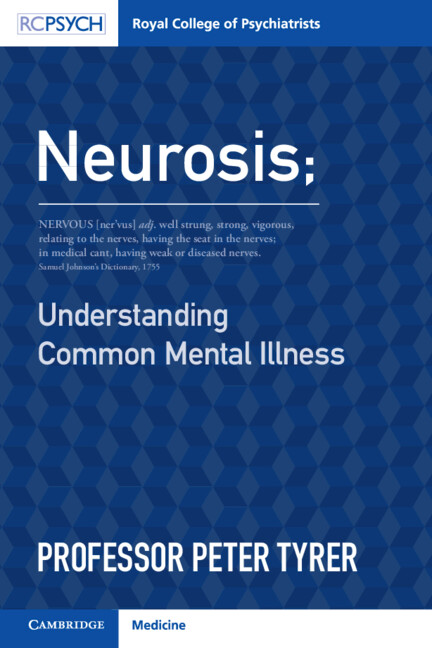
    Common mental illnesses have been diagnosed separately in recent years, but what is seldom understood is that they are all linked together, often much more closely than other disorders. In particular, combined anxiety and depression linked to personality disturbance, generally known as neuroticism, is very common. In the absence of awareness of its importance, this frequently leads to wrong clinical decisions and poor outcomes for patients. This book focuses on the concept of neurosis, tracing its history as a concept, its abolition from the DSM, the purpose and importance of the Nottingham Study of Neurotic Disorder, the re-definition of neurosis as the general neurotic syndrome, and its recently updated evidence base. Written for psychiatrists, psychologists and researchers, this book shows how recognising these combined common disorders is absolutely necessary for mental health practice, and urges that it is time that we re-examine our treatment priorities.

    Reviews

    ‘Psychiatry cannot advance without a good classification. We have failed to achieve this, most particularly with common mental disorders. This important book by Peter Tyrer shows a way forward, giving special attention to mixed anxiety and depressive disorders, the most important diagnosis of all. It should be mandatory reading for all psychiatrists.’

    David Goldberg - Professor Emeritus, Institute of Psychiatry, King's College London, United Kingdom

    ‘DSM-5 & ICD-11 are splitter systems that artificially divide the diagnostic pie into tiny slices. The resulting artificial and misleading ‘comorbidity’ often leads to fragmented and excessive treatments. Tyrer beautifully demonstrates the clinical realities that patients are necessarily more complicated than diagnostic systems and that flexible formulation is more important than rigid adherence to criteria sets. This is an extremely valuable book for all mental health professionals at all levels of training and experience.’

    Allen Frances - MD, Professor and Chair Emeritus, Department of Psychiatry, Duke University, Durham, NC, USA, and Chair, DSM-IV Task Force

    ‘This highly readable book has long been needed. It is an essential reference for improving clinical thinking, whether you are a physician or a psychologist. It helps building unitary perspectives that may shed light on phenomena that would otherwise remain scattered in the patient’s story. What is shared by syndromes such as anxiety, panic, phobic disturbances and irritability may be as important as the differences between them and conditions that are apparently comorbid could be part of the same general neurotic syndrome.’

    Giovanni A. Fava - MD, Clinical Professor of Psychiatry, University at Buffalo, State University of New York, Buffalo, NY, USA

    Refine List

    Actions for selected content:

    Select all | Deselect all
    • View selected items
    • Export citations
    • Download PDF (zip)
    • Save to Kindle
    • Save to Dropbox
    • Save to Google Drive

    Save Search

    You can save your searches here and later view and run them again in "My saved searches".

    Please provide a title, maximum of 40 characters.
    ×

    Contents

    Metrics

    Altmetric attention score

    Full text views

    Total number of HTML views: 0
    Total number of PDF views: 0 *
    Loading metrics...

    Book summary page views

    Total views: 0 *
    Loading metrics...

    * Views captured on Cambridge Core between #date#. This data will be updated every 24 hours.

    Usage data cannot currently be displayed.

    Accessibility standard: Unknown

    Why this information is here

    This section outlines the accessibility features of this content - including support for screen readers, full keyboard navigation and high-contrast display options. This may not be relevant for you.

    Accessibility Information

    Accessibility compliance for the PDF of this book is currently unknown and may be updated in the future.
