
- Coming soon
- Publisher:
- Cambridge University Press
- Expected online publication date:
- January 2026
- Print publication year:
- 2026
- Online ISBN:
- 9781009531467
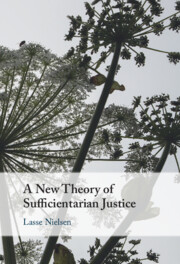
Sufficientarianism is the view that justice is fulfilled when everyone has enough. But how should we interpret this view as an ideal of distributive justice? This book develops and defends the umbel view as a new theory of sufficientarian justice. The umbel view suggests that justice is fulfilled if, and only if, no one is below the threshold level in any relevant sphere of value, and that below this level, we should give absolute priority to meeting people's basic needs. The book unpacks this new theory of sufficientarian justice as a framework with eight spheres of justice-relevant capabilities. It discusses the theory's implications for discrimination, political feasibility, and public policy and ends by demonstrating how the umbel view shows great potential for policy guidance on issues such as universal basic income, health inequality, and extreme wealth.
‘Even those who remain convinced that sufficiency is not enough will profit from this clear and systematic account of its place in distributive decision-making. Nielsen’s philosophical agility, warmth, and unpretentious prose make reading this complex discussion as engaging as talking to a friend.’
Paula Casal - Universitat Pompeu Fabra (UPF)
 Loading metrics...
* Views captured on Cambridge Core between #date#. This data will be updated every 24 hours.
Usage data cannot currently be displayed.
Accessibility compliance for the PDF of this book is currently unknown and may be updated in the future.