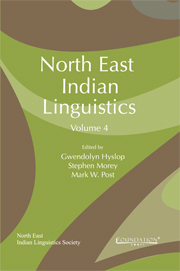

North East India is one of the most linguistically diverse regions of the world, with over 100, and perhaps as many as 200, different languages spoken. This book aims to produce a volume reflective of both the linguistic diversity of the region as well as the high quality of current research on North East Indian Linguistics. The articles in this volume cover four of the language families represented in North East India: Tai-Kadai, Indo-Aryan, Tibeto-Burman, and Austroasiatic. Divided into seven sections, the book presents the description and analysis of a wide variety of phonological, syntactic, morphological, socio-linguistic and historical topics in the study of several languages of the region origin of the Boro-Garo language family, Boro-Garo grammar, serial verbs in a hitherto undescribed variety of Boro, information about Dimasa dialects, phonology of Hajong, a language of Assam and Meghalaya, and analysis of copula constructions in Assam Sadri. The volume also contains an analysis of pronouns in Madhav Kandalis Ramayana, a version of the Ramayana written in colloquial Assamese of the fourteenth century. The final section in this volume discusses serial verb constructions in the Austroasiatic language war, the most detailed discussion of war syntax and semantics to date.Contributions in this volume range from renowned scholars of Tibeto-Burman linguistics to students from the North East making their first impact in the field of Linguistics. The book will be of interest to linguists, anthropologists, social scientists and general readers with an interest in the study, preservation and appreciation of North East Indian cultural and linguistic diversity.
Loading metrics...
* Views captured on Cambridge Core between #date#. This data will be updated every 24 hours.
Usage data cannot currently be displayed.
This section outlines the accessibility features of this content - including support for screen readers, full keyboard navigation and high-contrast display options. This may not be relevant for you.
Accessibility compliance for the PDF of this book is currently unknown and may be updated in the future.
