
Skip to main content Accessibility help
×
  • Cited by 6
    • Show more authors
    • You may already have access via personal or institutional login
    • Select format
    • Publisher:
      Cambridge University Press
      Publication date:
      June 2019
      June 2019
      ISBN:
      9781108612685
      9781108482271
      9781108711807
      Dimensions:
      (228 x 152 mm)
      Weight & Pages:
      0.5kg, 248 Pages
      Dimensions:
      (229 x 152 mm)
      Weight & Pages:
      0.37kg, 252 Pages
    You may already have access via personal or institutional login
  • Selected: Digital
    Add to cart View cart Buy from Cambridge.org

    Book description

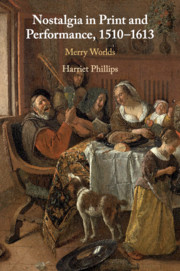
    For many people in early modern England the Reformation turned the past into another country: the 'merry world'. Nostalgia for this imaginary time, both widespread and widely contested, was commodified by a burgeoning entertainment industry. This book offers a new perspective on the making of 'Merry England', arguing that it was driven both by the desires of audiences and the marketing strategies of writers, publishers and playing companies. Nostalgia in Print and Performance juxtaposes plays with ballads and pamphlets, just as they were experienced by their first consumers. It argues that these commercial fictions played a central role in promoting and shaping nostalgia. At the same time, the fantasy of the merry world offered a powerfully affective language for conceptualising longing. For playwrights like Shakespeare and others writing for the commercial stage, it became a way to think through the dynamics of audience desire and the aesthetics of repetition.

    Awards

    Shortlisted, 2020 Shakespeare's Globe Book Award

    Reviews

    'Harriet Phillips' study is an exceptionally fine work. Her readings of individual literary texts, canonical and non-canonical alike, are consistently sharp, and are elegantly placed at the service of the wider argument. This book will be ranked among the most important recent studies of the place of the past in early modern England.'

    Philip Schwyzer - University of Exeter

    ‘… a richly rewarding and comprehensive study … Nostalgia in Print and Performance [, 1510–1613] represents groundbreaking new readings of work and periods too often treated separately by literary scholarship.’

    Andy Kesson Source: The Review of English Studies

    ‘Phillips offers an important, in-depth, and dense reading contextualized culturally and etymologically.’

    J. S. Carducci Source: Choice

    ‘In this smart, thoughtful, and important book … Harriet Phillips offers a welcome and rich expansion of early modern scholarship on nostalgia. As its subtitle suggests, this book challenges us to think critically about how early modern nostalgia could not only or exclusively commodify, but how it enabled collaboration and collective fantasy between writers and their readers and audiences.’

    Kristine Johanson Source: Modern Philology

    Refine List

    Actions for selected content:

    Select all | Deselect all
    • View selected items
    • Export citations
    • Download PDF (zip)
    • Save to Kindle
    • Save to Dropbox
    • Save to Google Drive

    Save Search

    You can save your searches here and later view and run them again in "My saved searches".

    Please provide a title, maximum of 40 characters.
    ×

    Contents

    Metrics

    Full text views

    Total number of HTML views: 0
    Total number of PDF views: 0 *
    Loading metrics...

    Book summary page views

    Total views: 0 *
    Loading metrics...

    * Views captured on Cambridge Core between #date#. This data will be updated every 24 hours.

    Usage data cannot currently be displayed.

    Accessibility standard: Unknown

    Why this information is here

    This section outlines the accessibility features of this content - including support for screen readers, full keyboard navigation and high-contrast display options. This may not be relevant for you.

    Accessibility Information

    Accessibility compliance for the PDF of this book is currently unknown and may be updated in the future.
