
Skip to main content Accessibility help
×
  • Cited by 11
    • Show more authors
    • You may already have access via personal or institutional login
    • Select format
    • Publisher:
      Cambridge University Press
      Publication date:
      05 April 2013
      18 April 2013
      ISBN:
      9781139565639
      9781107035935
      9781107470392
      Dimensions:
      (247 x 174 mm)
      Weight & Pages:
      0.76kg, 294 Pages
      Dimensions:
      (247 x 174 mm)
      Weight & Pages:
      0.59kg, 294 Pages
    You may already have access via personal or institutional login
  • Selected: Digital
    Add to cart View cart Buy from Cambridge.org

    Book description

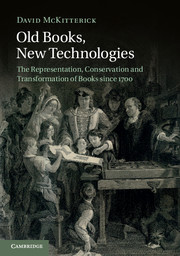
    As we rely increasingly on digital resources, and libraries discard large parts of their older collections, what is our responsibility to preserve 'old books' for the future? David McKitterick's lively and wide-ranging study explores how old books have been represented and interpreted from the eighteenth century to the present day. Conservation of these texts has taken many forms, from early methods of counterfeiting, imitation and rebinding to modern practices of microfilming, digitisation and photography. Using a comprehensive range of examples, McKitterick reveals these practices and their effects to address wider questions surrounding the value of printed books, both in terms of their content and their status as historical objects. Creating a link between historical approaches and the emerging technologies of the future, this book furthers our understanding of old books and their significance in a world of emerging digital technology.

    Reviews

    'A learned, sensible and well-written piece of historical scholarship.'

    Source: The Times Literary Supplement

    'The great value of [this] book is that it attempts to provide a larger, longer-term context for understanding what is happening today not (primarily) to new books but to retrospective collections, as more and more are digitized and made available on the web. If the meaning and status of these historical artifacts are being challenged today in new and menacing ways, it is not for the first time. The history of the transmission and evaluation of old books is itself the record of shifting approaches to these artifacts … what makes McKitterick's narrative so compelling is the wealth of detail it includes as well as the breadth of cultural objects it embraces. McKitterick alerts us at every point that what was true for books was true for sculptures, paintings, buildings, and the whole repertoire of culturally significant objects …'

    Source: College and Research Libraries

    'This book will appeal to anyone with an interest in old books, both from the perspective of how their content as well as physical characteristics have been preserved. … Although quite detailed, Old Books, New Technologies is not a heavy academic tome and makes for an enjoyable read. It provides an interesting view of how old books were considered and treated during the 18th and 19th centuries.'

    Mary McIntyre Source: Journal of the Canadian Association for Conservation

    Refine List

    Actions for selected content:

    Select all | Deselect all
    • View selected items
    • Export citations
    • Download PDF (zip)
    • Save to Kindle
    • Save to Dropbox
    • Save to Google Drive

    Save Search

    You can save your searches here and later view and run them again in "My saved searches".

    Please provide a title, maximum of 40 characters.
    ×

    Contents

    Metrics

    Altmetric attention score

    Full text views

    Total number of HTML views: 0
    Total number of PDF views: 0 *
    Loading metrics...

    Book summary page views

    Total views: 0 *
    Loading metrics...

    * Views captured on Cambridge Core between #date#. This data will be updated every 24 hours.

    Usage data cannot currently be displayed.

    Accessibility standard: Unknown

    Why this information is here

    This section outlines the accessibility features of this content - including support for screen readers, full keyboard navigation and high-contrast display options. This may not be relevant for you.

    Accessibility Information

    Accessibility compliance for the PDF of this book is currently unknown and may be updated in the future.
