Skip to main content Accessibility help
×
  • Coming soon
  • Select format
  • Publisher:
    Cambridge University Press
    Publication date:
    23 July 2026
    31 July 2026
    ISBN:
    9781009758734
    9781009758680
    Dimensions:
    (229 x 152 mm)
    Weight & Pages:
    350 Pages
    Dimensions:
    Weight & Pages:
Selected: Digital
Add to cart View cart Buy from Cambridge.org

Book description

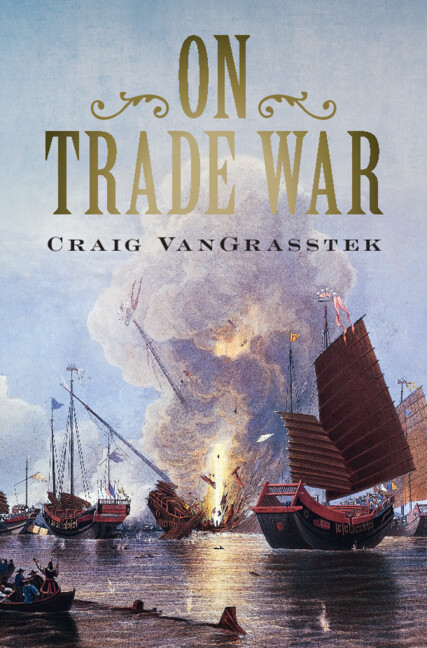
While today's global trade war may seem like a radical break from the established system of inter-state relations, history shows that states have been fighting trade wars as long as there have been states, trade, and war. The current rivalry between the United States and China is among the most pressing contemporary issues that may define international relations for the next decade. Craig VanGrasstek's On Trade War explains the theory and practice of trade war, placing the current conflict in an analytical framework that provides insights from history, political science, economics, and law. Pioneering a new way of examining trade and military relations between states, VanGrasstek's analysis identifies patterns from past trade wars that may shape our future.

Reviews

‘Even the greatest among great powers need allies, especially at a time of heightened rivalry. The historical cases presented here, from ancient times to our post-post-Cold War world, underline the need to maintain a transatlantic partnership that is based not just on raw interests but on shared values.’

Arancha González - Dean of the Paris School of International Affairs and former Spanish Foreign Minister

‘The global trading system already confronted serious headwinds when Craig VanGrasstek wrote our official history, and they have lately grown to hurricane force. Like a weatherman informing a frightened public, he clearly explains the causes and risks of this whirlwind.’

Pascal Lamy - former Director-General of the World Trade Organization

‘This breathtaking book provides what we sorely missed, offering a timely and thoughtful analysis of the profound transformations we are daily witnessing in the global trading system. It examines what this revolution means for the broader architecture of international organization, and will long remain the indispensable reference in the field.’

Rubens Ricupero - former UNCTAD Secretary-General

‘This sweeping account of trade wars through history is especially valuable as the United States and China launch a new and probably long battle. VanGrasstek's documentation is a gold mine, and his analysis contains lessons for scholars and diplomats alike.’

Gary Hufbauer - Peterson Institute for International Economics

Metrics

Full text views

Total number of HTML views: 0
Total number of PDF views: 0 *

Loading metrics...

Book summary page views

Total views: 0 *
Loading metrics...

* Views captured on Cambridge Core between #date#. This data will be updated every 24 hours.

Usage data cannot currently be displayed.

Accessibility standard: WCAG 2.1 AA

Why this information is here

This section outlines the accessibility features of this content - including support for screen readers, full keyboard navigation and high-contrast display options. This may not be relevant for you.

Accessibility Information

The PDF of this book complies with version 2.1 of the Web Content Accessibility Guidelines (WCAG), covering newer accessibility requirements and improved user experiences and achieves the intermediate (AA) level of WCAG compliance, covering a wider range of accessibility requirements.

Content Navigation
Table of contents navigation

Allows you to navigate directly to chapters, sections, or non‐text items through a linked table of contents, reducing the need for extensive scrolling.

Index navigation

Provides an interactive index, letting you go straight to where a term or subject appears in the text without manual searching.

Reading Order and Textual Equivalents
Single logical reading order

You will encounter all content (including footnotes, captions, etc.) in a clear, sequential flow, making it easier to follow with assistive tools like screen readers.

Short alternative textual descriptions

You get concise descriptions (for images, charts, or media clips), ensuring you do not miss crucial information when visual or audio elements are not accessible.

Full alternative textual descriptions

You get more than just short alt text: you have comprehensive text equivalents, transcripts, captions, or audio descriptions for substantial non‐text content, which is especially helpful for complex visuals or multimedia.

Visual Accessibility
Use of colour is not sole means of conveying information

You will still understand key ideas or prompts without relying solely on colour, which is especially helpful if you have colour vision deficiencies.

Structural and Technical Features
ARIA roles provided

You gain clarity from ARIA (Accessible Rich Internet Applications) roles and attributes, as they help assistive technologies interpret how each part of the content functions.