
Skip to main content Accessibility help
×
  • Cited by 15
    • Show more authors
    • You may already have access via personal or institutional login
    • Select format
    • Publisher:
      Cambridge University Press
      Publication date:
      06 November 2020
      03 December 2020
      ISBN:
      9781108686990
      9781108711845
      Dimensions:
      Weight & Pages:
      Dimensions:
      (229 x 152 mm)
      Weight & Pages:
      0.1kg, 86 Pages
    You may already have access via personal or institutional login
  • Selected: Digital
    Add to cart View cart Buy from Cambridge.org

    Book description

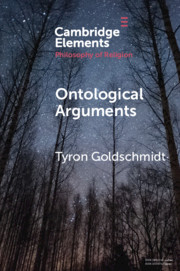
    Proving the existence of God is a perennial philosophical ambition. An armchair proof would be the jackpot. Ontological arguments promise as much. This Element studies the most famous ontological arguments from Anselm, Descartes, Plantinga, and others besides. While the verdict is that ontological arguments don't work, they get us entangled in fun philosophical puzzles, from philosophy of religion to philosophy of language, from metaphysics to ethics, and beyond.

    References

    Adams, Robert Merrihew (1994). Leibniz: Determinist, Theist, Idealist. New York: Oxford University Press.
    Ahmed, Arif (2007). Saul Kripke. London: Bloomsbury.
    Anselm (2001). Proslogion: With the Replies of Gaunilo and Anselm, Thomas Williams (trans.). Indianapolis: Hackett.
    Antognazza, Maria Rosa (2018). “Leibniz.” In Oppy, Graham (ed.), Ontological Arguments. Cambridge: Cambridge University Press, 7598.
    Aquinas, Thomas. (2014). Aquinas: Basic Works, Hause, Jeffrey & Pasnau, Robert (eds.). Indianapolis: Hackett.
    Arbour, Benjamin (2019). “Dogmatic Open-Mindedness and Open-Minded Dogmatics.” In Trickett, Gregory & Gilhooly, John (eds.), Open-Mindedness in Philosophy of Religion. Newcastle upon Tyne: Cambridge Scholars, 7699.
    Arbour, Benjamin (n.d.). “Preserving Anselmian Monotheism: A Reply to Nagasawa.” Unpublished manuscript.
    Astell, Mary (2002). A Serious Proposal to the Ladies. Peterborough: Broadview.
    Barnes, Jonathan (1972). The Ontological Argument. New York: St. Martin’s Press.
    Barth, Karl (1960). Anselm: Fides Quaerens Intellectum. Richmond: John Knox.
    Benacerraf, Paul (1965). “What Numbers Could Not Be,” Philosophical Review 74 (1): 4773.
    Bencivenga, Ermanno (1993). Logic and Other Nonsense: The Case of Anselm and His God. Princeton: Princeton University Press.
    Bernstein, C’Zar (2014). “Giving the Ontological Argument Its Due,” Philosophia 42 (3): 665–79.
    Burns, Elizabeth (2018). “The Ontological Argument: Patching Plantinga’s Ontological Argument by Making the Murdoch Move.” In Dougherty, Trent & Walls, Jerry (eds.), Two Dozen (or So) Arguments for God: The Plantinga Project. New York: Oxford University Press, 123–36.
    Brown, James Robert (2012). Platonism, Naturalism, and Mathematical Knowledge. New York: Routledge.
    Byerly, Ryan (2010). The Ontomystical Argument Revisited. International Journal for Philosophy of Religion 67 (2): 95105.
    Campbell, Richard (2018). Rethinking Anselm’s Argument: A Vindication of his Proof of the Existence of God. Leiden: Brill.
    Cartwright, Nancy (2019). Nature, the Artful Modeler: Lectures on Laws, Science, How Nature Arranges the World, and How We Can Arrange It Better. Chicago: Open Court.
    Chambers, Timothy (2000). “On Behalf of the Devil: A parody of Anselm Revisited,” Proceedings of the Aristotelian Society 100 (1): 93113.
    Chandler, Hugh (1976). “Plantinga and the Contingently Possible,” Analysis, 36 (2): 106–9.
    Coggins, Geraldine (2010). Could There Have Been Nothing? Against Metaphysical Nihilism. New York: Palgrave Macmillan.
    Collins, Robin (2018). “The Argument from Physical Constants: The Fine-Tuning for Discoverability.” In Dougherty, Trent & Walls, Jerry (eds.), Two Dozen (or So) Arguments for God: The Plantinga Project. New York: Oxford University Press, 89–107.
    Conee, Earl (2013). “Conceiving Absolute Greatness.” In Goldschmidt, Tyron (ed.), The Puzzle of Existence: Why Is There Something Rather Than Nothing? New York: Routledge, 110–27.
    Conee, Earl (2005). “Why Not Nothing?” In Conee, Earl & Sider, Ted, Riddles of Existence: A Guided Tour of Metaphysics. Oxford: Oxford University Press.
    Craig, William Lane (2018). “The Kalam Cosmological Argument.” In Dougherty, Trent & Walls, Jerry (eds.), Two Dozen (or So) Arguments for God: The Plantinga Project. New York: Oxford University Press, 389405.
    Craig, William Lane (2016). God over All: Divine Aseity and the Challenge of Platonism. Oxford: Oxford University Press.
    Dawkins, Richard (2006). The God Delusion. New York: Houghton Mifflin.
    Dennett, Daniel (2006). Breaking the Spell: Religion as a Natural Phenomenon. New York: Penguin.
    Descartes, René (1986). Meditations on First Philosophy: With Selections from the Objections and Replies. John Cottingham (trans.). Cambridge: Cambridge University Press.
    Descartes, René (1984). The Philosophical Writings of Descartes: Volume II. John Cottingham, Robert Stoothoff, & Dugald Murdoch (trans.). Cambridge: Cambridge University Press.
    Dicker, Georges (2013). Descartes: An Analytical and Historical Introduction (2nd ed.). Oxford: Oxford University Press.
    Efird, David, & Stoneham, Tom (2006). “Combinatorialism and the Possibility of Nothing,” Australasian Journal of Philosophy 84 (2): 269–80.
    Field, Hartry (1980). Science without Numbers. Princeton: Princeton University Press.
    Francks, Richard (2008). Descartes’s Meditations: A Reader’s Guide. New York: Continuum.
    Frege, Gottlob (1960). The Foundations of Arithmetic. J. L. Austin (trans.). New York: Harper.
    Gale, Richard (1991). On the Nature and Existence of God. Cambridge: Cambridge University Press.
    Gellman, Jerome (1997). Experience of God and the Rationality of Theistic Belief. Ithaca: Cornell University Press.
    Goldschmidt, Tyron (forthcoming). “Ontological Soufflé,” Ratio.
    Goldschmidt, Tyron (2019). “A Proof of Exodus: Yehuda HaLevi and Jonathan Edwards Walk Into a Bar.” In Lebens, Samuel, Rabinowitz, Dani, & Segal, Aaron (eds.), Jewish Philosophy in an Analytic Age. Oxford: Oxford University Press, 222–42.
    Goldschmidt, Tyron (2018). “The Argument From Numbers’. In Dougherty, Trent & Walls, Jerry (eds.), Two Dozen (or So) Arguments for God: The Plantinga Project. New York:Oxford University Press, 5975.
    Gould, Paul (2014). Beyond the Control of God? Six Views on the Problem of God and Abstract Objects. New York: Bloomsbury.
    Hartshorne, Charles (1962). The Logic of Perfection. La Salle: Open Court.
    Hoffman, Joshua, & Rosenkrantz, Gary (2002). The Divine Attributes. New York: Wiley-Blackwell.
    Huemer, Michael (2016). Approaching Infinity. New York: Palgrave Macmillan.
    Huemer, Michael (2009). “When Is Parsimony a Virtue?,” Philosophical Quarterly 59 (235): 216–36.
    Huemer, Michael (2005). Ethical Intuitionism. New York: Palgrave Macmillan.
    Hume, David (1998). Dialogues Concerning Natural Religion. Popkin, Richard (ed.). Indianapolis: Hackett.
    Johnson, David (2004). Truth without Paradox. Landham: Roman and Littlefield.
    Kant, Immanuel (1998). Critique of Pure Reason. Paul Guyer & Allen Wood (trans.).Cambridge: Cambridge University Press.
    Kraay, Klaas (2010). “Theism, Possible Worlds, and the Multiverse,” Philosophical Studies 147 (3): 355–68.
    Kwan, Kai-man (2009). “The Argument from Religious Experience.” In Craig, William Lane & Moreland, J. P. (eds.), The Blackwell Companion to Natural Theology. Oxford: Blackwell, 498552.
    Leftow, Brian (2018). “Aquinas” In Oppy, Graham (ed.), Ontological Arguments. Cambridge: Cambridge University Press, 4452.
    Leftow, Brian (1988). “Anselmian Polytheism,” International Journal for Philosophy of Religion 23 (2): 77104
    Leng, Mary (ed.) (2010). Mathematics and Reality. Oxford: Oxford University Press.
    Lewis, David (1970). “Anselm and Actuality,” Noûs 4 (2): 175–88.
    Logan, Ian (2008). Reading Anselm’s Proslogion: The History of Anselm’s Argument and Its Significance Today. London: Ashgate.
    Lowe, E. J. (2013). “The Ontological Argument.” In Meister, Chad & Copan, Paul (eds.), The Routledge Companion to Philosophy of Religion. New York: Routledge, 391400.
    Lowe, E. J. (2012). “A New Modal Version of the Ontological Argument.” In Szatkowski, Mirosaw (ed.), Ontological Proofs Today. Frankfurt: Ontos Verlag, 179–91.
    Lowe, E. J. (1998). The Possibility of Metaphysics: Substance, Identity, and Time. Oxford: Oxford University Press.
    Lycan, William (2019). On Evidence in Philosophy. Oxford: Oxford University Press.
    Malcolm, Norman (1960). “Anselm’s Ontological Arguments,” Philosophical Review 69 (1): 4162.
    Marek, Johann (2019). “Alexius Meinong,” Stanford Encyclopedia of Philosophy. https://plato.stanford.edu/entries/meinong/
    Matthews, Gareth, & Baker, Lynne Rudder (2010). “The Ontological Argument Simplified,” Analysis 70 (2): 210–12.
    Matthews, Gareth, & Baker, Lynne Rudder (2011). “Reply to Oppy’s Fool,” Analysis 71(2): 303.
    Mavrodes, George (1963). “Some Puzzles Concerning Omnipotence,” Philosophical Review 72 (2): 221–23.
    Maydole, Robert (2009). “The Ontological Argument.” In Craig, William Lane & Moreland, J. P. (eds.), The Blackwell Companion to Natural Theology. Oxford: Blackwell, 553–92.
    McGinnis, Jon (2011). “The Ultimate Why Question: Avicenna on Why God Is Absolutely Necessary.” In Wippel, John (ed.), The Ultimate Why Question: Why Is There Anything at All Rather Than Nothing Whatsoever? Washington: Catholic University of America Press, 6583.
    Millican, Peter (2004). “The One Fatal Flaw in Anselm’s Argument,” Mind 113 (451): 437–76.
    Millican, Peter (2007). “Ontological Arguments and the Superiority of Existence: Reply to Nagasawa,” Mind 116 (464): 1041–105.
    Miravalle, John-Mark (2018). God, Existence, and Fictional Objects: The Case for Meinongian Theism. New York: Bloomsbury Academic.
    Morris, Thomas (1987). Anselmian Explorations: Essays in Philosophical Theology. Notre Dame: University of Notre Dame Press.
    Morriston, Wes (2001). “Omnipotence and Necessary Moral Perfection: Are They Compatible?,” Religious Studies 37 (2): 143–60.
    Nagasawa, Yujin (2017). Maximal God: A New Defence of Perfect Being Theism. Oxford: Oxford University Press.
    Nagasawa, Yujin (2007). “Millican on the Ontological Argument,” Mind 116 (464): 1027–39.
    Naylor van Inwagen, Margery (1969). Descartes’ Three Versions of the Ontological Argument. Unpublished doctoral dissertation, University of Rochester, Rochester, NY.
    Nolan, Lawrence (2018). “Descartes.” In Oppy, Graham (ed.), Ontological Arguments. Cambridge: Cambridge University Press, 5374.
    O’Connor, Timothy (2008). Theism and Ultimate Explanation: The Necessary Shape of Contingency. Oxford: Wiley-Blackwell.
    Oppy, Graham (ed.) (2018). Ontological Arguments. Cambridge: Cambridge University Press.
    Oppy, Graham (2018). “Introduction: Ontological Arguments in Focus.” In Oppy, Graham (ed.), Ontological Arguments. Cambridge: Cambridge University Press, 118.
    Oppy, Graham (2011). “Objection to a Simplified Ontological Argument,” Analysis 71(1): 105–6.
    Oppy, Graham (2011a). “On Behalf of the Fool,” Analysis, 71 (2): 304–6.
    Oppy, Graham (2009). “Pruss’s Ontological Arguments,” Religious Studies 45 (3): 355–63.
    Oppy, Graham (1995). Ontological Arguments and Belief in God. Cambridge: Cambridge University Press.
    Parsons, Terence (1980). Nonexistent Objects. New Haven: Yale University Press.
    Pearce, Kenneth (2017). “Foundational Grounding and the Argument from Contingency,” Oxford Studies in Philosophy of Religion 8.
    Plantinga, Alvin (2007). “Two Dozen (or So) Theistic Arguments.” In Baker, Deane-Peter (ed.), Alvin Plantinga. Cambridge: Cambridge University Press, 203–28.
    Plantinga, Alvin (1974). God, Freedom, and Evil. Grand Rapids: Eerdmans.
    Plantinga, Alvin (1974a). The Nature of Necessity. Oxford: Clarendon Press.
    Poston, Ted (2018). “The Argument from (A) to (Y): The Argument from So Many Arguments.” In Dougherty, Trent & Walls, Jerry (eds.), Two Dozen (or So) Arguments for God: The Plantinga Project. New York: Oxford University Press, 372–86.
    Priest, Graham (2018). “Characterization, Existence and Necessity.” In Oppy, Graham (ed.), Ontological Arguments. Cambridge: Cambridge University Press, 250–69.
    Pruss, Alexander (2018). “Gödel.” In Oppy, Graham (ed.), Ontological Arguments. Cambridge: Cambridge University Press, 139–54.
    Pruss, Alexander (2009). “The Leibnizian Cosmological Argument.” In Craig, William Lane & Moreland, J. P. (eds.), The Blackwell Companion to Natural Theology. Oxford: Blackwell, 24100.
    Pruss, Alexander (2006). The Principle of Sufficient Reason: A Reassessment. Cambridge: Cambridge University Press.
    Pruss, Alexander (2001). “Śamkara’s Principle and Two Ontomystical Arguments,” International Journal for Philosophy of Religion 49 (2): 111–20.
    Pruss, Alexander, & Rasmussen, Joshua (2018). Necessary Existence. Oxford: Oxford University Press.
    Rasmussen, Joshua (2018). “Plantinga.” In Oppy, Graham (ed.), Ontological Arguments. Cambridge: Cambridge University Press, 176–94.
    Reicher, Maria (2019). “Nonexistent Objects,” Stanford Encyclopedia of Philosophy. https://plato.stanford.edu/entries/nonexistent-objects/
    Rizvi, Sajjad (2019). “Mulla Sadra,” Stanford Encyclopedia of Philosophy. https://plato.stanford.edu/entries/mulla-sadra/
    Rowe, William (2009). “Alvin Plantinga on the Ontological Argument,” International Journal for Philosophy of Religion 65 (2), 8792.
    Rowe, William (1987). “Modal Versions of the Ontological Argument.” In Pojman, Louis (ed.), Philosophy of Religion: An Anthology. Wadsworth: Balmont, 6973.
    Rowe, William (1976). “The Ontological Argument and Question-Begging,” International Journal for Philosophy of Religion 7 (4): 425–32.
    Russell, Bertrand (2004). History of Western Philosophy. London: Routledge.
    Russell, Bertrand (1905). “On Denoting,” Mind 14 (56): 479–93.
    Schneider, Susan (2017). “Idealism, or Something Near Enough.” In Goldschmidt, Tyron & Pearce, Kenneth (eds.), Idealism: New Essays in Metaphysics. Oxford: Oxford University Press, 275–89.
    Scotus, Duns (1962). Philosophical Writings. Allan Wolter (trans.). Indianapolis: Bobbs-Merrill.
    Sinnott-Armstrong, Walter (1999). “Begging the Question,” Australasian Journal of Philosophy 77 (2): 174–91.
    Smith, A. D. (2014). Anselm’s Other Argument. Harvard: Harvard University Press.
    Sobel, Jordan Howard (2004). Logic and Theism: Arguments for and against Belief in God. Cambridge: Cambridge University Press.
    Sorensen, Roy (1991). “‘P, therefore, P’ without Circularity,” Journal of Philosophy 88 (5): 245–66.
    Speaks, Jeff (2018). The Greatest Possible Being. Oxford: Oxford University Press.
    Spinoza, Baruch (1992). Ethics. Indianapolis: Hackett.
    Stang, Nicholas (2016). Kant’s Modal Metaphysics. Oxford: Oxford University Press.
    Stang, Nicholas (2015). “Kant’s Argument That Existence Is Not a Determination,” Philosophy and Phenomenological Research 91 (1): 583626.
    Steiner, Mark (1998). The Applicability of Mathematics as a Philosophical Problem. Cambridge: Harvard University Press.
    Street, Sharon (2006). “A Darwinian Dilemma for Realist Theories of Value,” Philosophical Studies 127 (1):109–66.
    Streumer, Bart (2017). Unbelievable Errors. Oxford: Oxford University Press.
    Swinburne, Richard (2016). The Coherence of Theism (2nd ed.). Oxford: Oxford University Press.
    Swinburne, Richard (2012). “What Kind of Necessary Being Could God Be?” In Szatkowski, Mirosaw (ed.), Ontological Proofs Today. Frankfurt: Ontos Verlag, 345–63.
    Swinburne, Richard (2004). The Existence of God (2nd ed.). Oxford: Oxford University Press.
    Szatkowski, Miroslaw (ed.) (2012). Ontological Proofs Today. Frankfurt: Ontos Verlag.
    Thomasson, Amie (1998). Fiction and Metaphysics. Cambridge: Cambridge University Press.
    Van Inwagen, Peter (2018). “Begging the Question.” In Oppy, Graham (ed.), Ontological Arguments. Cambridge: Cambridge University Press, 238–49.
    Van Inwagen, Peter (2012). “Three Versions of the Ontological Argument.” In Szatkowski, Mirosaw (ed.), Ontological Proofs Today. Frankfurt: Ontos Verlag, 143–62.
    Van Inwagen, Peter (2009). “Some Remarks on Modal Ontological Arguments,” Philo 12 (2): 217–27.
    Van Inwagen, Peter (2006). The Problem of Evil. Oxford: Oxford University Press.
    Van Inwagen, Peter (2001). “Existence, Ontological Commitment, and Fictional Entities.” In Loux, Michael & Zimmerman, Dean (eds.), The Oxford Handbook of Metaphysics. Oxford: Oxford University Press, 131–57.
    Visser, Sandra, & Williams, Thomas (2008). Anselm. Oxford: Oxford University Press.
    Weiss, Roslyn (2017). “Waiting for Godo … and Godan: Completing Rowe’s Critique of the Ontological Argument,” European Journal for Philosophy of Religion 9 (1): 6586.
    Wigner, Eugene (1960). “The Unreasonable Effectiveness of Mathematics in the Natural Sciences,” Communications in Pure and Applied Mathematics 13: 114.
    Williams, Thomas (2016). “Anselm’s Proslogion,” Topoi 35 (2): 613–6.
    Wilson, Catherine (2003). Descartes’s Meditations: An Introduction. Cambridge: Cambridge University Press.

    Metrics

    Altmetric attention score

    Full text views

    Total number of HTML views: 0
    Total number of PDF views: 0 *
    Loading metrics...

    Book summary page views

    Total views: 0 *
    Loading metrics...

    * Views captured on Cambridge Core between #date#. This data will be updated every 24 hours.

    Usage data cannot currently be displayed.

    Accessibility standard: Unknown

    Why this information is here

    This section outlines the accessibility features of this content - including support for screen readers, full keyboard navigation and high-contrast display options. This may not be relevant for you.

    Accessibility Information

    Accessibility compliance for the PDF of this book is currently unknown and may be updated in the future.
