
Skip to main content Accessibility help
×
  • Cited by 198
    • Show more authors
    • You may already have access via personal or institutional login
    • Select format
    • Publisher:
      Cambridge University Press
      Publication date:
      05 October 2015
      10 December 2015
      ISBN:
      9781316227367
      9781107106970
      9781108458177
      Dimensions:
      (228 x 152 mm)
      Weight & Pages:
      0.47kg, 214 Pages
      Dimensions:
      (229 x 152 mm)
      Weight & Pages:
      0.34kg, 214 Pages
    You may already have access via personal or institutional login
  • Selected: Digital
    Add to cart View cart Buy from Cambridge.org

    Book description

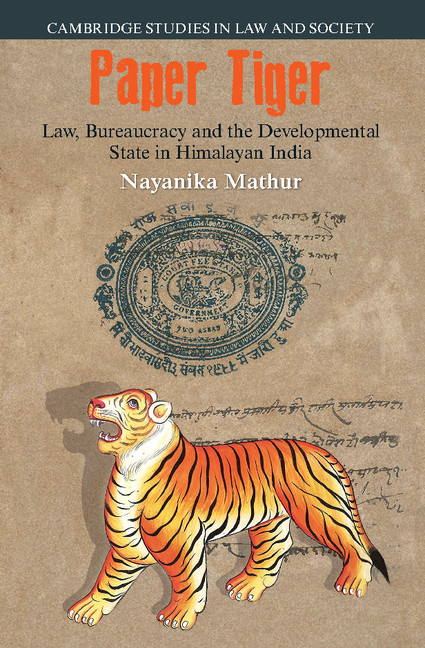
    A big cat overthrows the Indian state and establishes a reign of terror over the residents of a Himalayan town. A welfare legislation aimed at providing employment and commanding a huge budget becomes 'unimplementable' in a region bedeviled by high levels of poverty and unemployment. Paper Tiger provides a lively ethnographic account of how such seemingly bizarre scenarios come to be in contemporary India. Based on eighteen months of intensive fieldwork, this book presents a unique explanation for why and how progressive laws can do what they do and not, ever-so-often, what they are supposed to do. It reveals the double-edged effects of the reforms that have been ushered in by the post-liberalization Indian state, particularly the effort to render itself more transparent and accountable. Through a meticulous detailing of everyday bureaucratic life on the Himalayan borderland, Paper Tiger makes an argument for shifting the very frames of thought through which we apprehend the workings of the developmental Indian state.

    Awards

    Co-Winner, Sharon Stephens Prize, American Ethnological Society

    Reviews

    'This outstanding ethnography offers a rich glimpse of the workings of the state in a remote area of India. It shows that the problem of the implementation of law in India is less a problem of corruption or of neo-liberal governmentality and more a problem of the way in which the social life of paper produces a strange combination of affect and effect at the local level. Bureaucratic rule is created through the materiality of documents, letters and written texts which implement the state rather than the law, a paradox which explains both the omnipresence of the state and its limited effects on policy. This book will be of great interest to all students of the state, law and bureaucracy.'

    Arjun Appadurai - New York University

    ‘Demonstrating a stunning intimacy with the life of bureaucracy in a remote region of India, Paper Tiger brings alive the everyday forms of bureaucratic practice. The book is conceptually innovative and a model of ethnographic writing that will have a decisive impact on the study of the state in India and beyond. Above all, it is written with flair and an irony that makes it stand next to such literary classics as Krishna Sobti's rendering of lower level bureaucracy in Yaaron ke Yaar.'

    Veena Das - The Johns Hopkins University

    'Carefully researched and subtly argued, this book is a great Indian novel and an artful anthropological study in one. It first brings paper to life, and then pivots on the unforgettable tale of humans-as-prey and an all too slowly hunted, hungry leopard/tiger.'

    Annemarie Mol - University of Amsterdam

    'In the burgeoning literature on the anthropology of state, Mathur’s contribution is a significant one. Paper Tiger takes the inquiry of state away from the body of the state, into the domains of language, affect, emotion, time and space.'

    Atreyee Majumder Source: Economic and Political Weekly

    'Mathur’s contribution to the field of studying state practices, law and bureaucracy, apart from being a revelation of the peculiar context of the Indian state, is also a methodological novelty in the field of writing and doing ethnography … I would always go back to reading Paper Tiger as it is a compelling and grounded ethnography which presents a reflective stance on the process of its own making while delightfully elaborating on what it engages with.'

    Subhashim Goswami Source: Allegra Lab (www.allegralaboratory.net)

    'Paper Tiger is a brilliant book, an outstanding achievement of research and understanding. Mathur’s witty and accessible prose rests on a foundation of serious scholarship and groundbreaking methodology. … Paper Tiger is highly recommended, essential reading for all those first approaching the study of the Indian subcontinent, NGO workers and institutional and private international development donors.'

    Elisabetta Iob Source: The London School of Economics and Political Science Book Review (www.blogs.lse.ac.uk)

    'Nayanika Mathur’s Paper Tiger is an ethnographic work that reads beautifully for scholars and non-scholars alike. … (Mathur’s study) lays the necessary groundwork for more detailed explorations of the roles and the effects of laws targeting the improvement of the livelihoods of the poor in developmental states. The strength of this work rests in the author’s convincing representation of bureaucracy as an axis that generates affection through its effective use banalization and specialization. It adds depth and nuance to a growing body of scholarly work on transparency and accountability, as well as on Indian welfare laws and political culture.'

    Irene Hadiprayitno Source: The Journal of Legal Pluralism and Unofficial Law

    Refine List

    Actions for selected content:

    Select all | Deselect all
    • View selected items
    • Export citations
    • Download PDF (zip)
    • Save to Kindle
    • Save to Dropbox
    • Save to Google Drive

    Save Search

    You can save your searches here and later view and run them again in "My saved searches".

    Please provide a title, maximum of 40 characters.
    ×

    Contents

    Metrics

    Altmetric attention score

    Full text views

    Total number of HTML views: 0
    Total number of PDF views: 0 *
    Loading metrics...

    Book summary page views

    Total views: 0 *
    Loading metrics...

    * Views captured on Cambridge Core between #date#. This data will be updated every 24 hours.

    Usage data cannot currently be displayed.

    Accessibility standard: Unknown

    Why this information is here

    This section outlines the accessibility features of this content - including support for screen readers, full keyboard navigation and high-contrast display options. This may not be relevant for you.

    Accessibility Information

    Accessibility compliance for the PDF of this book is currently unknown and may be updated in the future.
