
Skip to main content Accessibility help
×
  • Cited by 1
    • Show more authors
    • Open Access
      You have digital access to this book
    • Select format
    • Publisher:
      Cambridge University Press
      Publication date:
      August 2025
      August 2025
      ISBN:
      9781009366564
      9781009366588
      9781009366618
      Creative Commons:
      Creative Common License - CC Creative Common License - BY Creative Common License - NC Creative Common License - ND
      This content is Open Access and distributed under the terms of the Creative Commons Attribution licence CC-BY-NC-ND 4.0.
      https://creativecommons.org/creativelicenses
      Dimensions:
      (229 x 152 mm)
      Weight & Pages:
      0.36kg, 238 Pages
      Dimensions:
      (229 x 152 mm)
      Weight & Pages:
      0.35kg, 238 Pages
    Open Access
    You have digital access to this book
    Selected: Digital
    View content
    Add to cart View cart Buy from Cambridge.org

    Book description

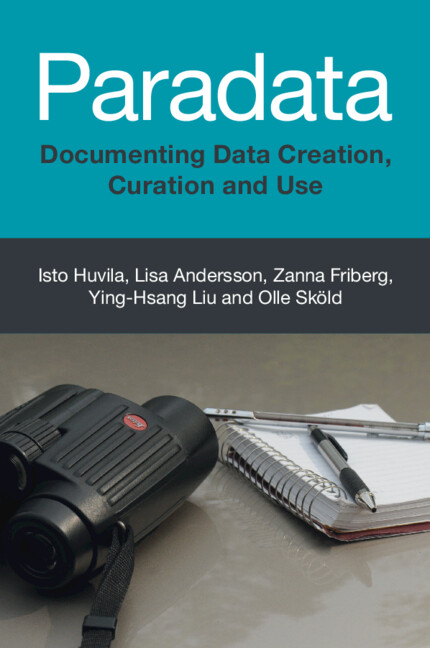
    To make sense of data and use it effectively, it is essential to know where it comes from and how it has been processed and used. This is the domain of paradata, an emerging interdisciplinary field with wide applications. As digital data rapidly accumulates in repositories worldwide, this comprehensive introductory book, the first of its kind, shows how to make that data accessible and reusable. In addition to covering basic concepts of paradata, the book supports practice with coverage of methods for generating, documenting, identifying and managing paradata, including formal metadata, narrative descriptions and qualitative and quantitative backtracking. The book also develops a unifying reference model to help readers contextualise the role of paradata within a wider system of knowledge, practices and processes, and provides a vision for the future of the field. This guide to general principles and practice is ideal for researchers, students and data managers. This title is also available as open access on Cambridge Core.

    Reviews

    ‘The book Paradata: Documenting Data Creation, Curation, and Use is a remarkable contribution to the field, offering deep insights into the complex practices and processes behind data documentation. By exploring the multifaceted nature of paradata, the book emphasizes its crucial role in ensuring the clarity, reuse, and long-term value of research data. The interdisciplinary approach, drawing from archaeology and information science, presents a comprehensive framework for understanding and managing paradata, making it an essential resource for researchers and practitioners alike. Paradata is something that we all need to embrace and understand in our data-driven world, and this book is a wonderful compilation, offering insights and invaluable context. Congratulation to the chief editor, advisory board members, all those who gave feedback, and the contributing authors.’

    Jane Greenberg - Drexel University

    ‘Huvila and his colleagues provide a much-needed and timely analysis of ‘paradata’. Paradata help us to understand the processes by which data are conceptualised and made, and those processes are never neutral nor innocent. Understanding these processes is crucial for the effective management, storage and re-use of data.’

    Sally Wyatt - Maastricht University, The Netherlands

    ‘If you are looking for an understandable and thorough discussion of how data is created and curated, Paradata is for you. Both a summation of the European Research Council funded CAPTURE research project and a primer on the concept and complexities of what makes up paradata - including data creation, curation and use - this book is of interest to a wide audience of information professionals or everyone who works with research data in any stage.’

    Carol Tenopir - University of Tennessee, Knoxville (Emerita)

    ‘This insightful volume introduces the concept of paradata: documentation of the circumstances in which data is made, managed, and used. Huvila and co-authors integrate comprehensive literature synthesis with robust empirical findings to produce an accessibly written, thought-provoking book. Scholars, practitioners, and students of data practices, data management, and data policy will find this book to be a rich and helpful resource.’

    Melanie Feinberg - University of North Carolina at Chapel Hill

    Refine List

    Actions for selected content:

    Select all | Deselect all
    • View selected items
    • Export citations
    • Download PDF (zip)
    • Save to Kindle
    • Save to Dropbox
    • Save to Google Drive

    Save Search

    You can save your searches here and later view and run them again in "My saved searches".

    Please provide a title, maximum of 40 characters.
    ×

    Contents

    Full book PDF
    • Paradata
      pp i-i
    • Reviews
      pp ii-ii
    • Paradata - Title page
      pp iii-iii
    • Documenting Data Creation, Curation and Use
    • Copyright page
      pp iv-iv
    • Contents
      pp v-viii
    • Preface
      pp ix-x
    • Acknowledgements
      pp xi-xii
    • 1 - Introduction
      pp 1-10
    • Paradata – Documenting Data Creation, Management and Use
    • 2 - The Concept of Paradata
      pp 11-39
    • 4 - Methods for Generating and Documenting Paradata
      pp 75-115
    • 5 - Methods for Identifying Paradata for Data Reuse
      pp 116-150
    • 6 - Methods for Managing Paradata
      pp 151-179
    • 7 - A Paradata Reference Model
      pp 180-210
    • 8 - Future Directions
      pp 211-220
    • Making Paradata Matter
    • Index
      pp 221-224

    Metrics

    Altmetric attention score

    Full text views

    Total number of HTML views: 0
    Total number of PDF views: 0 *
    Loading metrics...

    Book summary page views

    Total views: 0 *
    Loading metrics...

    * Views captured on Cambridge Core between #date#. This data will be updated every 24 hours.

    Usage data cannot currently be displayed.

    Accessibility standard: Missing or limited accessibility features

    Why this information is here

    This section outlines the accessibility features of this content - including support for screen readers, full keyboard navigation and high-contrast display options. This may not be relevant for you.

    Accessibility Information

    The PDF of this book is known to have missing or limited accessibility features. We may be reviewing its accessibility for future improvement, but final compliance is not yet assured and may be subject to legal exceptions. If you have any questions, please contact accessibility@cambridge.org.

    Content Navigation
    Table of contents navigation

    Allows you to navigate directly to chapters, sections, or non‐text items through a linked table of contents, reducing the need for extensive scrolling.

    Index navigation

    Provides an interactive index, letting you go straight to where a term or subject appears in the text without manual searching.

    Reading Order and Textual Equivalents
    Single logical reading order

    You will encounter all content (including footnotes, captions, etc.) in a clear, sequential flow, making it easier to follow with assistive tools like screen readers.

    Short alternative textual descriptions

    You get concise descriptions (for images, charts, or media clips), ensuring you do not miss crucial information when visual or audio elements are not accessible.

    Full alternative textual descriptions

    You get more than just short alt text: you have comprehensive text equivalents, transcripts, captions, or audio descriptions for substantial non‐text content, which is especially helpful for complex visuals or multimedia.

    Visual Accessibility
    Use of colour is not sole means of conveying information

    You will still understand key ideas or prompts without relying solely on colour, which is especially helpful if you have colour vision deficiencies.

    Use of high contrast between text and background colour

    You benefit from high‐contrast text, which improves legibility if you have low vision or if you are reading in less‐than‐ideal lighting conditions.
