
Skip to main content Accessibility help
×
  • Cited by 3
    • Show more authors
    • You may already have access via personal or institutional login
    • Select format
    • Publisher:
      Intersentia
      Publication date:
      09 November 2019
      12 September 2019
      ISBN:
      9781780689227
      9781780686974
      Dimensions:
      Weight & Pages:
      Dimensions:
      Weight & Pages:
    • Subjects:
      Law, Criminal Law
    You may already have access via personal or institutional login
  • Selected: Digital
    Add to cart View cart Buy from Cambridge.org
    Subjects:
    Law, Criminal Law

    Book description

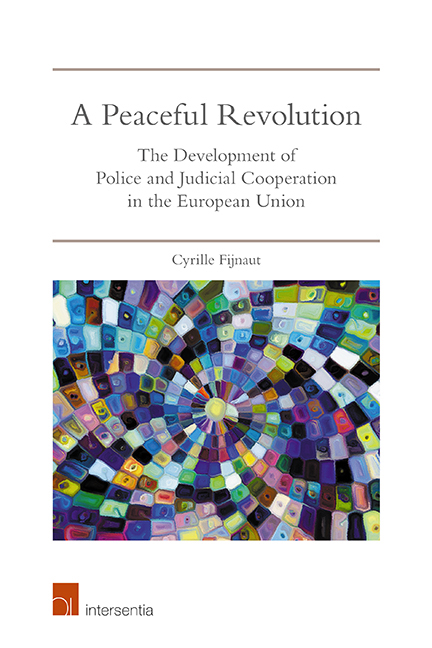
    The debate surrounding police and judicial cooperation in the European Union can be criticised for focussing too much on certain forms of cooperation or on specific problems. As a result, a thorough overview of what has been achieved in this area since the Maastricht Treaty's entry into force in November 1993 is lacking. In contrast to the disjointed and mostly secret cooperation between police and judicial services in Europe prior to 1993, the current regime has established a coherent and transparent system within the EU that can only be described as revolutionary. This book discusses that peaceful revolution in light of the action programmes (the Brussels Programme, the Tampere Programme, the Hague Programme and the Stockholm Programme) which were drafted in concurrence with all major changes to the constitutional relations within the European Union: the Maastricht Treaty, the Amsterdam Treaty, the Nice Treaty, the Rome Treaty and the Lisbon Treaty. This programmatic approach makes it possible to present in a clear manner the imposing array of police and judicial agencies, facilities and networks (Europol, Schengen Information System, Eurojust, European Arrest Warrant, etc.) created through democratic processes with the aim of ensuring the security of the citizens of the European Union. In particular, the problems concerning the control of internal and external borders and with respect to the containment of terrorism demonstrate that this system urgently needs to be reinforced. It is ironic that the Brexit negotiations demonstrate the importance of the current system of police and judicial cooperation in the European Union: the United Kingdom would like to keep the great benefits of a number of its crucial components. CYRILLE FIJNAUT is a former Professor of Criminology and Criminal Law at Erasmus University Rotterdam, KU Leuven and Tilburg University. He is a leading expert on the transatlantic history of criminology, the containment of organised crime and terrorism, comparative criminal procedure and police law, and the history of policing in Europe and the Low Countries.

    Refine List

    Actions for selected content:

    Select all | Deselect all
    • View selected items
    • Export citations
    • Download PDF (zip)
    • Save to Kindle
    • Save to Dropbox
    • Save to Google Drive

    Save Search

    You can save your searches here and later view and run them again in "My saved searches".

    Please provide a title, maximum of 40 characters.
    ×

    Contents

    Metrics

    Full text views

    Total number of HTML views: 0
    Total number of PDF views: 0 *
    Loading metrics...

    Book summary page views

    Total views: 0 *
    Loading metrics...

    * Views captured on Cambridge Core between #date#. This data will be updated every 24 hours.

    Usage data cannot currently be displayed.

    Accessibility standard: Unknown

    Why this information is here

    This section outlines the accessibility features of this content - including support for screen readers, full keyboard navigation and high-contrast display options. This may not be relevant for you.

    Accessibility Information

    Accessibility compliance for the PDF of this book is currently unknown and may be updated in the future.
