
Skip to main content Accessibility help
×
  • Cited by 6
    • The digital format of this book is no longer available to purchase from Cambridge Core. Other formats may be available.
    • Show more authors
    • You may already have access via personal or institutional login
    • Select format
    • Publisher:
      Acumen Publishing
      Publication date:
      05 February 2013
      31 March 2010
      ISBN:
      9781844654352
      9781844651733
      9781844651740
      Dimensions:
      Weight & Pages:
      00kg,
      Dimensions:
      Weight & Pages:
      00kg,
    You may already have access via personal or institutional login
    Selected: Digital
    Add to cart View cart Buy from Cambridge.org

    Book description

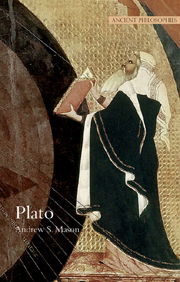
    Plato (c.428-347 BCE) stands at the beginning of many debates that have continued throughout the history of philosophy. His literary career spanned fifty years and the influence of his ideas and those of his followers pervaded philosophy throughout antiquity. Andrew Mason’s lucid and engaging introduction, draws on recent scholarship to offer a fresh general survey of Plato’s philosophy. Aware of the methodological challenges that confront any writer on Plato, Mason handles the issue of Plato’s intellectual development and relationship with Socrates with an assured grasp. Thematically structured, the book begins with Plato’s principal contribution to metaphysics, the “Theory of Forms”, which forms a necessary background to his thought in many areas. His theory of knowledge, which is intimately linked with the Forms is explored in detail along with Plato’s views of the soul, an important theme in itself and an entry point to discussion of his ethics, one of Plato’s major concerns. Finally, the book deals with two areas of Plato’s thought which have had an especially important historical impact, not confined to academic philosophy: his theory of God and nature, and his aesthetics. Throughout, Mason highlights the continuing themes in Plato’s work and how they develop from one dialogue to another.

    Reviews

    "An excellent introduction to Plato’s thought, and it should be recommended as one of the first readings for both students of philosophy and those who wish to engage with Plato. . . The choice of topics is the most likely to give the best overall view of Plato’s thought and the treatment of each topic accomplishes what should be its primary purpose, turning readers towards Plato with a clear approach, an emphasis on the argument, a set of various perspectives and a willingness to face the problems and raise questions for further exploration. Mason at the beginning of the books states that nothing can replace a reading of Plato’s dialogues; he is right, but his book is a very good supplement."

    Source: Bryn Mawr Classical Review

    Refine List

    Actions for selected content:

    Select all | Deselect all
    • View selected items
    • Export citations
    • Download PDF (zip)
    • Save to Kindle
    • Save to Dropbox
    • Save to Google Drive

    Save Search

    You can save your searches here and later view and run them again in "My saved searches".

    Please provide a title, maximum of 40 characters.
    ×

    Metrics

    Altmetric attention score

    Full text views

    Total number of HTML views: 0
    Total number of PDF views: 0 *
    Loading metrics...

    Book summary page views

    Total views: 0 *
    Loading metrics...

    * Views captured on Cambridge Core between #date#. This data will be updated every 24 hours.

    Usage data cannot currently be displayed.

    Accessibility standard: Unknown

    Why this information is here

    This section outlines the accessibility features of this content - including support for screen readers, full keyboard navigation and high-contrast display options. This may not be relevant for you.

    Accessibility Information

    Accessibility compliance for the PDF of this book is currently unknown and may be updated in the future.
