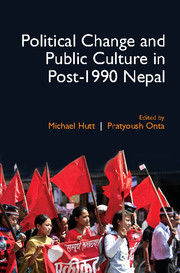
This book explores various domains of the Nepali public sphere in which ideas about democracy and citizenship have been debated and contested since 1990. It investigates the ways in which the public meaning of the major political and sociocultural changes that occurred in Nepal between 1990 and 2013 was constructed, conveyed and consumed. These changes took place against the backdrop of an enormous growth in literacy, the proliferation of print and broadcast media, the emergence of a public discourse on human rights, and the vigorous reassertion of linguistic, ethnic and regional identities. Scholars from a range of different disciplinary locations delve into debates on rumours, ethnicity and identity, activism and gender to provide empirically grounded histories of the nation during one of its most important political transitions.
Loading metrics...
* Views captured on Cambridge Core between #date#. This data will be updated every 24 hours.
Usage data cannot currently be displayed.
This section outlines the accessibility features of this content - including support for screen readers, full keyboard navigation and high-contrast display options. This may not be relevant for you.
Accessibility compliance for the PDF of this book is currently unknown and may be updated in the future.

