The Political Power of Protest

-
Select format
-
- Publisher:
- Cambridge University Press
- Publication date:
- 05 February 2013
- 15 April 2013
- ISBN:
- 9781139381277
- 9781107031142
- 9781107657410
- Dimensions:
- (216 x 138 mm)
- Weight & Pages:
- 0.42kg, 210 Pages
- Dimensions:
- (216 x 138 mm)
- Weight & Pages:
- 0.3kg, 210 Pages
- Subjects:
- Sociology of Race and Ethnicity, Area Studies, Politics: General Interest, American Studies, Sociology: General Interest, American Government, Politics and Policy, Politics and International Relations, Sociology
You may already have access via personal or institutional login- Subjects:
- Sociology of Race and Ethnicity, Area Studies, Politics: General Interest, American Studies, Sociology: General Interest, American Government, Politics and Policy, Politics and International Relations, Sociology
Show more authors 
You may already have access via personal or institutional login
Book description
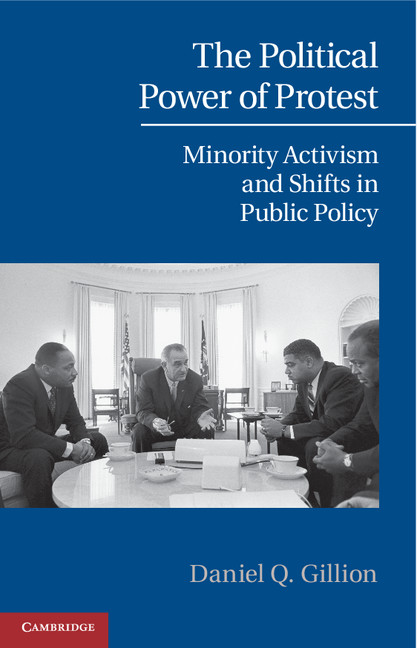
Gillion demonstrates the direct influence that political protest behavior has on Congress, the presidency and the Supreme Court, illustrating that protest is a form of democratic responsiveness that government officials have used, and continue to draw on, to implement federal policies. Focusing on racial and ethnic minority concerns, this book shows that the context of political protest has served as a signal for political preferences. As pro-minority rights behavior grew and anti-minority rights actions declined, politicians learned from minority protest and responded when they felt emboldened by stronger informational cues stemming from citizens' behavior, a theory referred to as the 'information continuum'. Although the shift from protest to politics as a political strategy has opened the door for institutionalized political opportunity, racial and ethnic minorities have neglected a powerful tool to illustrate the inequalities that exist in contemporary society.
Awards
Co-Winner of the 2014 Best Book Award, Race, Ethnicity, and Politics Section, American Political Science Association
Reviews
'Gillion tackles a large question in a slim volume: 'Do protest actions truly influence the behavior of public official?' The research presented in this book shows that government action at the national level can be influenced by minority group protests … Summing up: recommended. Upper-division undergraduate, graduate, research and professional collections.'
J. D. Rausch Source: Choice
'… illuminating and persuasive, and his examination of the Supreme Court’s responses to minority protests is especially innovative.'
Allan J. Lichtman Source: Journal of American History
Contents
Contents
Metrics
Altmetric attention score
Full text views
Full text views helpTotal number of HTML views: 0
Total number of PDF views: 0 *
 Loading metrics...
* Views captured on Cambridge Core between #date#. This data will be updated every 24 hours.
Usage data cannot currently be displayed.
Accessibility standard: Unknown
Why this information is here
This section outlines the accessibility features of this content - including support for screen readers, full keyboard navigation and high-contrast display options. This may not be relevant for you.
Accessibility Information
Accessibility compliance for the PDF of this book is currently unknown and may be updated in the future.